Thursday, April 08, 2010

Tempest in une théière

The first couple in France has tried to reign in bloggers according to "Rumor of Sarkozy Infidelities Sets Off a Modern French Farce." Editors at Le Journal du Dimanche disciplined two supposedly rogue bloggers at the paper, removed the blog in question, and then issued a formal apology for posting titillating gossip online without a proper sources. Under fire from pro-Sarkozy media outlets, the JDD filed a criminal complaint, which set off a police inquiry and allegations that the law had been violated by "introduction of fraudulent information into a computer system," a law which was also used against political opponents accused of dirty tricks by Sarkozy in the Clearstream trial. Nonetheless, readers of Techdirt expressed amazement at this provision in French law. As one commenter wrote:

So in France, it is illegal to enter fraudulent information into a computer system? How do test data generators or sample data work in France? If I enter a fake name when opening a Facebook account, am I a criminal?

What if I enter a fake name into my contact list on my phone?

Apparently the French head of state has ordered "an investigation by the French domestic intelligence agency" of stories being generated about each partner's possible adultery that circulated not only via the news site blogosphere but also through the Twitterverse when journalists reposted the rumors.

Labels: , , ,

Thursday, January 07, 2010

The Plan to Save French Pop Music


For readers who do not know me personally, I should probably open this post by explaining my status as an unabashed Francophile, of the kind that has been out of fashion since perhaps 1959. I feel genuinely patriotic emotions when I hear "La Marseillaise" or see the French tri-color. I never get lost in the city of Paris, even though I get lost on the streets of Irvine all the time. And at the height of my enthusiasm for the punk rock movement as a teenager, I was also a member of a French folk singing ensemble.

I love France.

I do not, however, love French pop music.

I've chosen the clip above from the pop star Zazie to demonstrate why I associate words like "tuneless" and "maudlin" and "the opposite of funky" with the popular music of my beloved imaginary homeland.

But now there is a plan to save French pop music. And it involves Google.

AP has announced the "Tax Google to Fund the Arts" plan that has been submitted in an official report commissioned by the Ministry of Culture, and Reuters reports that this "Google tax" would pay for creative work. The basic idea is that revenue supposedly lost to illegal downloading can be supplied to artists through subsidies from the state for legal purchase programs.

As those who have already commented upon the plan indicate, however, it doesn't address the basic failures of the recording industry to find a profitable business model that is sustainable or the fact that the recording industry would rather coerce fans than find other revenue streams. After all, we are not talking about just subsidizing high art like opera or symphonic music that represents shared culture and its aspirations to excellence, we are talking about Zazie and her ilk.

This is a terrible idea.

1) It uses a strategy that should be familiar to those in America who followed the passage of "Masha's law" through Congress, a piece of legislation that wanted to make the financial penalty for downloading child pornography the same as illegally downloading a song. In the Virtualpolitik book, I go through the addled logic of legislators in great detail and how one kind of serious criminality became associated with a common behavior and how the victimization of the young became equated with the supposed victimization by the young of the record companies. However you feel about file-sharing, mixing legislation about it with anything else is a mistake.

2) It actually weakens the message of France's prominent Google critics, who have expressed concern about the privatizing of public culture and the potential derailing of the country's massive book digitization initiatives. I've grown to greatly respect Jean-Noël Jeanneney and the issues that he raises about the Googlization of culture and have profited from our many exchanges. (See here, here, and here.) The intellectual debate in France about Google receives a lot more media attention than it does here in the United States, and if this becomes a story about pop music not proprietary software, an important part of the public discussion about digital culture gets quashed. On our side it will just become a "Why Do the French Hate Us and Our Technology Companies" story, and the issues about the corporate monopoly and the privacy policies of the Mountain View, California company can just continue to be ignored.

(For those who read French, I've reposted the relevant part of the text about Google from "Annexe XI" on page forty-eight of the report at the very bottom of this entry.)

3) It just confirms what I've discovered from my interactions with the French Ministry of Culture. I well remember the frustrating conversation that I had with their deputy minister in charge of the digital patrimony in which he refused to recognize the possibility that remix culture is an essential part of culture itself. He also said that protecting copyright holders was more important than vernacular creativity. He even said that he wasn't concerned about making digital materials created by the government on public websites easier to be reused, repurposed, and commented upon by the public.

The AP story explains the current situation in France as one hostile to online free culture practices.

Sarkozy's government is making efforts to regulate the Web and protect intellectual property in the Internet age. Lawmakers here recently passed legislation that would cut off people caught illegally downloading movies and music from the Internet, and authorities are debating how to best respond to Google Book's request to digitize French libraries' collections.


Some might be tempted to chalk up the current mood in France to the fact that the French head of state is actually married to singer Carla Bruni, but I would say that there is a longer history of French legalism that may be at work.

I actually read the report and the letter of thanks from Frédéric Mitterrand that acknowledged receiving the document: "création et internet." The word "droit" or "droits," which means "right" or "rights" in French, appears 184 times in the report. For a culture in which the revolutionary "rights of man" often appears on tablets like the Ten Commandments, this emphasis on rights, combined with the remains of Roman legal culture and its emphasis on natural law, plays out very differently from our own English common law understanding of rights discourses. When we talk about rights, we talk about them in relationship to the individual, while the French understanding of rights is often grounded in collective experience, the general will, and the public good.

Yet nowhere in this document is the creative commons argument seriously addressed, although there is one CC advisor listed among the record company and publishing industry representatives in the appendices.

It is also interesting to see how the United States is held up as a model for profit extraction that the French should emulate and how companies like Netflix and Hulu earn praise.

-------------------------------------------------

The Google Critique on Page 54, which accuses the company of discrimination and violation of transparency laws.

De nombreux éditeurs de services culturels et de presse en ligne font part de leurs craintes relatives à la diminution de la valeur des espaces publicitaires vendus sur leurs sites. La baisse de leurs recettes publicitaires pourrait à terme menacer la viabilité économique de leur activité et entraîner la disparition des éditeurs dont les contenus, notamment culturels, sont les plus coûteux à réaliser ou à acquérir. Le financement de la création pourrait donc être significativement affecté par l’assèchement des revenus publicitaires.

Les éditeurs concernés considèrent que la moindre valeur des espaces proposés aux annonceurs s'expliquerait, au moins en partie, par la position dominante acquise par la société Google sur le marché de la publicité en ligne et surtout par certaines pratiques de cette société. Ces considérations renvoient aux interrogations fréquentes sur l’évolution du partage de la valeur sur le marché numérique des biens et services culturels. Sur ce marché, les difficultés à dégager des revenus publicitaires conséquents se doublent d’un déséquilibre préoccupant du partage de la valeur entre créateurs de contenus culturels, éditeurs de services culturels développés autour de ces contenus et hébergeurs en ligne qui, tels Google, occupent une position telle sur le marché qu’ils captent l’essentiel des revenus publicitaires issus de la monétisation des contenus culturels.

Il n'est pas exclu que certaines pratiques de Google puissent être qualifiées d'abus de position dominante. Ses parts de marché sont importantes. Les barrières à l'entrée pour de nouveaux concurrents sont significatives. Certains comportements en cause ressemblent à des précédents classiquement sanctionnés par les autorités de la concurrence, notamment les infractions suivantes : pratiques discriminatoires mises en oeuvre par une société en position dominante, vente liée, conditions de vente non transparentes pratiquées par une entreprise en position dominante, abus d'exploitation.

Il ne faut pas en déduire qu'une action contentieuse à l'encontre de Google serait légitime ou aurait des chances de prospérer. Les faits restent à confirmer et pourraient d’ailleurs s'expliquer autrement que par une violation du droit de la concurrence. Enfin, à supposer que le comportement de Google soit bien à l'origine des difficultés rencontrées par les éditeurs de services en ligne, cette société pourrait évidemment disposer de moyens de défense crédibles. Parmi ceux-ci, Google pourrait faire valoir que les autorités américaines et communautaires ont récemment analysé les marchés en cause à l'occasion de son acquisition de la société DoubleClick en 2007. Or les autorités n'ont pas identifié de problèmes de fonctionnement sur ces marchés. Google pourrait aussi faire valoir que son modèle économique est à l'origine de progrès considérables dans la qualité de la recherche sur internet et profite aux éditeurs, qui voient ainsi le nombre de leurs visiteurs augmenter.

Labels: , ,

Wednesday, September 02, 2009

The Googlization of the BNF

Lunch yesterday with the former head of the bibliothèque nationale de France, Jean-Noël Jeanneney, was filled with the recent drama involving the entry of the long resistant French national library into negotiations with Google to digitize possibly tens of millions of volumes from its huge collection and to open up its cultural patrimony to the stewardship of the California search engine and targeted advertising company.

This kind of information culture story would likely get little column space in the United States, but in France the clash of personalities involving past and present incarnations of the national library and the Ministry of Culture has gotten considerable attention in major magazines and newspapers.

Many might say the brouhaha began with Jeanneney's critical piece in the center-right Le Figaro , "BNF et Google : l'insupportable tête-à-queue," in which he described his reaction to reading in La Tribune that the BNF had begun the deal-making process with Google and voiced his concerns that Minister Frédéric Mitterrand might be abandoning the publicly funded digital library Gallica and surrendering to the possible hegemony of Anglo-Saxon corporate interests. (Le Figaro had earlier compared Google's overtures to a "seduction," although the Times of London dismissed the French reaction as an excessive response to the brusing of 'Gallic Pride.") Soon the wire service AFP had also picked up Jeanneney's denunciation

Just before our lunch Alain-Gérard Slama had written "Google-BNF: le flacon et l'ivresse." (The title seems to refer to the French saying "What matters the jug, if drunkeness be within?") While acknowledging the benefits of increased access to the texts of the BNF, the author also notes the monopoly on indexing that Google would be able to exercise. By distinguishing between the European project of selective digitization for "pedagogical" and "patrimonial" ends and noting potential cost savings to the government, Le Figaro does present competing arguments.

Keeping with the alcohol metaphors, in an interview called "La BNF sauce Google" in Sudouest.com, Jeanneney compared Google's policies toward its users as being like a "free" discotheque that charges exorbitant prices for drinks.

Meanwhile, a blogger at Le Monde attributed Jeanneney's antipathy to residual anger over his firing, but the writer also acknowledged that even Americans like historian Robert Darnton have expressed reservations about the legal and cultural ramifications for the reading public as a result of Google's digitization plans. The paper also detailed how Mitterand was responding to the controversy.

Labels: , ,

Tuesday, September 18, 2007

Patrimonial Intentions

I will admit that I have certain feelings about the French Ministry of Culture that most normal people would associate with the Internal Revenue Service. I am in awe of their authority; I feel a lot of deference toward their power over my psyche; and I dread going inside any of their buildings and confronting my own cultural anxieties and insecurities that go back to long before I studied with Jacques Derrida and Jean-François Lyotard in graduate school and corresponded with Claude Lévi-Strauss. Most people who know me will attest to the fact that I am a pretty hard-core Francophile, particularly during World Cup play in either soccer or rugby, but since I only speak the language for about three days in a given year, carrying on a formal conversation in connection with any kind of official business is very much like the disproportionate relationships involved with some Kafka hero being called before the Law.

Nonetheless, I took a deep breath and ended my European trip with an extensive interview with Christophe Dessaux and Sonia Zillhardt at the Ministry of Culture to discuss the digitization policies of their nation-state. It was a long conversation, in which they both seemed interested in the turned tables of having librarians become the object of study, but it was a bit frustrating because they often went back to their well-rehearsed talking points or the text of official reports. So in terms of the "field work" aspect of learning about social conflicts and belief systems in digitization or software development projects from talking with native informants, there wasn't as much to go on for getting a sense of the story of what wasn't built through revealing anecdotes or suggestive language choices. This is what "media archeologist" Erkki Huhtamo has called the "cryptohistories" of the study of digital culture, and it's a necessary part of scholarship that would otherwise be missed in field full of whizz bang demos, congratulatory narratives about technological progress, and endless corporate and institutional self-promotion efforts.

I left the meeting with a sense of incoherence about their national digitization strategy. They were still thinking about digitization efforts in terms of particular online exhibits, such as materials about the history of slavery, rather than true Internet-based libraries that would facilitate original interdisciplinary scholarship.

Perhaps one of the most uncomfortable moments in the interview was when I pointed out that the Web 3.0 material that they aimed me toward in the latest issue of Culture & Recherche involved Second Life, which for all the media hype, could be problematic given its proprietary software and extremely restrictive end user license agreements and its re-instantiation of the digital divide for the smaller group with more current graphics cards and nimble computers. When I visited the Second Louvre, at this publication's suggestion, I found it totally empty, as many have commented about SL environments.

Much of their conversation also involved the importance of policing copyright in ways that indicated a surprisingly narrow interpretation of fair use. As agents of cultural production, they argued, their advocacy role for producers of art was critical. They argued that stopping piracy was much more central to their organization than facilitating a "remix culture" with the materials that they had put online. For all their talk about democratization, they also seemed remarkably disinterested in user-generated content on Ministry of Culture sites and were still thinking about the feedback loop only in terms of the "contact us" e-mail or message.

Labels: , ,

Monday, September 17, 2007

Designing Horses

Here's a question for the man on the street: Who is the Librarian of Congress? Don't know? The answer is Cold Warrior James Billington! In contrast, I was amazed at the number of regular French citizens who had heard of the man who had famously led their national library, a diverse group which included engineers, waiters, mothers of autistic children, toy designers, hotel clerks, and grad students in computer science. I doubt such a diverse cross section of the American public would know the name of our librarian-in-chief.

I interviewed Jean-Noël Jeanneney, famed Google critic and former head of the Bibliothèque nationale de France in his unassuming offices at Europartenaires for the chapter on digital libraries for my upcoming Virtualpolitik book from MIT Press. Of course, I think it's an issue that more Americans should care about, given the monetary value, cultural capital, and life-or-death difference that information can make in our daily lives. If I had a film crew, I'd want to do a muckracking comparative documentary on the subject, à la Michael Moore's Sicko, rather than an academic book, to show why citizens of other countries are willing to devote more of their taxpayer dollars to digitization efforts and debate digitization choices.

For a man who once presided over the four looming ultra-modern towers of the BNF and its prison-like impersonal reading rooms, it was strange to sit down at a table with Jeanneney, after being let to his office past a kitchen, in a building full of modest flats near the city's main mosque.

The title of this posting comes from Jeanneney's definition of a "camel" as a "horse designed by committee." Known for his executive authority leading France's efforts to build a massive digital library and some might say his autocratic style, I found him to be a remarkably engaged and energetic participant, in which he comes off as much younger than his sixty-five years, in the debate about what Siva Vaidhyanathan has called "The Googlization of Everything." Jeanneney's own book on the subject, which appears in English under the title Google and the Myth of Universal Knowledge, has also been translated into Arabic, Portuguese, Chinese, German, Japanese, and Spanish and will shortly be out in paperback. Ironically, I discovered that the very first hit on Google for the book is this one.

In short, Jeanneney argues that the Mountain View, California company is benefiting from "the philosophy of American capitalism" combined with oligarchical tendencies that date back to "old Greece" when "wealthy people" were in charge of "defining culture." In contrast, Jeanneney argues that consumers must pay for their culture somehow, a message that goes back to his time heading France's public broadcasting network, when he argued that "no radio is free," and that of the "two systems of financing culture" it was better to go with the publicly financed one in which metamedia is seen as part of the public interest.

It was an extended discussion about national resources, intellectual property, social media, the public good, and other fundamental questions about ethics and epistemology. At one point he gave me a copy of his rhetorically fascinating farewell letter to the staff of the BNF, entitled Lettre aux personnels de la Bibliothèque nationale de France au moment de leur dire adieu, a seventy-eight page printed document in which he tries to have the last word in a contentious debate about archival policies.

Although he's known as a Google-critic or as he says "not a Googlist," Jeanneney also admitted to relying on the search engine, like most academics, as Berkeley researcher Diane Harley has shown. He was not aware, however, that the BNF had a prominently displayed Google search interface on its web page, even during the time of his tenure, according to the Internet Archive. (See above.) He also said that there was a certain "ambivalence" created by the heroic narrative of the "birth of Google," although he believed that the limits of their idealism could be clearly seen just in schemes to alter page ranking to suit the highest bidder. Like Ted Nelson, earlier this week at the ACM Hypertext Conference, he also pointed to Google's mortality, and the fact that it was a "fragile giant." He even expresses some perverse gratitude toward the company, because he claimed that it encouraged Europe to mobilize.

As to the cultural politics of France, he had some choice words after his forced retirement from the BNF. He also said that it was too early in the Sarkozy administration to judge the strength of what he characterized as a "laziness of feeling" about strategic planning for mass digitization that he thought could be a feature of both the political right and left. He pointed out the irony of the scale of the cost, when the eight million euros he was requesting would be comparable to the cost os a "big apartment in the sixteenth district." (I stayed in the 17th during my visit.)

I asked him about his praise for the Library of Congress in his book, particularly of the American Memory Collection, which I find to be incoherent in its historical vision and riddled with troubling incursions of private interest, the most obvious of which is the archive devoted to Coca Cola advertisements, which was paid for by guess who. At this he indicated that I might me "more anti-American" than he was, although he explained that much of this was a rhetorical move aimed to assuage cultural conflicts between the two countries linked to the Iraq war. He also seemed less focused on the linguistic politics of the Internet in our interview, which was largely conducted in English, than I had expected, given that so much of the book was about resisting English hegemony.

Since I had just spoken with librarians at the British Library who demonstrated the machines involved in their corporate partnership with Microsoft, I asked him if he thought that the paradigm there was really as different from the Google model, as they had claimed. He seemed skeptical about Great Britain's commitment to digitization and warned of the danger of "seduction" by the private sector, although he felt that they had moved toward a greater European cultural identity in recent years. (And, just so you can feel like you've learned another piece of cocktail party trivia from this column, I will add in the fact that the head of the British Library in Lynn Brinley.)

Despite his ambitious digital information infrastructure-building goals, Jeanneney is skeptical about Internet utopianism. Later in the week, his essay in Le Débat about the concept of "gratuité" was slated to appear in which Jeanneney questions the ideology of "free culture." He has also been critical of Wikipedia of late: in Le Point in "Wikipédia, une encyclopédie pas si Net," which translates as "Wikipedia, a not so nice encyclopedia," he argued that that "the road to hell is paved with good intentions" and that the notion of collective intelligence represented faith in a "mysterious alchemy" by which the sum of individuals would produce a superior rather than an average intellectual output.

To his credit, Jeanneney also recognized the importance of archiving "born digital" materials early on by using "les robots" to "augment," "harvest," and "collect" digital ephemera, which in the French case -- like many other countries -- first involved saving web pages relevant to the 2002 elections. He also said that he had bought materials from Brewster Kahle and the Internet Archive to improve the nation's digital collections.

At the end of the nearly two-hour-long interview he showed me a framed print of one of the wonderful globes that the BNF has put on display, next to his current window on the world. If you speak French, you can check out the podcasts of Jeanneney's popular radio show, Concordance des temps, here, in which he brings on an historian to discuss then-and-now historical parallels on subjects such as high profile poisonings (Ukranian presidential candidates and medieval political challengers) and reforming politicos (Sarkozy and Napoleon III).

Labels: , ,

Playtime

Today I had lunch with French PhD candidate and computer scientist Jean-Baptiste Labrune and his girlfriend for a wide-ranging conversation over a Left Bank lunch about the role of English as the lingua franca of the study of digital culture, creativity, cognition, design, games, environmental experiences, and intergenerational play that included everything from the origin of the green button on a copying machine to the work of those with Kolkoz and We Make Money Not Art.

I met Jean-Baptiste after he sent a message to the Institute for Distributed Creativity mailing list with many cool links about the sociality and history of e-mail.

Labels: , ,

Thursday, July 19, 2007

Cultural Software

Software has been a powerful metaphor to describe the platforms and positions of France's Socialist party for several years now. As early as 2002, in articles like "Refonte du logiciel socialiste? Libre ou propriétaire?", commentators were noting the prevalence of the term "software" in the political discourse of the left. To "update software" was also important in 2005, when both loyalists and critics were looking ahead to the present, and the recently concluded national elections and this month's party congress. The phrase continues to be part of the cultural conversation this week, as the party's losses and needs to regroup are assessed.

Of course, as advocates for open source technologies, France's socialists have also been interested in software on a literal level, but it sounds like someone in the City of Light must have read J.M. Balkin's classic study of ideology, Cultural Software, which is now available under a Creative Commons license.

Labels: ,

Wednesday, June 13, 2007

Slide Show


As a rhetorician, I have to say that I hate corporate talks, especially ones in the church of Microsoft that incorporate ads for BMW, but it's worth waiting until the demo of Notre Dame on this one to see how the idea of creating 3D virtual landmarks and landscapes from images on 2D digital photo-sharing sites like Flickr is being realized. Microsoft's Photosynth project, enabled by the acquisition of Seadragon, points to how Web 2.0 might already be evolving into Web 3.0. Although his talk is full of e-culture buzzwords about the "long tail," "emergence," the "metaverse," "collective memory," and "virtual earth" initiatives, speaker Blaise Aguera y Arcas is an interesting figure for print culture as well, because his research cast doubt on Gutenberg's status as the founder of movable type. See this video for more on his work as a Gutenberg-denier (or Gutenberg-revisionist). I thought it was interesting also to note his comment about how "the lawyers" who are protective of the copyrights of individual photographers could be an obstacle to this project.

Labels: , , , ,

Sunday, April 29, 2007

French Connection

The upcoming U.S. Presidential elections aren't the only large stage for political rhetoric on the web. For example, after a first round of elections in France and an impressive 85% voter turnout, the field has been narrowed to two candidates who represent the bifurcation of the country between the political Left and Right. Now that the race has narrowed to Ségolène Royale and Nicholas Sarkozy. Each has an official campaign website. The website for Sarkozy includes a Sarkothèque, where logos for the candidate can be grabbed to show loyalty, along with pdf versions of Sarkozy's position papers. The website for Royal offers the Ségosphère, where prospective voters can watch Internet videos and take online quizzes about the statements of her challenger. YouTube presents both highly satirical and earnestly soulful videos about the political contenders.

Labels: , ,

Saturday, January 13, 2007

Slow News Day


Well, it's not really that slow a news day, since there were some notably stiff sentences handed out last week that may well have a chilling effect on educators and parents who are held responsible for monitoring the use of the Internet by the young. A substitute teacher convicted of having pornography on a school computer faces up to 40 years in prison, and the daughter of Patti Santangelo, whose fight against the recording industry became a cause célèbre in the blogosphere, received a hefty $30,750 fine for piracy despite dropped charges against her mother.

However, I want to take a Virtualpolitik day to review Google and the Myth of Universal Knowledge by Jean-Noël Jeanneney, president of the French national library, the Bibliothèque nationale de France. Jeanneney makes a good case for skepticism about Google's ambitions to digitize the content of the world's great libraries and brings up many of the same objections that are raised by Siva Vaidhyanathan in his essay about the potential for "A Risky Gamble with Google" about privatization, proprietary technologies and contracts, and potential corporate vulnerability to liability for copyright violation. Jeanneney is also making a cultural argument about the threat to basic European information infrastructure when English texts are privileged, and cultural artifacts that buttress American ideology are prioritized. He argues for creating a competing European search engine with Airbus as the cooperative model. He also claims that if citizens don't pay as taxpayers, they will pay as consumers, so that publicly funded initiatives for digital libraries need support, which is a case that I have certainly similarly made. Furthermore, even though some -- like Cory Doctorow -- are skeptical about claims made for metadata, Jeanneney is making an argument for a qualitative as well as a quantitative approach to digitization that values electronic mark-up of documents and the value of readable text.

Still, I find myself with issues about this book. No one is a bigger Francophile than I am. I use my iPod to download French news broadcasts from the Internet, crane my neck to follow a conversation in French between a pair of tourists, and will even confess to getting choked up over certain French national symbols when I'm in Paris. But I think that Jeanneney is clearly not speaking to an American audience or even to me.

Although he disavows a "crusade or a culture war" his implicit equation of "civilization" (a frequently used word) with European values is a bit off-putting, and he devotes relatively little attention to the needs of the developing world, despite an interesting claim that "inequalities of knowledge" will actually proliferate if knowledge is voluminously stored without proper cataloging for retrieval. He's clearly irked by American anti-French xenophobia, but it's odd that he focuses on a relatively arcane example, Simon Schama's Citizens and its unsympathetic historical portrayal of the French revolution, rather than something more indicative of the mainstream U.S. Zeitgeist like statements made on talk radio or the switch to "Freedom fries."

Certainly even relatively right-wing Gaulists that I know brag of their ancestors' signatures on revolutionary cahiers of complaint. Granted, Jeanneny is probably right that Americans misunderstand the French revolution, and the fact that it was also an information revolution that attacked the king's control of copyright deposit and other forms of censorship by the elites. My favorite authors of this period -- Madame Roland, Germaine de Staël, Olympe de Gouges, the Marquis of Condorcet, Louis-Sébastien Mercier, Restif de la Bretonne -- were keenly aware of this feature of their historical time. But it seems like a cocktail party argument about cultural difference rather than a relevant objection to Google's plans.

Furthermore, Jeanneney actually says remarkably little about the "myth of universal knowledge" promised by his title or even addresses what I consider to be a fundamental schism between two contemporaneous cultures: a culture of knowledge and a culture of information.

Finally, there are a number of notable blind spots in this book. He praises the index as an organizational invention, and yet declines to provide one for his own book. He holds up the Library of Congress as a model with their American Memory project and yet ignores their regrettable deal with Coca Cola. He lauds his own digital library Gallica without acknowledging how inefficient its document selection and metadata parameters can be.

Labels: , ,

Wednesday, May 24, 2006

Zee Problem of Zee Budget

The plan for a French Budget Game, as described in Collision Detection, is a tantalizing object of study for critics of digital culture, because it is as a "serious game" intended to educate citizens about the complexities of govenment funding. Nonetheless, it is not actually the daring invitation to gather collective wisdom from the electorate that it could be. Unlike the Policy Analysis Market, that created some interesting debate in this blog, the simulation in France doesn't allow user input to shape the model. There may be protestors in the streets, but there won't be flash mobs on the web.

Stay tuned. On his website, the economic minister assures us that soon we will in fact be able to direct the national budget ourselves -- or at least pretend to -- through this interactive game: "Bientôt sur ce site un jeu interactif où vous pourrez prendre les commandes du budget de la France."

Labels:

Tuesday, March 21, 2006

Is There Any Other Kind of Culture than Information Culture?

The news about pending legislation in France to require Apple iTunes proprietary technology to be uncoupled from the company's iPod player may remind some of last year's story about French resistance to the Google Print electronic archive initiative. In both cases, accusations were made that American cultural hegemony was being furthered at the same time that corporate technological monopolies were being strengthened.

Indeed, information culture now seems to dominate the French cultural agenda, probably rightly. For example, on today's homepage of the French Ministry of Culture and Communication, a francophile can learn about video game designers being honored, watch a Flash film about copyright, or read policy statements about plans for the European digital library. How quaint the websites for the National Endowment for the Humanities or the National Endowment for the Arts look in comparison! The U.S. may be a powerhouse in the digital "culture industry," but our federal institutions still privilege print and live performance.

If even the French admit that what they largely mean by "culture" is "information culture," then Siva Vaidhyanathan's recent manifesto about the rising profile of Critical Information Studies in relation to Cultural Studies is a timely call to action to what essentially remains a fundamentally provincial academic community.

Then again, perhaps this French resistance can be dismissed as mere pique in response to the famed "French military victories" Google prank.

Labels: , ,

Saturday, December 31, 2005

Auld Lang Syne


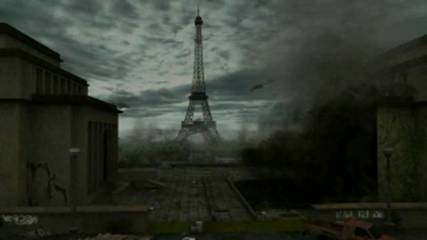
As a holiday, New Year's Eve always has a certain apocalyptic flavor to it, so it is perhaps fitting to preview the soon-to-be-released Left Behind Games that will capitalize on the success of Tim LaHaye's popular series of evangelical thrillers by creating an associated Christian video game line. In the game's trailer, the scenes of urban destruction look very much like the CGI smoldering landscapes of European civic desolation from the webpage for the National Front. Nonetheless, Left Behind: Eternal Forces appears to be a quintessentially American game situated in a timeline of United States history (starting with 1492) and ending with the skyline of New York City wreathed in smoke.

The satisfactions of interactive virtual simulations of urban destruction designed specifically for the small screen can be rendered by remarkably primitive interfaces, such as that of the Defend New York Flash game that appeared shortly after the September 11th attacks. Unlike Christian first person shooter games that involve close combat with Satan's minions in the antiquated private spaces of a catacomb or a late-medieval fortress, the Left Behind games have a more ambitious anti-urban agenda that entails the wholesale destruction of the architectures of present day man-made public space.

(For more about this fast-evolving genre, see the religious games section of Water Cooler Games.)

Labels: , , ,

Saturday, December 24, 2005

The War We've Been Waiting For


Am I the only one in America who knows that we are planning an invasion of France? Perhaps not. The Army video Future Combat Systems: 2005, introduced by General Peter Schoomaker, is easily accessible from the World Wide Web. In the film we see "Assault on Normandy 2014" in which it appears our boys take on those pesky Frenchmen with their very best high tech gear. Of course, I'd like to believe "Normandy" is a code name . . . or just a metaphor for a daunting military front.

But looking at the actual video with its swarthy opponents, ominous buildings covered with Arabic graffiti, and streets of burning cars, I couldn't help but wonder if the U.S. armed forces weren't planning to start their occupation of the land of liberty, equality, and fraternity in the territory of the recently rioting French suburbs.

Don't get me wrong. No one is a bigger Francophile than I am, but if it means I get to eat better cheese, then I guess I'll have to go along with it.

Labels: ,

Wednesday, November 16, 2005

Make a New Plan Stan

Sunday, November 13, 2005

Alternative Reality on Skyblog


Skyblog, the youth music and blog website that has faced prosecutions of three of its bloggers in recent days for content that allegedly encouraged French rioters is currently highlighting a new site that presents photographs of peace and prosperity in the urban banlieues that have been the flashpoints of violence and vandalism in the past. Bloggers are encouraged to submit images that counter stereotypes about urban decay and contradict the dystopian visions of ultra right wing pundits.

Labels: , ,

Paris is Burning

The website for the ultra right-wing National Front in France has 3D CGI graphics of burning cars and urban destruction. Although the artwork of the website actually long predates current riots in France, website visitors can still have the virtual experience of being led through a dystopian vision that seems to reflect current events in which the city of light has been plunged into darkness. In these graphics, however, the enemies of the city (explained as "immigration" and the "explosion des banlieues") remain invisible.

Labels: ,