Wednesday, December 23, 2009

Avatarded

Last weekend I went to see the new James Cameron film Avatar and was disappointed to see how little of the humor and sociality of virtual worlds was actually represented on the big screen. Because of a central conceit in the plot that the the main character was coincidentally the identical twin brother of a scientist who had already mind-melded with the avatar in a naturalized bio-futuristic way, the writers could claim to have a staff of scientific consultants and yet ignore the fact that our brains are largely wired by experience and that biological twinship would be more helpful in organ donation than being able to drive a robotic arm.

And don't even let me get started on the science of networks that is presented in the film with its magical Internet of communicating and communing vegetation around one of two giant trees that somehow only has all the good features of networks (sustainability, redundancy, adaptability) and none of the bad features (cascading failures, lack of hierarchies, routing through vulnerable large hubs).

I also don't want to start in on these magical eco-friendly natives who somehow don't have technology or culture distinct from nature in a narrative that is more Lion King meets The Little Mermaid than a serious discussion of augmentation and prosthetic experiences.

Unlike this video about Second Life, Avatar gives us no sense that virtual worlds are cultural entities that require interpretation, workarounds, and trial and error efforts. To dramatize the organic ease of adapting to a virtual world, at one point the protagonist is running at high speed seconds after inhabiting his remote body.

The one thing that Avatar seems to appropriate accurately, quite regrettably, from onlne environments like World of Warcraft or Second Life is the voyeuristic rhetoric around a scantily clad and exaggerated hyperfeminine form.

Of course, the other potentially interesting aspect of the Avatar story is the idea that playing a role of one's combatant on the other side of a conflict can change attitudes about political opponents. As I finish an essay for Error: Information, Control, and the Culture of Noise for Continuum about the SonicJihad debacle in Congress, this issue about being able to play a simulation from more than one side seems a valuable thing to bring to the theatre. Unfortunately, the hero merely switches sides completely and abandons his human allegiances, so the potential loss of multiple perspectives is lost.

Update: For more on academia's reflections on Avatar, see Nancy Lutkehaus on being a Hollywood advisor and the thread about the film on Savage Minds.

Labels: , ,

Tuesday, November 10, 2009

If I Can Measure It, It's Information

Virtualpolitik friend Siva Vaidhyanathan is quoted in today's Los Angeles Times article, "Google to buy AdMob in bid to reach mobile users."

"They define everything in the universe as information," said Siva Vaidhyanathan, a media studies professor at the University of Virginia, "which means everything in the world is potentially in their domain."

Because Google is fundamentally an advertising company, Vaidhyanathan said, its highest priority is to "harvest users' attention" and sell that commodity to eager marketers.

Vaidhyanathan raises an interesting point about how information is defined and how that definition assigns a monetary value and how the number of potential factors classified as information in Google's scheme reaches into the realm of sublime numbers. Of course, when information was first being defined with mathematical theories during the Cold War, information scientists like Claude Shannon and Norbert Wiener realized how this quantification might have economic and political effects, even if they understood those effects in the context of a battle with a Communist other.

In contrast, some argue that "Google Devalues Everything It Touches."

Labels: , ,

Friday, July 11, 2008

On Transparency

Transparency has become an issue for those who care about visibility, which in the open software movement has translated into wanting to be able to see the raw code by which programs function and among those who participate in social networks has manifested itself as an overriding concern about seeing exactly how people are connected and viewing their most private social ties.

Of course, there are many who say that we are presented with too much information in our contemporary digital lives. A recent New York Times story, "Lost in E-Mail, Tech Firms Face Self-Made Beast," describes how corporations concerned about productivity are trying to create devices that provide more screens and filters to protect their employees from the barrage of data that they face on a daily basis. For example, Intel's concern with this issue is expressed on their official blog with tags such as "infoglut," "infomania," and "information overload" and approaches to practices of redesign and self-government that even include old school coaching.

However, in The Social Life of Information, John Seely Brown and Paul Deguid have argued that much of this anxiety about so-called information overload is actually rhetoric that is designed to promote corporate agendas and to limit consumer choice. (See Julia Lupton's recent review of the book's applicability to everyday users and designers here.)

The issue might really be more about information representation rather than information screening, so that users who wish for more context and content can reach it with a mouse click or two at their discretion. In the case of a program like Photoshop, savvy users can examine a PSD file and see the entire history of a document's creation. For example, the image on the left has six layers; the spotlight, table, and reflection are all computer-generated. The image on the right has twenty-five layers and uses many techniques of digital collage. Access to these kinds of electronic files can be invaluable to those who are interested in what has been called "media archeology" so that scholars can analyze how digital artifacts produced by teams of people come into existence and represent the final product of competing discourses and material constraints.

On the other hand, as social network sites make it possible to see more of the links that connect people together and gather more information about an individual's social capital, which danah boyd and others have argued is by definition part of their function in that they make visible far more than was ever possible before, I think there is an issue about the consequences of transparency that has yet to be considered. John Rawls argued that we can make the best kinds of ethical decisions by imagining ourselves in the "original position" in which knowledge about our relative position of privilege is obscured so that we would hypothetically make choices through this thought experiment that would be fair no matter what our rank in the social, cultural, and economic hierarchy. If we are able to see so many connections, rules, and rankings from the outset, will we have the same incentive to treat our neighbors ethically?

Labels: , , ,

Monday, May 12, 2008

Walter Walks

Among those who study information theory, the concept of the "Wiener Walk" has a particular utility for analyzing seemingly random pathways. Among new media theorists, in contrast, it is often the figure of the flâneur who is the reference point for theoretical reflections about meandering, particularly when writers acknowledge their intellectual debts to Walter Benjamin and to Charles Baudelaire before him. This roving figure appears in texts that includes Ian Bogost's Unit Operations and Lev Manovich's The Language of New Media. The flâneur even crosses paths at one point with the book Mediated: How the Media Shapes Your World and the Way You Live in It, which I heard about in the equally mediated albeit face-to-face environs of a religious sermon punctuated by a tap dancing promenade from Steve Zee.

In today's talk by Todd Presner, "HyperCities, Google, and the Digital Dialectic," Presner discussed how the MacArthur Foundation grant-winning Hypercities project functions as an "interactive web-based research platform," but he also described how this group of related projects commented upon two high-traffic commercial sites that he sees as bound together by a "digital dialectic": Google and Google Earth, in considering how their histories of spectatorship may overlap and be contained in one another in affiliated forms of cultural mapping.

As a story in Der Spiegel points out, the Mountain View search software company has created a virtual double of Berlin, which is painstakingly recreated as 3D models, that consists of 44,000 buildings, 550 structures with photo-realistic facades, and five landmark examples of architectural space into which the user can seemingly fly.

Following Manovich and others, Presner argued that this software presents a particular cultural from of navigational space, which is dictated by the conventions of the combat flight simulator. Presner also discussed how the famed "Earthrise" photograph by NASA, with its Apollonic view associated with the detached omniscient eye in a plane that has been severed from the embodiment of a human observer is another important visual trope in Google Earth. Presner claimed that this concept of a sublime reverie can in turn be linked to the German philosophical tradition, in which words like Aufhebung and Erhebung in the Hegelian lexicon specifically call up images of rising above. Of course, this image of the Earth without borders or clouds or night like the proprietary Van Sant GeoSphere can be seen as a scene of disaster triumphant, much like Horkheimer and Adorno's fully enlightened world.

What Presner has created is a kind of "map bigger than the territory," to use Borges' terms, that gives particular attention to the role of railway networks, which he also describes in his book Mobile Modernity: Jews, Germans, Trains. As Heinrich Heine has observed, railroads served as a kind of providential event that killed space and predicted the mortality of time.

Yet, as Presner noted, although many of the maps in the Hypercities collection represent a topography of architectural monuments and railway stations, the project's sensibilities are also influenced by the vignettes that Walter Benjamin presents from his walks through the city and other kinds of diagrams that show social and economic structures, fleeting somatic experiences, and memories. One of the uses for the site's mark-up functions would therefore be to annotate these maps with other kinds of more personal landmarks that might suggest other networks and systems in play, not merely the functional yet absent electricity grids or sewers but also real and fictional spaces of encounter. In other words, in Habermassian terms that Presner didn't use, a hypercity could attempt to depict lifeworld as well as system.

Presner even allows for the mapping software to present counterfactual histories. What if we put in the Berlin Wall in 1772? He argued that this “cartographic imaginary” of annotation, remixing, and play also continues the Situationist project of remapping of European cities. As such, he acknowledged his own "weakly messianic practice" of remapping places of "erasure and oblivion," such as a Jewish graveyard that had long been removed from the map of the city.

By using Google tools, he said he hopes to denaturalize common operations such as "panning and zooming" and to encourage users of the site to think critically about spectatorship, epistemologies, and ideologies of new media, so that we can "examine their intentions and investments."

He is also piloting a Hypercities map of Los Angeles in collaboration with historians of the Filipino communities in the city. Like his virtual Berlin, he hopes to foster a "proliferation of authorship" that will allow users to incorporate even seemingly asocial forms of urban subversion, such as posting what could be considered graffiti or pornography, in addition to the project's suggested kinds of augmentation, such as community histories or oral histories. In order to do this, he used an architecture that made compromises, because he wanted an open system that could still allow for copyright protected materials to be shown in fair use teaching environments. Thus, he created an elaborate privilege system that is both open and vetted

I've already signed up for a Hypercities account to use with my students in Winter. Presner explained how his own students were assigned to "live" virtually in particular parts of the city and create their own stories of arrival and departures and connections. For example, he showed how one of his twelve groups of students melded fictive and factual elements by creating a Mafia-style family saga.

Labels: , , ,

Friday, April 11, 2008

Eggs on Slow Heat

McKenzie Wark came to the Irvine campus yesterday morning to discuss his book project GAM3R 7H30RY, which was actually developed as a text online with the input of readers and then updated still further after being printed by Harvard University Press. In his quest for the meaning of a "shared text" of the kind that Wark argued music or television programs can no longer offer, Wark claimed that videogames presented an opportunity to "take a familiar object and make it strange." Moreover, he described his rationale for focusing on single-player games in terms of his intention to reflect on "human interaction with a machine." Before the room of student game designers, he also confessed to his own relatively weakness as a videogame player and his particular struggles with attaining competence in Civilization III, where he depended on the play skills of others to level up.

Wark was careful to differentiate himself from the celebratory culture around fandom promoted by Henry Jenkins several times during the course of the day and at one point described the value of treating a game as an "object of indifference." Furthermore, he described his own lack of enthusiasm for MMO games, because scholarly interest in the economic, social, and political activities going on -- with the work of Edward Castronova as Wark's prime example -- was "not just about the game and game play."

He did find some kinds of ethnography in World of Warcraft worth pursuing for their pedagogical value, but Wark also said that he "hated" Second Life and observed that when he took his classes in to explore the virtual environment, he said that he frequently only met others there touring with classes. As a "class of object that fits the college environment too neatly," he compared Second Life to the MOOs of the previous century.

In Gamer Theory, Wark compares the shadow plays in Plato's famous "Allegory of the Cave" in the Republic to videogames, in that -- as my Cooper translation says -- "honors, praises, and prizes" are awarded to those who are "sharpest at identifying the shadows as they passed by" or "best remembered which usually came earlier, which later, and which simultaneously," much like classic arcade games that rely on pattern recognition activities. Unfortunately, the Perseus Project is currently down or I would have checked the original Greek for its game-like synonyms.

By using this famed parable about the reflective life, Wark points out how the rest of everyday life in our contemporary culture has become game-like, from the casino betting involved in retirement plans to the opportunistic strategizing required for dating. Thus the rules for real life seem comparatively arbitrary and opaque, while the rules of games can be intuited through careful observation in the course of play. Wark claims that games make us more likely to "hold everyday life accountable." In meditating about this procedurality in my own daily interactions, I've cited Ian Bogost's work, but I could see how Wark's inverted latent Platonism could also apply.

Yet Plato also argued that situated media would encourage the young to give in to their violent passions in the spirit of imitation. However, contrary to the messages in the mainstream media, Wark argues that videogames are fundamentally divorced from violent experiences or the desire to do others physical harm as the aversion of gamers to the 2001 electrical shock experiments in Tekken Torture seems to show. As the parent of two young gamers who are also rugby players, I definitely here more talk about real-world aggression and hurt in the latter venue than the former.

Wark insisted that "forms have their time," and just as the novel did "specific cultural work" in the era of the rise of the bourgeoisie and the industrial economy, the videogame may be performing operations that may have relevance outside of the CPU, the screen, and the win conditions of an individual user's play experience, especially now that poetry has become what he called a "minor form."

To explain how the game functioned "as form not representation," he emphasized the constitution of a game as an algorithm, which in turn he felt compelled to define. An algorithm, Wark asserted had a beginning and end directed by a procedure designed to generate a result. Like others asked to define an algorithm, he also came back to the familiar analogy of a recipe. In his case, it was a very specific recipe with only one ingredient: scrambled eggs. Scrambled eggs, Wark counterintuitively declared, required no butter or oil, since there was sufficient fat in the egg itself to promote thorough and even cooking and prevent adhesion, if the heat was appropriately low. In the question-and-answer session, Wark argued that this kind of algorithmic thinking was very different from the mathematics of the ancient Greeks and the world of Plato and Aristotle. (Yet I couldn't help but make a mental note that as early as Homer, the test of civilization was to be among "men who eat bread" and thus sufficiently evolved to have mastered an understanding of the notion of a recipe.)

Here's what I once wrote about defining an algorithm:

An algorithm is any set of computable steps designed to achieve a desired result. It is named after a ninth-century Persian mathematician, Al-Khawarizmi, who wrote a famous book about the rules of arithmetic. Technically, an algorithm must reach a result after a finite number of steps, thereby ruling out “brute force” approaches to a given problem, which can run indefinitely until the desired result is reached.

To understand what an algorithm is, watch any action and try to break it up into a series of distinct steps: a baby crawling up a staircase, a pigeon flying away with a crust of bread, a gardener watering a bed of flowers. Each movement can be divided into smaller isolated movements to make a “program.” The algorithm can be more or less efficient. Change the steps or tinker with the sequence, and the action can be done more quickly or with less effort. The baby advances more confidently. The pigeon gets away more gracefully. The gardener waters more flowers per hour.


I was less sure about Wark's definition of the literary term "allegory" for the undergraduate audience, which sounded like more narrow "typology" to me, but the argument that followed about how "all games are digital without exception" was definitely soundly illustrated, despite the fact that Wark admitted to being more comfortable making analogies to cricket than to basketball, given the fact he is a native to Australia. As an inveterate Dodgers fan, I liked his thought experiment about "what if calls in baseball were like comments about wine."

Although obviously at issue, this argument went beyond simply observing win and lose states. For example, he objected to those who insisted that The Sims was not a game, since one could "level up" and "top out." He also pointed out how much The Sims looked like Orange County, where the U.C. Irvine campus is located. In closing, Wark surveyed how different audiences might accept this binary ordering and yet still invent new goals, which could include the following four choices: Play, Not Play, Cheat, and Trifle.

Wark's own early videogame initiation with Space Invaders had to do with pub culture, gendered spaces, and the social dynamics of buying rounds as well. As table-top interaction, it definitely sounded better than Microsoft Surface. But it may not compare to the bar game with which many men in Providence, Rhode Island were once obsessed. My pal, Clinton-insider and pundit Ted Widmer, who now directs the John Carter Brown Library back in his home town, once took me to see this hole-in-the-wall drinking establishment, where patrons played an automated bowling game. It was said that anyone who bowled over 300 died shortly afterward, so there was a lot of suspicion and folklore about the game.

Labels: , , , ,

Friday, April 04, 2008

Mano-a-Mano (or Womano)

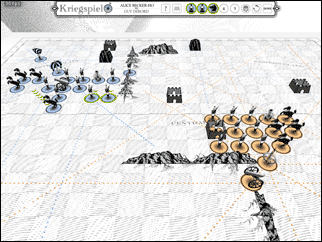
Yesterday, Alexander Galloway of NYU came to the UCI campus to discuss famed French situationist, tactical media progenitor, and author of The Society of the Spectacle Guy Debord and his foray into game design during the nineteen-seventies. Fortunately, Debord's book about his rarely played strategy-based board game, which he co-authored with his wife, Alice Becker Ho, is in print and recently translated into English. You can download and play an online version of Debord's game, renamed and redesigned by Galloway's team as "Kriegspiel" here.

Unfortunately, as Galloway explained to the audience, he had recently received a lawyer's letter regarding possible infringement of the rightful owner's intellectual property. Despite Galloway's insistence that an "idea for a game" or its "rules" are "not subject to copyright," those pursuing cease-and-desist orders against the makers of the Scrabulous application for Facebook might disagree.

Galloway opened his talk by looking at progressive movements of the nineteen-sixties and how, by the time that Debord was prototyping his "game of war" in the nineteen-seventies, radical groups like the Red Brigades had advanced to political kidnapping and assasination. (Among the images Galloway showed to the audience was the body of slain politician Aldo Moro in the back of a Renault R4.) Yet, in a time of asymmetrical conflicts, Debord created a game that was "abrasively anachronistic." Of course, Debord was familiar with contemporary games that modeled multilateral rather than bilateral relations, such as Djambi, which he played himself, which features both reporters and assassins. As Galloway pointed out, games with totalitarian goals could still represent the struggles of advanced liberal democracies.

Debord formed his own game company in an attempt to mass produce the game, the Society for Strategic or Historical Games, although only a few art editions were created in metal. (See above for Galloway facing off against McKenzie Wark.) Yet the game seemed closer to representing the work of Prussian military thinker Carl von Clausewitz than the "rhizomatic distributed networks" with which Debord is often associated, and as a manifestation of the game theories involved in military engagement it isn't even capable of the crafty improvisations and psychological engagement that characterize Sun Tzu. Although the design of the game emphasizes sleek unornamented and abstract modernism, the battlefield scenarios seem inspired by Napoleon without the information design insights, as mapped by Minard, that Edward Tufte has associated with the French leader's retreat.

Galloway pointed out that the seeming symmetry between North and South is actually more complicated than it initially appears, however, and that the role that pieces that serve as "reflector units" that control "lines of communication" play in the strategy of the game points to the importance of networked interactions.

I'm looking forward to checking out Galloway's "massively two-player" version of the game online, particularly since its open source architecture and Java Monkey Engine will allow others to skin the game and create interesting mods.


Update: There's more from McKenzie Wark about this story here.

Labels: , , , , ,

Saturday, February 23, 2008

The Sourcerer's Apprentices

I've been thinking about Vannevar Bush's 1945 essay "As We May Think" a lot lately as I finish up the manuscript for the Virtualpolitik book, so I was particularly interested to hear Wendy Chun's talk yesterday, which emphasized the "may" in the title of Bush's article, which was printed in The Atlantic Monthly and Life.

The first part of her paper dealt with the questions of critical hindsight that have been so important for new media studies, particularly as it has emerged from tired utopian/dystopian binaries and the hackneyed metaphors of double-edged swords that still play out in the mainstream media. In addition to pointing out the irony of the increasingly biological obsessions of bioart and nanotech critics in a field about hardware and software, she reminded the audience that a focus on future technologies made analysis of present ones difficult. As indicators of a possible sea change in the field, Chun emphasized many scholars' interest in getting beyond "vapor theory" and the influence of presentist work by Lev Manovich, Peter Lunenfeld, Geert Lovink, and even -- more recently -- novelist and onetime futurist William Gibson.

In answer to Paul Virilio's despair that online phenomena are gone by the time that a critical discourse can be formed about them, she suggested that it might be good to consider "getting beyond speed" and seriously interrogate the idea of memory instead. She was careful, however, to distinguish memory from the archive and not to associate memory with permanence either. Much as Derrida considers forgetfulness to be at the heart of the archive, Chun is interested in what she calls "the enduring ephemeral" as well as the "degeneration" of memory or that which we "repress and deny."

Despite her interest in getting beyond speed, she was still deeply engaged with questions about new media temporality. She pointed out that Lev Manovich argued that "where" an image is could be less important than "when" an image is and seriously presented McKenzie Wark's "theory as event" and Geert Lovink's "theory on the run" as legitimate critical alternatives to her view.

Although not many people in the room had read his essay, she also corrected those who may still idealize Vannevar Bush's ideas as precursors to the present by asserting that he was describing a mechanical analog future that can not come to pass. She also showed a truly bizarre animation of the Memex from Dynamic Diagrams that adopts a first-person present address about the device while suppressing its obvious anachronisms. She emphasized how strong this belief in a source or what she punningly called "sourcery" could be, and not only among Ted Nelson and Douglas Engelbart who looked back to the Memex as an origin for their ideas but also among those who have recently entered the field.

I was particularly interested to hear Chun point out how Bush obliterates the difference between machine reading and human reading and presents mechanical devices as error free, much as he presents media that never degrade. Lately I find myself rereading the passages in which Bush seems captivated with the promise of what he calls a “new symbolism” divorced from the irrationalities introduced by locality, language, and culture in which one day people will “click off arguments on a machine with the same assurance that we now enter sales on a cash register” or “manipulate premises in accordance with formal logic, simply by the clever use of relay circuits” to crank out “conclusion after conclusion” as consistently as a “keyboard adding machine.”

Labels: , ,

Sunday, January 27, 2008

Show Offs and Showdowns

Lovink's chapter on "Updating Tactical Media" in Zero Comments raises a number of interesting issues in thinking about balancing activism with engagement with policy-making and the role of the public intellectual assumed by many of my colleagues both inside and outside academia. Lovink quotes Paul Garrin's warning that "Tactical Media is not only something that Media Activists engage in. It's advertising, corporate psychological warfare of Perception Management."

As someone who well remembers Act Up, I'm not sure that Lovink is right to date the phenomenon to 1992, although his catalogue of "ways to connect, relay, disconnect -- and again reconnect -- a veritable stampede of pirate radio waves, video art, animations, hoaxes, wi-fi networks, music jam sessions, Xerox cultures, performances, grassroots robotics, cinema screenings, street graffitti, and (don't forget) computer code" accurately describes how tactical media attempt to engage public audiences by mixing branding with political subversion and high art with low. Despite the critique of blogging with which Lovink opens Zero Comments, he also argues that "blogs are an essential vehicle" for "sticky ideas."

One could argue that the recent public showdown between friends, colleagues, and fellow copyleft advocates Kembrew McLeod and Siva Vaidhyanathan over a robot-costume/Bill-Clinton-heckling incident also represented a kind of showdown between Tactical Media Activism and Critical Information Studies. There are certainly those who use tactical media who have a place in the academy and even members of The Yes Men are known to keep campus office hours and go to department meetings. But there is certainly tension between those who embrace the spirit of what Lovink calls "protestivals" and those who focus on public testimony wearing suits to try to convince policy makers by using formal channels for official political deliberation.

Finally, I tend to side with Lovink when he says that at least theory needs to be part of the globalization debate as well, but -- since I studied with Derrida and Lyotard in graduate school -- I may not seem like the most neutral party on that question to readers of this blog.

(Speaking of Tactical Media Activism, I will be giving a talk about hacktivism at this year's Popular Culture Association in San Francisco.)

Labels: , , , , ,

Friday, November 02, 2007

Book Nook

As part of a conversation about the editor as book designer and book designer as editor, I was very pleased to introduce Peter Lunenfeld and Lorraine Wild today at the day-long symposium sponsored by the campus's new "Design Alliance," The Book, the Brand, and the Box. Of course, I don't think that you can really talk about media studies without saying anything about print culture, so moderating this discussion felt like a natural extension of the scholarly issues about interfaces that I was already exploring.

The first Lunenfeld book I read was The Digital Dialectic: New Essays on New Media, a ground-breaking collection of stereotype busting essays of the highest intellectual caliber about matters digital that includes work by Lunenfeld, Kate Hayles, William Mitchell, Lev Manovich, Erkki Huhtamo, George Landow, my UCI colleague Mike Heim, and creator-critics such as Bob Stein and Brenda Laurel.

Just this week, I assigned students the chapter on “The Interface” from Lev Manovich’s The Language of New Media, which I noticed opened with an extended discussion of the significance of Lunenfeld’s work, specifically his famous interrogation of the lopsided influence of Ridley Scott has had on shaping public attitudes about technology for decades through Blade Runner (1982) and Scott's Macintosh computer ad (1984).

Lunenfeld is also the author of the influential Snap to Grid: A User's Guide to Digital Arts, Media & Culturess, which I think was one of the first books to write about hypertext and virtual reality without resorting to utopian or sci-fi clichés or poststructuralist jargon. In the book Lunenfeld questions an ideology of aesthetic freedom, by looking closely at how computers shape the artistic practices and thereby sets the stage for today’s research in code studies or software studies that looks critically at questions of constraints. The artists Lunenfeld analyzes in this influential book include Char Davies, JODI, Christian Möller, Stelarc, and William Gibson.

As an interface designer, he appeared as creator and editorial director of the Mediawork project, where he produced a pamphlet series for the MIT Press that was intended to redefine the relationship between serious academic discourse and graphic design, and between book publishing and the World Wide Web. I had been reading Lunenfeld's USER in connection with some of the things said about the term "user" at the 4S and AoIR conferences this year and had been savoring its wide-ranging exploration of contemporary culture that includes graphically dramatic commentary on apocalyptic warnings, bumper sticker rhetoric, blockbuster art shows, 24/7 schedules ramped up to the speed of “25/8,” and the semiotics of equating technology and videogame play with masturbation. It was interesting to see how Lunenfeld described this polemical work as something other than a manifesto, since Lunenfeld claims that in the current mediascape “part of the excitement is that the old categories don’t hold; there’s no coherent, oppositional avant-gardes anymore. There are still cries of rage and acts of violence, but not much in the way of compelling manifestos. I’m interested in utilities anyway, not manifestos. A utility adds functionality to a software system, and can be built upon in turn by further utilities later on down the road. Utilities are evolutionary rather than revolutionary . . ."

As someone who studies both intellectual property claims and cultural narratives about theories of information, I'm looking forward to Lunenfeld’s forthcoming monograph The Secret War Between Downloading and Uploading: How the Computer Became Our Culture Machine. Kudos to innovative MIT editor Doug Sery for choosing yet another readable/teachable title to bring to the press.

Lunenfeld opened his talk with a wonderful image of a book whose pages were woven on a Jacquard-style loom, a copy of which you can also see here on this page from the Institute for Figuring. Like Adrian Johns, Lunenfeld is interested in how the alternative histories of computing also can be read in the alternative histories of printing manufacture. Lunenfeld described this book of prayer as a "brilliant fiasco" and "outlier in the history of information-delivery devises" that sold only sixty copies, despite its luminous presentation in silver and black thread. However, in response to the death-of-the-book debates that were going on when I was writing my dissertation, Lunenfeld argued that the book was a "highly adaptable object" and that even "dry and dusty" academic books can be enlivened by graphic presentation techniques borrowed from the design explosion taking place in the magazine world.

He showed layouts from McLuhan's The Medium is the Massage and the ubiquitous alphabet-city "junkie wear" leather jacket for which Baudrillard's Simulations was designed to be interior pocket-sized. He also pointed out that the once visually innovative series from Zone Books could no longer be put in the laptop bags now commonly carried by both men and women, since they were now more like "medieval manuscripts chained to a library." Lunenfeld described himself as a maker of "interstitial literature for an interstitial time" and was willing to acknowledge the importance of "chunking" and "pull quotes" to serve current practices of dilatory reading.

He closed by looking at perhaps the most controversial area of academic publishing: web delivery of content. The most radical authors in favor of the free culture model are those who like Lawrence Lessig and Chris Kelty are putting entire books from academic presses online with Creative Commons licenses, apparently without harming sales. In contrast, Lunenfeld showed what had been developed for the Mediaworks pamphlets, which included supplementary "Webtakes," such as an extraordinary web comic essay by Scott McCloud in response in to the Brenda Laurel book from the series, and delivery of content that included multimedia modes of production that enriched otherwise insufficient text, such as DJ Spooky's music+text+sticker graphics packaging.

In Lorraine Wild's talk, the editorial policies of MIT Press continued to be an important theme, since she discussed how the controversial image on the cover of the catalogue for Wack! Art and the Feminist Revolution had generated considerable outrage and explication in the art blogosphere, after MIT Press rejected a restrained painting of a pile of white laundry against a hardwood floor as insufficiently attention-getting for the cover of the book.

As one of the principals of Green Dragon design and a person who helped radically revamp the curriculum of graphic design education in America in her role as a pedagogue at Cal Arts, Wild also had a lot to say about Los Angeles as a regional site for exchanging ideas and techniques. She talked about the "Ed Ruscha" effect and the way that artists could engage with industrially printed books. She also claimed that print designers were now in a position much like painters in the late nineteenth century as photography and cinema were on the rise and that working during the "birth of another medium" in the digital realm created challenges when clients wanted screens with icons rather than books. She also talked about the art catalogue business and how branding strategies could be so important for the printed matter she had designed for the Murakami show up now at MOCA that also makes copyright and intellectual property central subjects for art.

Speaking as an LA native and one who dabbles with collaborative pedagogical experiments designed to get students to think critically about the natural and built environment that surround them, perhaps the most exciting part of Wild's talk was the making of l.a. now as a collaboration between students of architecture, public policy, and design in the area. Although she described the book initially as "one giant copyright violation" with pages and pages taken off the Internet posted around a room in their first interdisciplinary session, this collection of census data, cinematic images, snippets from regional literature, etc. turned out to be a remarkably successful project, both as a publishing venture and a sadly now-dated portrait of the region.

During the question and answer period, there was considerable talk about why book design wasn't a factor in academic hiring, promotion, and tenure, with some like Catherine Liu arguing against the "deconstructive preciosity" of books like Avital Ronnell's The Telephone Book and the value of "kicking it old school" with "tough-minded" academic tomes.

Labels: , , , , , ,

Thursday, October 18, 2007

War Buddy

It was a week that I saw a lot of Sean Lawson, since he presented at both the 4S and AoIR conferences about the military's use of social media and persuasive games. Sean is both a policy wonk and a Ph.D. candidate in Science and Technology Studies at RPI, who has discovered the value of rhetoric to explain many phenomena in the discourses of political organizations.

At the 4S conference, he gave a presentation on the military-funded videogame, Future Force Company Commander, which he points out is strangely unconcerned with either training or recruitment, the ostensible motivations for creating other military games like America's Army. The cinematic opening scene of F2C2 in an exotic pagoda-studded land -- in which a terrorist aiming for a vehicle on a bridge is foiled by magically repellent armor -- Lawson describes as the "only entertaining part of the game," which is largely taken up with plotting assets on highly symbolic maps. As the Blue Force fighting the Red Force, which is armed with Soviet-era equipment, the player must deal with defending one country against an invader in a conflict between the fictional aggressor Sabalan and U.S. ally Dalilar. As Lawson points out, strangely there seems to be no airforce in the army of the future, and no attack helicopters, no tanks, or really no marines either. Lawson explains the message of the game as such: "the network is the weapon," and "seeing the enemy is as good as killing the enemy." He argues that the rhetoric of the game can be explained by the fact that its maker is SAIC, which has a vested interest in infowar, networked combat, and C4ISR models. Of course, there's more to be said about the rhetorical efforts of SAIC, about which I'll have an article in the forthcoming issue of media/culture.

In his AoIR presentation about military bloggers, Lawson pointed out that restrictions on solders' use of social media reflected a contradictory attitude about the new ideologies about information and networks that are central to the work of top strategists within the military. As Lawson points out and this video shows, President George W. Bush addressed the Second Annual Milblog Conference. And yet on April 19, 2007, the Army released new OPSEC Regulations against blogging, and in May, the Department of Defense announced plans to block access to social media sites like YouTube and MySpace. In his research Lawson looked at 44 military blogs and took advantage of The D-Ring ("where the military and new media collide") , Wired's defense blog Danger Room, and aggregating services like Milblogging. Lawson argues that military bloggers are both inside and outside these structures of authority, so it isn't a simple case of one side pitted against another. As the bloggers themselves point out, they see themselves as contradicting the reports of the mainstream media and engaged in the battle for the hearts and minds of civilians at home.

Lawson's work is still evolving, like most graduate students, and I'd like to see him draw on more nuanced examples of rhetorical thought rather than overemphasize a dated and relatively heavy-handed critic like Lloyd Bitzer, but he's looking at important public policy issues of the kind that I'd like to see in more new media dissertations, and I look forward to seeing him again at conferences in the months and years ahead.

Labels: , , , ,

Tuesday, September 04, 2007

Cult Following, Part Two

Obviously, there is similarity in the titles of both Andrew Keen's Cult of the Amateur (2007) and Theodor Roszak's The Cult of Information (1986). Both of them also claim the ethos of the cognoscenti and categorically deny that they are technophobes. Keen describes himself as "an apostate, an insider now on the outside who has poured out his cup of Kool-Aid and resigned his membership in the cult," and Roszak compares himself to the boy in the fairy tale saying that the emperor has no clothes, although he also points out that the "manuscript for this book was typed on a word processor," and that "at numerous points, the research for the text made extensive use of electronic data bases." Like Keen's book it's also full of stories from the author's professional and personal life as he explains the roots of his skepticism.

However, Roszak's reading of religious fervor around technology is considerably more subtle, in that it focuses on the "folklore" of technology and looks closely at the history of information theory and the contributions to the field of computer science and signal processing by sometimes problematic pioneers like Claude Shannon and Norbert Wiener. It's also a more theoretically sophisticated book: it uses the theories of Habermas rather than merely name-drops or tells anecdotes about the contemporary German philosopher. In pointing out the Weberian character of electronic bureaucracy, Roszak facilitates dialogue with scholars like Jane Fountain, who work on Weberian theory and the "virtual state." Furthermore,in its critique of educational technology, it presents a much more nuanced argument about "vested interests" instead of a tirade like that of the book version of Digital Diploma Mills by David Noble. Even twenty years later, Roszak's book is still relevant, while Keen's may not be.

Labels: ,

Monday, September 03, 2007

Cult Following, Part One

Okay, users and musers, it's time for another Virtualpolitik book review. And this time it's a double-header, with the more recent The Cult of the Amateur going up against a tried-and-true classic, The Cult of Information.


As you can see above, Keen made a bad showing on the Colbert Report, in which he compares Web 2.0 to the Third Reich and claims "even the Nazis didn't put artists out of work." Keen goes on to assert that if no one "pays" for art then it must not have any aesthetic value. Colbert points out to Keen that the Presidency has been a much greater source of influential misinformation than distributed networks.

Ironically, Keen also sent his book tour spam to the mailing list of the Institute for Distributed Creativity, which prompted outrage about Keen's use of their online community for his anti-Web 2.0 self-promotion in a thread called "Spammer de la Silicon Valley." At the same time the iDC's own Trebor Scholz has put together a much more thoughtful critique in his course syllabus on The Social Web, which asks "Is it feasible to live ethical, meaningful lives in the context of the Social Web today?"

It is precisely these kinds of serious questions about digital sociality that Keen avoids in his light read on file-sharing culture. Much of it just repurposes the rhetoric of criminality already in the mainstream media in which the Internet is merely a conduit of the Seven Deadly Sins. (Unlike our government, at least Keen doesn't equate it with terrorism as well.)

I'm certainly leery of many aspects of Web 2.0, but Keen's book is supremely illogical at a number of critical junctures. He's right that the word "democratization" is often misapplied to networked social media that are sometimes callow get-rich-quick schemes, and that search engine technology presents an insidious threat to privacy. And the final chapter on "solutions," with the exception of the call for greater regulation, is not an entirely stupid call for hybrid print-Internet initiatives.

At one point he moralizes about how "Samuel Johnson, Edmund Burke, and James Boswell didn't hide between aliases while debating one another." Of course, lots of great literature was written under a pseudonym, particularly -- as Bitch PhD's Tedra Osell has pointed out -- literature written by women. What about Sor Juana, George Sand, George Eliot, or the Brontë sisters who wrote under the pseudonyms of Currer, Ellis and Acton Bell? It's noticeable, actually, how little of the "great art" that Keen declares to be in danger is written by women.

His claims about the threats to the academy are also problematic. He bemoans the status of Encyclopedia Britannica, but doesn't acknowledge that the decline of encyclopedic writing by academics has as much to do with tenure and reward systems that no longer recognize work done for reference works as it does with the existence of rival upstart Wikipedia. Then he totally loses me when he talks about the terrible effects that custom publishing has wrought in higher education. As the Writing Director for a large-enrollment first-year course, I'm grateful not to be stuck with irrelevant readers or writing textbooks that don't address the ambitious inquiry-based humanities instruction that we provide.

He also may be over-investing print in stability and authority, given that historians like Adrian Johns point out that ink-and-paper media were also fractious and contentious spaces.

As the owner of a small apartment building, who also has to periodically rent apartments through Craigslist, I'm not nostalgic for the old days of newsprint classified ads in the way that Keen is. He should be old enough to remember that these ads were enormously time-consuming and didn't allow for easy exchanges of different kinds of information between contractual parties.

Finally, it seems strange to me that Keen won't acknowledge the role that media conglomeration has played in the struggles of national newspapers and other media ventures that focus on return for shareholders rather than serving a particular segment of the geographical population.

Labels: , ,

Tuesday, July 17, 2007

Our Best Guesstimate

To give it credit, I have to acknowledge that the National Intelligence Estimate, which was released today, does try to explain basic principles of probability and rational decision-making to a lay audience of readers, but it does so very poorly, even if the moronic color-coded Homeland Security bars have been replaced in their analysis by a continuum that is mostly made up of more telling shades of gray. Unfortunately, it doesn't really bother to explain its methodology either, other than present an assertion of qualitative rather than quantitative aims: "Assigning precise numerical ratings to such judgments would imply more rigor than we intend."

I know that theories of information can be pretty intimidating with their differential equations and seemingly nonsensical terms like "reliable failure predictor." But just last week I heard an astrophysicist explain Bayes' Theorem at a cocktail party, and everyone present understood basically how at least one approach to the study of probability worked.

The report also neglects to make some important distinctions between necessary and sufficient causes. For example, like many government reports, it still implicitly presents Internet communication as a significant indicator of and contributing factor to terrorist activity, even though websites facilitate many more non-violent forms of communication as well.

We assess that the spread of radical—especially Salafi—Internet sites, increasingly aggressive anti-US rhetoric and actions, and the growing number of radical, self-generating cells in Western countries indicate that the radical and violent segment of the West’s Muslim population is expanding, including in the United States. The arrest and prosecution by US law enforcement of a small number of violent Islamic extremists inside the United States— who are becoming more connected ideologically, virtually, and/or in a physical sense to the global extremist movement—points to the possibility that others may become sufficiently radicalized that they will view the use of violence here as legitimate.

Although the report seems to acknowledge that electronic communication only produces a sign of increased jihadist activity rather than stimulates the activity in and of itself, "virtual" contact often seems more important to these analysts than extremists' "physical" ties. Note also those favorite negative buzzwords in the George W. Bush administration: "rhetoric" and "ideology." Of course, my U.C. Irvine colleague rhetorician Steve Mailloux would certainly contest assertions that we can ever be ideologically neutral or rhetoric-free.

Labels: , , , , ,

Monday, May 14, 2007

Fighting from a Hole


The first day keynote address at the ISCRAM conference in Delft was from Erik Hollnagel of the École des Mines de Paris. In his talk, Hollnagel incorporated information theory, behavioral psychology, and systems analysis to make an interdisciplinary argument against linear models for crisis management. As a close reader of governmental and organizational communications, I was interested to hear Hollnagel's criticism of negative reporting models and the tendency for government employees and others with responsibility for public safety not to give information when there isn’t an obvious change in state to announce. He compared the crisis management mindset that produces this autopilot behavior to choosing to fight from a hole rather than fight from a hill, in that all decisions when things go wrong are purely reactive. At a time when policy makers have pontificated about "known knowns," "known unknowns," and "unknown unknowns," while ignoring what Slavoj Žižek calls "unknown knowns," Hollnagel's attention to how human beings can be irrational decision-makers, particularly when information overload or information overload is at issue, is worth keeping in mind. Although his extended analysis of fatal yet avoidable incidents looked abroad, to the Fukuchiyama Line accident and the July 7th attacks on London transport, faulty American disaster prediction during September 11th and Hurricane Katrina also appeared in his ruminations. Notably, Hollnagel pointed out America's role in the space program and how a mission control paradigm produces both successful moon landings and Apollo 13 disasters.

Labels: , ,

Sunday, April 08, 2007

Not Spaced Out

I have friends who won't even use the word "cyberspace" anymore and who vigorously excise it from the manuscripts of others in their editing or peer reviewing capacities. So I will admit to some skepticism about possible anachronisms in Mark Nunes' Cyberspaces of Everyday Life, particularly given the way that the trope of "everyday life" from de Certeau and Braudel has become a kind of truism in the cultural conversations taking place in the academy about things digital. (I like Jenny Cool's meditation on the "Data Structures of Everyday Life," for example.)

Yet I think it's a book about computer-mediated communication that will age well and hopefully stay in print, like my HCC colleague Michael Heim's book about word processing Electric Language. Of course, maintaining relevance is a real challenge when academics have to scramble to keep up as we move from Web 2.0 to Web 3.0. And even Nunes himself is willing to admit that the term began to disappear in The New York Times between 1999 (which had 410 articles mentioning "cyberspace") and 2004 (which had only 70 such items). Nonetheless, in 2007, survey data indicates that more citizens are going on virtual tours and visiting real estate online. And whether I'm writing about digital libraries or memory palaces, conceptions about "cyberspace" from the nineties probably still shape my thinking.

Like my UCI Facebook friend Paul Dourish, Nunes argues that space is always social and informational. In this, it seems that Nunes shares an anti-Newtonian "patron saint," Gottfried Leibniz, with Norbert Wiener (and with Anna Munster, who took Leibniz's side against Descartes in Materializing New Media) on the grounds that the Saxon philosopher was a precursor in understanding the relational, networked quality of space.

Nunes has some entertaining background history about maps, post office systems, and distance learning, but the heart of the book is its theoretical perspective, which smartly integrates network theory with work on online communities and Internet practices. Given that I first encountered Nunes' book through an Amazon.com recommendation, I found his meditation on the functionality of this online mega-bookstore particularly salient, since I've read other good books in the Minnesota series and actually knew Nunes from twenty-five years earlier when we were both punk-era teenagers enrolled in the same summer school.

Of course, I might have liked to have seen Nunes take on some of the origin myths about online communities more directly. His story about how the Georgia homeless could be both included and excluded by philanthropic-seeming laptop initiatives by the Atlanta-Fulton Library System told more about the civic Realpolitik at work in state-sanctioned online community programs than liberatory narratives like those told about Santa Monica's Public Electronic Network, which I know to be only partial truths based on my first-hand experiences with putting at-risk teens on P.E.N.

Finally, this being Easter Sunday, and a cold but clear April day in Boston, I spent the day largely offline, first in morning services in King's Chapel and then on an afternoon walking tour of the Freedom Trail (for which a far inferior virtual tour exists).

Labels: , ,

Wednesday, February 28, 2007

Human Factors


The precipitous drop of the stock market this week reminded me of what Norbert Wiener called the problem of the "extremely smooth curve" in his 1948 treatise on Cybernetics: anticipating such curves may optimize performance by virtue of their gradual movement, but as representations of actual information they lack the sensitivity of more troublesome, less predictable, but more accurate "rough curves."

My former UCI colleague, philosopher Tim Schoettle, wrote his dissertation about investor perceptions the stock market. Writing in a bull market, he argued that there wasn't a ceiling for the value of the Dow. But computer programs can do much more rapid belief-updating than people can, and with particular pre-programmed sell-off thresholds the market tumbled 200 points in one minute, one of the the fastest declines in the market's history, which was later characterized as a "computer glitch." So perhaps with new rapid-response networked technologies "rational" computers may be more likely to set off a panic than "irrational" people, as events begin to cascade around the globe.

Virtual capitalism also functions at the level of the individual, as more citizens rely on on-line bill paying or investment interfaces on the Web. In "Blogging Away Debt," The New York Times reports that some consumer spendthrifts aspire to sound financial management through the sacrament of confession and hope to gain some fiscal discipline not by moving numbers around more rationally on their desktops but rather by confessing to their bad financial decisions online.

Labels: , , ,

Saturday, February 03, 2007

Primary Sources

Okay hackers and slackers, it's time for another Virtualpolitik book review. Thanks to a series of airport delays, I've had the opportunity to spend the last few days looking over the excellent New Media Reader from MIT Press. In the interest of disclosing possible biases, I'll confess to having known editors Nick Montfort and Noah Wardrip-Fruin since the DAC conference in Copenhagen, but the book is well worth picking up even if you aren't familiar with their work. It's already been praised by Lev Manovich and Janet Murray for good reason, who provide introductions, but it's a notable collection of teachable texts from a number of perspectives.

I often complain that those who study hypertext and virtual worlds tend to apply literary theory to technological phenomena without considering how technological theories could conversely elucidate new media texts. This is a book that collects many of the major accessible texts from computer scientists speaking to broad audiences that should be included in the critical theory canon, given how central information culture has become.

Moreover, it's the best collection of primary sources about gender and informationalism that I've ever seen. For example, it's got the wonderful lead in to the famed human vs. computer Turing test about guessing whether someone is male or female (50). Or Licklider's laugh-out-loud anachronistic assertion that "one can hardly take a military commander or corporation president away from his work to teach him to type" (80).

Furthermore, it's a terrific look at the early pioneers of computerized information science that offers real insight into the Weltanschauung of their emerging discipline, and it contains a number of examples of how they use themselves as experimental subjects that were literally almost Freudian in their appeals.

Of course, these historical accounts include assessments of failures and admissions of limitations that often don't appear in more utopian narratives in the literature of technology. If anything, I would have liked to have seen more of this acknowledgment of programmatic restraints. Perhaps this desire for more narratives and explanatory theories about reaction, anxiety, and blindness regarding technology's role in a society reflects my own research bias, but I do think there is a tragic dimension to many of the initiatives at Xerox PARC that were stymied by certain cultural and even national biases. Readers may remember that my dad was a Xerox Senior Systems Analyst for most of his engineering career, and I grew up watching their personal computer, printer-plotter, and other ahead-of-their-time projects flounder. (Then again, my family has a long history of involvement with innovative but doomed ambitious technical projects, so I may have a more jaded point of view about progress than most people.)

Having taught similar material to undergraduates, I may have a few minor quibbles about the choices they made. Given the usefulness of sound-bites in those situations, I would have picked different pieces by Wiener, Weizenbaum, and Negroponte, but what they've chosen would certainly still work in a classroom. I would have also liked to have seen Heidegger and Bateson in there for foundational theory. And, of course, I think Weaver's introduction to -- and its essential skewing of -- Shannon's Mathematical Theory of Communication is always on my must-read list for potential syllabi.

This may seem petty, but I'm also something of a translation snob, so it bugged me to see such a stilted translation of the poetry of Raymond Queneau that used dated poeticisms like "nought" and "ere" and "O" that weren't in the original, which a wise woman and excellent translator once taught me to avoid. Furthermore, as someone willing to encourage my classes to mutilate books, I was also faintly peeved that one couldn't actually cut apart the poem with the French line and the English translation in front and back position.

Finally, I would have liked to see less work from rarefied arts communities and more of the DIY aesthetic of users actually hacking systems and creating stuff in the practices of their everyday lives. (See my nascent media manifesto on the subject in the weeks ahead.)

Overall, however, The New Media Reader is a well-designed landmark book with a great user interface that includes a timeline and -- amazingly -- a CD-ROM that actually works. Seeing Quicktime films of actual demos from the sixties and having access to actual programs from an earlier era of computing is truly thrilling. My advice to people teaching digital media survey classes would be: buy it; read it; assign it.

Labels: , , ,

Friday, July 07, 2006

The Horses of Elberfeld

Yesterday, I was making a relatively obscure point about "The Horses of Elberfeld," when a student pointed out the existence of the Subservient President website, which was modeled on Burger King's engrossingly interactive and much forwarded Subservient Chicken page.

Unfortunately Subservient President turned out to be a relatively unsatisfying experience, especially when compared to the endless hijinks of the corporate fast-food fowl who can be made to do just about anything, except for the things that make the man in the chicken suit wag his finger at the screen indicating that the user should be ashamed of himself or herself for even suggesting such a command. Subservient Chicken was developed by the ad firm Crispin Porter + Bogusky, which is known also for their hip, youth-oriented social marketing campaigns in favor of AIDS testing and against teen smoking.

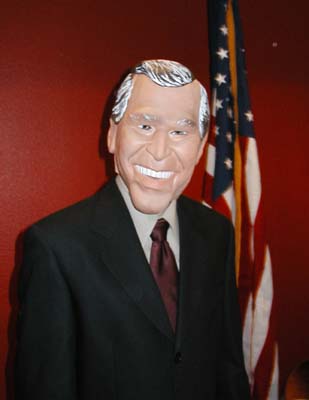
In contrast to our reactive feathered friend, Subservient President often looks confused when asked to do something that the chicken would have easily mastered, such as doing push-ups or jumping jacks on the small screen. Luckily, knowing some of the keywords (particularly those related to Weapons of Mass Destruction or drunk-driving) made it a slightly less frustrating user experience, but the disconnect between keyboard and screen was still relatively marked. A little online research revealed that this Chief Executive in a rubber mask who promises to deliver "politics just the way corporate America wants it" was created by Steve Anderson of USC, who is also Associate Editor of the innovative online journal Vectors.

And what does this have to do with the Horses of Elberfeld? I had been invited to team-teach for the day with my friend, colleague, and fellow intellectual property activist Jenny Cool in her Social Analysis of Computing class. I was explaining a footnote in the introduction to Claude Shannon's Information Theory classic A Mathematical Theory of Communication, which was written by one of Shannon's collaborator's Warren Weaver. Weaver quotes K.S. Lashley as follows:

When Pfungst (1911) demonstrated that the horses of Elberfeld, who were showing marvelous linguistic and mathematical ability, were merely reacting to movements of the trainer's head, Mr. Krall (1911), their owner, met the criticism in the most direct manner. He asked the horses whether they could see such small movements and in answer they spelled an emphatic 'No.' Unfortunately we cannot all be so sure that our questions are understood or obtain such clear answers.


I managed to find what appears to be a photograph of one of the Horses of Elberfeld. It's interesting that so many of the early Information Theory pioneers, many of whom were also doing work on Artificial Intelligence, were so worried about situations of fake interactivity in which communication only appears to take place. Several decades later when the computer program Eliza was brought to life, a precursor of Subservient Chicken that mimicked interactions with a Rogerian therapist, her creator Joseph Weizenbaum wanted to ask hard questions about the social significance of accepting this kind of interaction as a norm.

I would argue that this substitution of "interactivity" for communication or participation can also have political consequences. Users expressed frustration with the level of interactivity that Subservient President provided, but how interactive is the White House website really, even if there is an "interactive" heading on its navigation bar? There may be 360-degree virtual tours or exhibits in which you can turn the pages, but how well does this serve the interests of the electorate? I would argue that this even extends to the formulaic use of the Internet conventions of "chat" at Ask the White House, in which my question is never picked -- although not for lack of trying.

This week a computerized voice, programmed by my insurance company, asked me a lot of prying, personal yes-no questions and nagged me interactively about getting a mammogram. Fair enough, there were perhaps anomalies that would cause me to be picked out of a database, but why delegate the responsibility to a machine? I now regularly get pre-recorded calls from candidates for office. Based on my political anomalies, like the fact that I walk precincts, how long before I'm picked out of a database for an "interactive" call?

Labels: ,