Thursday, June 03, 2010

Rulebooks for Life


Today I was delighted to introduce game designer and critic Tracy Fullerton, as part of the seminar series at the Center for Computer Games and Virtual Worlds. Fullerton is an Associate Professor at USC's Interactive Media Division in the cinema school, but I first got to know her as one of the members of the feminist game collective Ludica.

She began her talk by discussing the role of the experimental avant-garde in the history of film to criticize Roger Ebert's dismissal of videogames as a meaningful genre of cultural production and rebut his declaration that "Video games can never be art." Rather than pay attention to Ebert's headline-grabbing negations, Fullerton urged her audience to attend to John Sharpe's more nuanced exploration of the potential virtues of videogames. Nonetheless, she admitted that videogames were far from a mature medium. She compared them to "gangly teenagers" who were growing unevenly and who were "held back by their own success."

Fullerton also made a point of differentiating "experimental or exploratory games" from "art games" that have recently been receiving critical attention. She also raised questions about the auteur model of game design that characterizes the work of Jason Rohrer, Jonathan Blow, and others who fit "our myth of the artist" as solo producer.

However, even collaborative approaches could go wrong, according to Fullerton, if not oriented around processes that allow time for reflection. She discussed the "game jam" mode of production, which could be wildly creative although it allowed "less time to think and less time for thoughtfulness." In contrast, she talked about the long schedules of corporate "waterfall" modes of top-down hierarchical production and how even the more dynamic "scrum" forms of mass market organization might only be "flexible" rather than reflective.

She then explained her own thoughts about the "meandering march" that might be experienced by the player navigating the experimental videogame The Night Journey and by her team of game designers as they learned to collaborate with famed video artist Bill Viola. She cited this article by William Judson about Viola's "pursuit of enlightenment through attention to transcendent experience" to explain the basic concept of a game about revelatory experiences and reflection in which players are supposed to move more slowly rather than more quickly. She explained how the "player had to enact a journey of their own" as darkness is falling in the game world.

Initially, Viola had planned to include a number of spiritual text that he had found inspirational and Fullerton was stumped by the initial plan to "read books in the game." Although they tried a number of approaches from illuminated manuscripts to word mazes to concrete poetry, the presence of the letters to be decoded seemed to detract from the game. So then they prototyped a version with a voice-over reading instead, but eventually they deleted the voice-over, which Fullerton said had functioned "like scaffolding or a mold" in the project. Unlike the usual "document, execute, polish" sequence, the results were more unpredictable but also more satisfying.


She also described her work developing Walden, a game about Henry David Thoreau's famous "experiment in self-reliant living." Unlike most games with reward "acquiring more," Fullerton wanted a game that rewarded balance. She also thought that the text was relatively easy to adapt, unlike most literary works, because Thoreau spelled out the rules himself. There were four basic needs: food, fuel, shelter, and clothing (a list that Fullerton granted many might find arguable). And then some additional quality of life items to be included: solitude, sound, reading, and visitors. Thus the game becomes about the challenge in negotiating between sustaining life and seeking inspiration. Of course, this work is still an adaptation, and Fullerton's team still had to decide what not to include. So they left out tidbits like the fact that Thoreau brought his laundry home to his mother. It is interesting to note that Fullerton described a similar issue about whether or not to include text in the game as the one she struggled with in The Night Journey. For more about Walden, see the video above, which Fullerton describes as a "tone piece," not a representation of game play and this posting about Fullerton's talk by Jana Remy.


During the question-and-answer session, the audience learned more about Fullerton's interest in "the relationship between action and outcomes," we learned more about the fascinating game Pathfinder, which her USC team has been developing to encourage students who may be the first ones in their families to go to college to learn how to "game the system" and understand "college admissions as a game." Because the point system is transparent, Fullerton hopes to help students learn about time management and fiscal planning in a way that has cards for "killer breakup" (can't earn as many points) and "robotics club" (a points bonanza).

Fullerton also talked about her confession at the recent GDC that she feared that she might be becoming a worse game designer as a result of working on so many educational games, where state standards for topics like "transcendentalism" or "botany" might interfere with the enjoyability of play.

Check back to the Center's website for video of Fullerton's talk. Footage of the Nick Montfort / Ian Bogost talk is now posted here, which I also introduced, although I did so barely coherently in a week during which I was constantly running around from place to place for the DAC conference. Hopefully the lighting will also be better for the Fullerton talk.

Labels: , ,

Thursday, March 04, 2010

Bat Out of Hello

Stefano Gualeni gave a talk in this year's seminar series for the Center for Computer Games and Virtual Worlds at UC Irvine, which may have contained more philosophical content than would-be game designers in the audience may have expected. In the European context, such a talk would probably seem like much less of an anomaly, given the presence of theorists like Miguel Sicart or conferences like the Philosophy of Computer Games.

Known for creating the Tony Tough games and a popular basketball simulator, and for lending a hand to the anarchic Fairytale Fights, Gualeni explained that he had trained as an architect and therefore wanted to start his talk with Rafael's famed fresco of the School of Athens to introduce his overview of metaphysics, which quickly made its way to Martin Heidegger's criticism of the "fundamental mistake" of assuming a separation between the real world of objects and the mental world of subjects, so central to Western thought and a major concern of René Descartes' substantial dualism that opposed the thinking think and the extended thing.

Then Gualeni jumped off from Plato's "myth of the cave" to an elaborate diagram that went from the base in the "Real" where subjectivity functions to make sense of the world through real experience and interaction to the real of metaphysics, which must mediate with abstract representations, such as charts, taxonomies, or phylogenetic trees. Atop of this structure he sketched out "Mediaphysics" as the realm of the imagination, which provided some answer to Hume's assertion that human beings are confined within the sensory apparatus. For Gualeni it is impossible to wax philosophical without mentioning Marshall MacLuhan who argued that first the man made the hammer then the hammer made the man. He also used Borges' famous story about "The Library of Babel" to argue that computational media are fundamentally different from books.

Which brings him to his central question: "What is it like to be a bat?" It is also the question asked in 1974 by the realist philosopher Thomas Nagel, and one difficult to answer because we are bound to human subjectivity and one recently re-asked by Katherine Hayles in her plenary talk at DAC 2009 as being critical to so-called "object-oriented ontology." The question serves as the subject for Guileni's game Haerfest. He reframes the question in the context of the game as "not what is it like for me to be a bat but rather what is it like for a bat to be a bat."

Labels: , ,

Thursday, December 17, 2009

Splitting the Indifference

Today Mic Bowman of Intel gave a talk at the Center for Computer Games and Virtual Worlds at UC Irvine in which insights about how social experiences are constructed were applied to the technical problems created by the fact that at "the core of most virtual world applications is a quadratic computation of the set of interactions among avatars (users) and a shared scene," which creates a "fundamental barrier to scaling experiences in these applications." Much of the talk was devoted to specifics of previous techniques for limiting the interaction among avatars through spatial subdivision or sharding. However, Bowman argued that these algorithmic approaches consequently caused "the content and shape of the interaction" to be "driven by the limits of the simulation." Although I might argue that all kinds of real-world social interactions are constrained by certain architectures of control, Bowman claimed that Intel's use of "distributed systems technologies to balance the simulation load dynamically and to optimize network communication" in OpenSim could create more compelling and naturalistic virtual worlds.

One of the examples that Bowman kept coming back to is the challenge of creating an experience like "watching a baseball game with your buddy" rather than just "watching a baseball game." As he pointed out, a simple mouse swipe across the screen that changes the view of the player's avatar can create many technical problems, because the associated shift in head position has be be updated from the perspective of all the other avatars in a given scene. Fortunately, he noted, there can be a lot of redundancy for purposes of rendering scenes, as in the case of an event taking place on the other side of the stadium, which probably looks very similar to the avatar sitting next to you. In a talk that detailed the challenges of partitioning for scenes and operators, accounting for a user's cone of sight, and accommodating collision detection and physics, Bowman noted that there were lessons to be learned from real-time media streaming, as well as thinking about scene management from the perspective of the client. He also observed that granularity of attention matters, since those doing protein folding on ScienceSim might have very different expectations from those planning a workshop or a business meeting.

Labels: , ,

Wednesday, October 28, 2009

Pins and Needles


Yesterday I attended one of the sessions at UCLA's Mobile Media series, a talk by web artist Jonathan Harris.

The slides in Harris's talk contained words and phrases like OPINIONS, BELIEFS, VIBRATIONS, OUR DIGITAL CRISIS, NO TRUE ESCAPE, WORLD BUILDERS, SIMPLICITY, LANGUAGE, SPECIAL EFFECTS, IDEAS, ACTING ALONE, IMITATION, REPUTATION, IRONY, and SCIENCE + SPIRITUALITY that were spelled out in leaves, pine needles, or dirt to represent his reflections about technology and digital participation seen from the perspective of his Oregon cabin. Harris mentioned a range of possible icons for work that addressed what he saw as fundamental questions: Frank Lloyd Wright, Donald Judd, and Andrei Tarkovsky, who was mentioned several times. (My favorite Tarkovsky clip is below, starting on the middle of the YouTube timeline.)


Harris expressed his concern that too often designers missed the fact that "mystery is an ally if you are making stuff," and that the "vibrations" that make up the sounds, images, and colors of an artist's palette had become -- in the era of digital social networks -- about a "volume of communication" and a "number of relationships" that had become too difficult to manage. Not only was the intensity of such Internet vibrations increasing, Harris also argued that they were becoming "more homogeneous."

Harris also had harsh words for our "mania with social networks," which he asserted reinforced sameness and were "making us stupid." He forecast that if the forces of "compression and velocity" continued unchecked, people would be reduced to transmitting "monosyllabic grunts" on the Internet. He said that his general message to people from "journalism, publishing, and radio," which were "collapsing," was that they should have "patience," since it is not their business to "make tools to get their stories out," but he worried that the Web's tendency to be "good at breadth" and "bad at depth" might keep the trajectory headed toward crisis rather than encourage users to "bounce to something earlier."

So he also counseled his audience of design students to think about being "world builders" and "deciding what the digital world will look like." He argued that this would involve thinking critically about "simplicity," which he argued shouldn't be confused with what he called its "fashionable idea" incarnation as John Maeda-style minimalism. Rather Harris insisted that designers should reject the "prudish," "fascist," or "hardass" character of minimalism in order to embrace "organicism" as a more appropriate approach that is guided by nature and its regulations of complexity.

(Disclaimer: I actually like the wit and political engagement of Maeda's work, and I don't agree that his information design is as soulless as Harris implies.)

He also argued that "language" was a major category for design, as a "system for expressing ideas," which could include photography and dance as well as Java and Flash. At this point he acknowledged the presence of audience member Casey Reas, co-creator of the language Processing. He argued that earlier Internet projects of his, such as We Feel Fine, might have been too much like "going to the opera" and not enough like "playing Beatle songs" at home to elevate one's mood. (His newest story-generation project, cowbird, is being done in "basic HTML and Javascript.)

However, he did concede that there could be value is some "special effects," such as "motion," "interaction," "physics," or "layering." But he argued that web interface creation should be less like "fashion design" and more like the zen of sword making.

At the point in his presentation where he talked with the slide with the word "ideas" spelled out, he claimed that ideas were not like "memories stored in the brain" and that brains were more like radio receivers than hard drives.

In closing, he said that he was not a big fan of "irony" and was similarly skeptical about imitation. His final 1-2-3 dictum had to do with having a 1) universal concept that was 2) executed with as much simplicity as possible and 3) contained an element of play, nostalgia, or beauty that humanized the work.

During the question and answer session, he explained how the Whale Hunt had been a defining moment in his career and how he would still choose his laptop over his sketchbook and pen and paper.

Those in the mood to look back at the "web evolution" that Harris deplores can check out the Internet Archaeology site, which shows screenshots of social network sites becoming more complex with each iteration.

Labels: , , , ,

Monday, September 14, 2009

Clubhouse Speaker


The MIT Club and the Harvard Club are sponsoring an event for the Virtualpolitik book this Saturday, September 19th at 3 p.m. at the main branch of the Santa Monica Public Library in the Martin Luther King Auditorium.

The event is free and open to all even if you are not MIT Club or
Harvard Club members.

Labels: ,

Tuesday, September 01, 2009

DIY Authentication

I gave a talk yesterday at the University of Amsterdam as part of this year's Masters of Media speakers' series, which has been organized by Geert Lovink. Part of my talk about "D.I.Y. Authentication: Digital Rhetoric and the Subversive Potential of Information Culture" was a recap of the chapter in the Virtualpolitik book about satires of surveillance and authentication, which opens with the story of hacktivist Chris Soghoian.

But I also presented some of my newer work that extends the implications of the case studies in that chapter to the changing nature of the social contract in the Internet era and how the lack of an accepted means of authentication makes it difficult to conduct real political deliberations with Web 2.0 technologies. I began by arguing that the focus of public rhetoric had gone from authenticating citizens in the previous administration to authenticating the president in this one, as birth certificate anxieties gripped a particular constituency. I concluded my presentation with a screening of interviews with Soghoian and Chris Kelty from my new online video project.

There was a lively discussion afterwards. Lovink pointed out that my presentation might justifiably seem too U.S.-centric, given its lack of inclusion of parliamentary systems. Students said that I should attend to the interest in electronic voting among nationalist parties such as TON (Trots op Nederland) under Rita Verdonk's leadership. Another audience member pointed to the work of Stuart Shulman at authenticating blogs. In keeping with the theme of web generators and pseudo-interactivity that I discussed, Anne Helmond recommended that I check out the Whatever Button from Michael Stevenson that can turn words like "confirm," "accept," and "agree" in forced contract EULAs into the word "whatever" as a way to dramatize user apathy about compelled choices.


Lovink also gave me copies of From Weak Ties to Organized Networks from the Institute of Network Cultures recent "winter camp" and Digital Material from the University of Amsterdam Press.

Labels: , ,

Tuesday, August 25, 2009

Out of Sight, Out of Mind?

I will be in the Netherlands for the next week, and, as the announcement below indicates, I'll be giving a talk in Amsterdam on the 31st of the month. I hope friends of Virtualpolitik will come hear the ways that I am thinking about authentication and the social contract in contemporary Internet politics.

DIY Authentication: Digital Rhetoric and the Subversive Potential of Information Culture

Public Lecture and Book Launch by Elizabeth Losh
Writing Director, Humanities Core Course, University of California
Irvine, USA

Author of Virtualpolitik: An Electronic History of Government Media-
Making in a Time of War, Scandal, Disaster, Miscommunication, and Mistakes
(MIT Press, 2009)

Introduction by Geert Lovink
Room F.2 11B

University of Amsterdam

Bushuis Kloveniersburgwal 48

1-5 PM

Your lecture starts at 3 PM

August 31 2009, 3-5 PM

As the American government becomes an increasingly active content-creator, officials in the United States have become obsessed with banning certain applications that allow critics and the general public to generate authentic looking documents, reports, and online forms. In October of 2006, these anxieties became particularly prominent when a graduate student in computer science, who was critical of airline security procedures instituted by the U.S. Transportation Security Administration, created a humorous web generator that could print what appeared to be authentic boarding passes from Northwest Airlines. The genre of the online generator, which is used for everything from creating doctored photographs of church signs to online aliases with superhero names, has become a particularly popular vehicle for political satire in the current Internet reputation economy, as PHP programs are circulated amongst those who use their basic programming skills to create Internet ephemera capable of creating more Internet ephemera, an activity that is sometimes seen as extremely threatening to the virtual state.

Today government agencies not only have official Web sites but also sponsor moderated chats, blogs, digital video clips, online tutorials, videogames, and virtual tours of national landmarks. Sophisticated online marketing campaigns target citizens with messages from the government—even as officials make news with digital gaffes involving embarrassing e-mails, instant messages, and videos. In Virtualpolitik, Elizabeth Losh closely examines the government's digital rhetoric in such cases and its dual role as media-maker and regulator.

In describing how the Bush administration often struggled with understanding computational media, Losh reports on a video game that panicked the House Intelligence Committee, government Web sites produced in the weeks and months following 9/11, PowerPoint presentations by government officials and gadflies, e-mail as a channel for whistleblowing, videogames for the military and first responders, national digital libraries, and computer-based training for public health professionals.

Losh concludes that the government's Virtualpolitik—its digital Realpolitik aimed at preserving its own power—is focused on regulation, casting as criminal such common online activities as file sharing, videogame play, and social networking. This policy approach, she warns, indefinitely postpones building effective institutions for electronic governance, ignores constituents' need to shape electronic identities to suit their personal politics, and misses an opportunity to learn how citizens can have meaningful interaction with the virtual manifestations of the state.

Update:
Please note the new location.

Labels: ,

Wednesday, May 06, 2009

What is the Public Record?

Yesterday I spoke at the Berkman Center at Harvard in a talk called "From the Cloud to the Crowd: Social Media in the Obama Administration." (Click photo to play.) One of the Berkman fellows, David Weinberger, author of Everything is Miscellaneous, also liveblogged the session. Slides from the talk are here.

Labels: ,

Thursday, April 23, 2009

The Search Engine on the Other Side of Black Rock

Fred Turner's talk today, "What Burning Man does for Google" shows that he has developed his thesis about what he sees as an "anti-intuitive" confluence of Protestant ethic and California ideology that represents a possible "utopianist vision of work and play," since I last heard him speak about "Burning Man at Google: How Art Worlds Help Sustain New Media Industries" in 2007. (This paper of Turner's provides citations for many of his main points.)

Turner opened by noting that his academic perspective was also informed by his ten years as journalist and by ironically observing how the UC Irvine campus itself represents the "intense integration of interpersonal and personal growth and commercial activity" in its franchised consumer architecture that he would end up arguing is analogous to "the ethos of new media manufacturing" that would be the subject of his talk.

Turner described himself as currently a scholar of "large-scale bureaucratic organizations, distributed social networks, and remnants of collaborative military culture," economic systems whose interests were not necessarily opposed to "commons-based peer production." Taking Paul DiMaggio's argument from "Cultural Entrepeneurship in Nineteenth-Century Boston" about the function of the Protestant cathedral in Boston to industrial firms in Lowell Massachusetts, Turner argued that the Burning Man festival in the Black Rock desert of Nevada served a similar cultural function for Google. To set the stage, he went back to cultural infrastructure and Marx and how aesthetic formations emerged out of need to live life in relation to mode of production. However, he also insisted that "we’ve entered a period in which culture is becoming the base of production."

Much as he did in a recent Annenberg talk, Turner used the Burning Man photographs in the lobby of Building 43 in Google's Mountain View headquarters as his first piece of evidence of the status of art installations in the desert as "factory sites." Although Google's lobby presents a fundamentally different appearance than the headquarters of IBM in the fifties, which was furnished with blond wood, wool-suited receptionists, and imposing THINK signs, the Google decor similarly establishes a distinctive corporate style. He rehearsed the history of the company's allegiances to Burning man, including the time that Larry Page and Sergey Brin shut down much of the firm in 1999 to allow employees to attend and the narrative that credits Eric Schmidt's attendance at the festival to his hiring in 2001 as CEO. Furthermore, Turner registered the uncanniness of having those on the Google payroll attend company events in their Burning Mans costumes, so that they mixed with colleagues improbably clad in chaps or fake fur. Their corporate education program actually extended to making how-to videos for cooking and camping at the Playa and conversely offering internal seminars for co-workers in the remote site.

Based on his "two summers of running with the crowd," which included ecstatic experiences riding a bicycle around at night, Turner claimed that the "festival serves as an infrastructure." He argued that "we tend to think in voluntary contexts" with Wikipedia as the model when considering "commons-based peer production," however he sketched out a more complex structure to characterize such arrangements. He listed the following ingredients as essential: a notion of the commons, a leveled management structures, interpersonal visibility that allows one to be seen by others, subsidy, and a communal ethos. For example, as some companies would allow their programmers a day off to “play” with Linux, Google had workers use 20% of their time for pet projects that could be developed into lucrative consumer products. However, Turner asserted that this "rhetoric of community" does not mean that resources are distributed equitably. Much like George Orwell's line about how "some animals are more equal than others," Turner wryly observed that some people make money but some people don’t, so this system actually constitutes a "mode of manufacturing" rather than just volunteering.

Turner claimed that this mode of production enables a number of effects: the fusion of personal and professional “growth,” the use of financial AND social numeration, and the transformation of the worksite into home and home into worksite. The openness at Google isn't always divorced from coersion, Turner noted, since people were jammed into offices with three people in systems of forced collaboration that also included open e-mail lists to facilitate talking to one another and developing ideas for goods. He pointed out that Marissa Mayer, who was project manager for 20% time, acknowledged that it was profitable for the company, since more than 50% of new products were developed on 20% times, but insisted that the key to this productivity wasn’t the 20% but rather being employed “a company that really trusts them” in ways that were not strictly contractual. Turner argued that executives like Mayer were harnessing the individual’s desire to create and to grow for the earnings of the firm in ways that make a global appeal for the greater good in Google's "don't be evil" dictum, which Turner compared to the motto "what’s good for the world is good for GM."

As an illustration of the effectiveness of the Google gift economy he told the story of Krishna Bharat who had been searching for 9/11 news items after the attack on the World Trade Center by Al Qaeda. Bharat wrote a script for finding related articles and then circulated the script on a company listserv as a "gift" the the "community." From this exchange, Google managers spotted a product and developed it into what would later become Google News.

In explaining the principles that govern the "peer theater" that is Burning Man, Turner listed its statement of fundamental principles: 1) radical inclusion, 2) gifting, 3) decommodification, 4) radical self-reliance, 5) radical self-expression , 6) communal effort, 7) civic responsibility, 8) leave no trace, 9) participation, 10) immediacy

He noted how this version of self-reliance actually mirrored the state of many technology workers who labor with no pension packages, experience rapid turnover with 2.5 year average stints, and a nomadic ethic about "not working for the company but for the valley." He also claimed that the stated aim of radical inclusion was in practice limited to white, rave-oriented hipsters who were less diverse than the acid generation, despite a landscape defined by the public transportation dictated by art cars. Moreover, he observed that "leave no trace" still required a team to stay behind for six weeks and clean up. Even though the limitations on commerce could be starkly summed up ("you can buy coffee, and you can buy ice"), and people were instructed to cover up all logos, Turner argued that many of the practices of corporate capitalism were still maintained and that he found himself "gifted with more business card than a conference." As he put it, "there was money everywhere" even though "there was no cash," because the money was in the trailers, in the amenities, and in the privileged few who flew in and the fact that even the many who drove paid a $300 basic admission.

Citing his mentor Bennett Berger, Turner insisted that Burning Man facilitates "ideological work" that responds to pressures that might otherwise result in bending or breaking of common cultural myths, so the attendees must do reparative work through their collective stories. He also alluded to the work of Emile Durkheim about "aboriginal effervescence" that results from shared happy feelings of being together in the outback, which can serve as a "persistent symbolic resevoir" long after the event that may be commemorated by necklaces that mark tribal occasion. In this way the dominant narratives about "engineers first" and "mad scientists" can be sustained to cope with supplying "what new media promises but does not deliver." Turner credited his own field work as well, which he described as interviewing leaders and founders of the event, among others in a pool of about a hundred informants (including about fifty on-site interviewees) .

To illustrate how some Google products directly relate to this nostalgic attachment, Turner showed a rendering of the Virtual Playa that combines a Microsoft flight simulator with Google's mapping features for a future avatar-based Google Earth application that would allow a participant to fly back down into camp from an aerial view high above the planet.

He closed by describing a "persistent cultural infrastructure" for "ideological work by employees, users and others" that is based on "distributed, peer-based modes of product development" that serves as its material setting. He finished by suggesting that it may "also model a new relationship between culture and industry," since "in the nineteenth-century industrialists went to church and built museums," but with the Google/Burning Man synergy "church, museum, and factory are one."

Respondent Jeanne Scheper expressed appreciation for Turner's talk, but also pointed to a number of possible loose ends, such as relationship of the festival to contemporary aesthetics or to postmodern urbanism. The examples she cited included the Art in America piece "In defense of Burning Man: the controversial, anarchic arts festival, held every summer in the Nevada desert, is now in its 20th year" and the ways that "deindustrialized cities" were hoping that bohemians will save them. She also looked to Alan Liu's work on the uses of cool as a way to provide another reading of the event.

Turner answered that there were even more threads to be followed that he hadn't addressed. For example, in looking back to his prior work on the Whole Earth Catalog and the role of Stewart Brand in countercultural entepreneurship, he argued that the story he was telling wasn't about a cooptation by commerce but an embrace of the military, which included affections for Norbert Wiener, Buckminister Fuller, and military whole systems theory. He also argued that the "new communalism" represented by Burning Man not only "embraced commerce, collaboration, research, and lab style" but also "turned away from politics" and retreated from the civil rights and free speech movements of the sixties that effected more fundamental change. Not only does the Burning Man culture represent a crypto-military and anti-political form of organization, Turner argued that although not "not officially racially exclusive," the absence of hip hop music and the loneliness of the protesting presence of the "soul tent" attested to the color-coding of "cultural things that are cool and uncool," "apportioning resources," and "knowing symbolic codes." In answer to a comment from Jerome Christensen about the Heidelberg art project's status as art, Turner also argued that at Burning Man art could function "as a category like religion that can disclaim its connection to the material world."

There also were two significant defenders of Burning Man in the crowd who resisted Turner's corporate reading and claimed their own authority to speak as long-time participant-observers with over a decade of perspective apiece. Tom Jennings argued that the event did facilitate forms of significant social action and consciousness raising, as evidenced by the existence of charitable actions in places like Hurricane Katrina-ravaged New Orleans by groups like Burners without Borders, despite what he called the "corruption" of a profit-making structure with thousands of volunteers and what Turner had called "rule-based sexuality" built around the self in sites like the bondage-oriented Camp Arachnid. Speaking as an ethnographer, Jenny Cool argued that people were attracted by the promise of a "temporary autonomous zone," like the one theorized by Hakim Bey, even if it what can and can’t take place was tacitly and not so tacitly regulated so that nudity and drugs could be sanctioned but not liability producing guns.

Turner responded with an extended criticism of the "T.A.Z." explanation. As he said, "One thing utopia isn’t is a temporary autonomous zone." For Turner, utopian visions are about "reaching out to those who are different in fundamental ways rather than just tolerating those with different personal predilections ( ecstacy vs. acid, men vs. women). As proof, he pointed to the absense of immigrants at Burning Man, despite its position in relation to a nation of immigrants. Although he said that he treasured his own "personal sexual drug-doing freedom," he also wanted to "live with people unlike myself" and accept "maybe a character flaw" in his "intellectual attachment to the Puritans."

Turner's T.A.Z. rebuttal also involved the current events issue of piracy, which has made headlines of late both because of the Swedish pirate party of copyright scofflaws and because of the Somali pirates terrifying merchant ships off the African coast. Turner pointed to the ways that discourses about pirates could be connected to temporary autonomous zones. He also observed that Buckminster Fuller celebrated pirates as ideal citizens who built their own societies in in-between spaces and functioned as network entrepreneurs. Turner questioned this ideology of individual empowerment and freedom by recalling his how his students in his Digital Media and Society class responded to his opening day question "What’s a computer?" by saying "a thing that let’s me do anything I want."

Catherine Liu echoed many of Turner's concerns about "new media money’s relationship to culture" and the ways that it supported "artistic" self-expression rather than "art" in the sense of Marcuse’s semi-autonomous sphere. As an example, she mentioned Paul Allen's narcissistic philanthropy and the way technologists pride themselves on not taking art as a fetish to the extent that they may laud the kitsch of a Norman Rockwell Museum. She argued that Alan Liu’s vision of the ethical humane is too weak an abandonment of critique and that it cedes to much to the "very libertarian" Silicon Valley set. She also argued that the Burning Man enthusiasts actually exemplified Protestant ideology by praising "enjoyment in moderation" and the idea of the "reasonable" individual.

There were also those in the business contingent who questioned how deep the Burning Man roots really were in high-tech companies or how exemplary a case study Google really was. In response, Turner reminded the audience of his business communications credentials as a veteran of the Sloan school who considered himself well-versed in "the sociology of the firm" and "the affective part of the worker." However, he qualified his claims somewhat by conceding that this was not just "a digital world story," because it connected to a "deeper shift toward a knowledge-based economy" bent on "harnessing the individual in the life of the firm," much as corporations in the 1980s embraced team-building to "push back against the Japanese and Toyotaism." Notheless, some took issue with how he was defining "manufacturing" and materiality, given the models of "China, Brazil, and Mexico," which Turner described as representative of the fact that he wasn't talking about "one regime replacing another" but a "layering." Still, Turner insisted that it was hard to ignore that big companies sent employees to Burning Man for "creativity training" in nice trailers.

As Paul Dourish noted, "a lot of Apple people go," but he suspected that they do so "differently." To this Turner commented that there were ironies to the Apple company's hierarchical structure and locked down code, given the countercultural ethos the firm projects ever since casting itself as a rebel to a 1984-style regime. (He described Steve Jobs as having only "thin connections to counterculture" despite Jobs' claim at Stanford that the Whole Earth Catalog was his bible.) Given that this connection to counterculture was "more ideological and less organizational," he agreed that it was "not fair to let Google stand in." Turner also indulged in some Apple mockery by mentioning the "complex announcement of showing an iPhone" or how he was once booed by an audience that saw he had a PC.

He also offered a critique of the STS (Science and Technology Studies) perspective about "values built into design" and "how users matter," although he acknowledged that this might have been the case for the bicycle and the laptop in that users' interaction with designers helped produce a stable technology. But he counterargued that structures of capital and commodity also shape technological design, as Alan Kay's reading of the Whole Earth Catalog as a "guide to interface design" might represent. For Turner, ingrained collective practices of "engineers tweaking stuff in relations to things already made" in cultures supported by their own highly specific cultural myths might be more significant. Turner claimed that the focus should be on "what things are meaningful" and how "suppliers of meanings and frameworks meet machines" rather than just intellectually "hunkering down with users and machines" alone.

He described his own viewpoint as "inside/outside" and "in love with both." To explain his attitude he described being a reporter in Providence, RI who covered a man who "bilked widows out of houses" that he nonetheless found "charming." The man's enemies loved that he "busted the bastard" in the story, and the man's friends liked how Turner showed what an accomplished businessman he was.

Although he warned that like the Puritan's City on the Hill, we may be creating new exclusionary narratives that are "white" and "separate and maybe equal," he also held out hope for other kinds of contemporary sociality that were more inclusive, such as the culture around bike shops in San Francisco or "the White House recently." In his criticism of Burning Man, Turner insisted that he was defending the "40s ideal of universalism" that included incorporating the poor in ways that often only churches were willing to do now. As a final anecdote, he described how his costume at Burning Man of "khakis and button-down shirt" irritated a man who was wearing a dress who was highly offended by Turner's seeming lack of freedom in dress, a freedom that Turner characterized as really operating under another set of constraints.

(For those who want to have a newsreel to illustrate this post, you can check out films about Burning Man like Beyond Black Rock and Dust and Illustions.)

Labels: , , , ,

Wednesday, February 11, 2009

King for a Day

In his talk "Society as Software," John L. King dissected a number of glossy new media titles, such as Lawrence Lessig's Code and Other Laws of Cyberspace and Gert Hofstede and Gert Jan Hofstede's Cultures and Organizations: The Software of the Mind, that depend on the analogy between human procedures for cultural organization and lines of machine-readable code despite the absence of the term "software" in their indexes. He also expressed his disappointment in the Cartesian critique of Richard Rorty's "The Brain as Hardware, Culture as Software" despite his respect for the recently deceased philosopher. Although he didn't meantion Cultural Software by J.M. Balkin among what he calls his "list of frauds," he argued that the analogical concept has "traction" but little substantive analysis about how the comparison actually works.

Chiefly he argued that the claims of these humanists and social scientists have far too little to do with the discipline of computer science with which he has associated himself and reflect a vernacular sense of the "loose notion of society" that has little to do with machinery. As he put it, understanding software can be challenging but understanding society is even more difficult. In contrast, King asserts that there is a lot to be learned from mothballed works in information science on the topic, such as the 1975 book Computing an Introduction to Procedure and Procedure Followers or the 1987 article by Leon Osterweil "Software Processes are Software Too." King pointed out that Osterweil even compared the law to software years before Lessig made this same rhetorical move.

Although he illustrated his talk with everything from film stills from Rocky IV (to illustrate Cold War ideas about man and machine) or historical photographs of steam engines, King's main example had to do with the computerization of air travel procedures that is still dictated by the three aging IBM databases designed to calculate the number of meals needed in-flight. In taking the audience through his own experiences booking a flight on Northwest to his speaking engagement, he explained how -- just as computer scientists grapple with attempting to remake the Internet in initiatives like GENI and avoid the pitfuls of the "bricolage" that we currently have, which is characterized by unanticipated uses and purposes -- integrated systems for air travel show the impossibilities for testing the system as the events of September 11th did. King also offered a hopeful message about how even during "runtime" the passengers on United Flight 93 were also able to exploit affordances and attack the attackers during their unanticipated combat mission.

Labels: , , ,

Wednesday, February 04, 2009

Nihilism, Decay, and the Place of Theory

In Geert Lovink's final lecture for the the Critical Theory Emphasis at UC Irvine the topic was "Net Criticism in the Web 2.0 Age."

Lovink began by looking at the Web 1.0 genre of the mailing list and singled out the nettime lists as an exemplary case that is now both dormant and vibrant, although it has transformed from its original incarnation after its 1997-1998 heyday when it represented the voices of four to five thousand people.

Then Lovink introduced the title of his talk by encouraging audience members to look at recent books about the current debate about the nature of art criticism, such as The State of Art Criticism, and the assumptions about disciplinary preparation that it represents. He sketched out his own history rethinking the virtual public/public domain/third space view first as part of the Amsterdam squatters movement and then as an Internet activist. He also encouraged more skepticism from his American audience about Lawrence Lessig's call to save capitalism from its own monopolies and what he called the "Berkman center" ideology, since he asserted that the market was a "problem for defending and defining freedom," and "the hype machine has not been taken apart." Yet he said what he meant by "critical" didn’t necessarily refer to the Frankfurt School, since he lamented that there was really "no new Marxist network theory" to speak of.

To answer his own question "Why don’t we have net criticism?" despite the activities of three billion users, he offered several possible explanations. First, he suggested that the lack of interest could be tied to the failure of news media who merely issued what he called "cut and paste press releases." Second, he advocated for a "progressive/techno-libertarian coalition" to be made in acknowledgement of how the Internet was such an "integral part of society" that involved "osmotic interfaces between inside and outside." He announced himself as seeking more than just "to alienate people" in his quest to "get a better sense of the different agendas" and understand how figures like Joi Ito, Lawrence Lessig, and Richard Stallman (with his "theological raves") are "operating in a field that is hegemonic in nature. As he points out both factors work in concert, since "the press will never question seriously what they say," nor will it "seriously question Microsoft or Google," since we have not "developed a critical IT press." He argued that there were some issues "still with the Berkman line" worth examining, such as "spam filters, copyright laws, the patchwork of security," although he also presented a "call for engagement and responsibility" beyond Berkmanism.

Although he declared that "software is the most sublime cultural artifact of our time," he argued that methods from traditional art criticism would be inevitably insufficient since "cultural practices are not pure art forms." Furthermore, he argued that net criticism 'does not need the general support of grand theories of great thinkers," since it was "not about the right quote from Walter Benjamin," and such criticism might produce "few academic careers for individuals." He also suggested that the "rhizome metaphor of Deleuze" couldn't tell us much "about the nature of the objects." In contrast, Lovink offered that "cybernetics, systems theory, and mass psychology" might still prove relevant to net criticism, although these theories also reflect "the shadows of the enormous tragedies of WWII" to which they form a response, so that net criticism can get beyond its obsession with the Cold War.

Next, he asked the following question: "Why use the concept of criticism in the first place?" After all, he granted that the "dystopian futurism" of science fiction led to significant contributions to net criticism in the 1980s, particularly thanks to the work of Bruce Sterling. He also credited Alex Galloway and Wendy Chun with addressing the "gap between humanities and world of engineers and scientists" in their work. He spoke about the need for "not just ideology criticism" and a "critique of the wired generation" but criticism that was able to "read code itself" despite the "rigor and study," and he lauded Lev Manovich for his work on software studies that moved net criticism in this direction. As for himself, he championed the importance of including those with "crooked CVs" that are "almost irreparable."

He also argued for something like Northrop Frye's 1957 Anatomy of Criticism that created a kind of "autonomous zone." Returning to the example of art criticism, he pointed out that they were asking if all art critics should be art historians, as they tested the boundaries of the field. He reminded the audience about Terry Eagleton's Function of Criticism and Said’s call for public intellectuals as well, in suggesting what the tasks might be for a ask "virtual intellectual."

Following this introduction to theoretical principles, the two main genres that served as the subjects for his talk were blogs and YouTube videos.

For blogs, he thought that they raised interesting questions about "what is the public sphere" and bemoaned the fact that blogs were now becoming "corporate enclosures in social network sites." As a significant genre, much like diary-keeping, he asserted that bloggers were not just "failed journalists," since they were engaged with a "technology of the self," through which they could "experiment with the public diary." Blogs, he claimed, allowed writers to construct "sculptures around a link, event, or observation" or manifest a "dense cloud of impressions around a topic." For all his well-known criticism about the narcissism of blogging, he also insisted that through blogging people were "invited to reflect in world that doesn’t usually does not allow it," so that blogging is "not just a PR of the self" but a special kind of engagement with "software architecture" through the “voice” of a person and practices of orality. For Lovink, blogs were "tools for oral exchanges not extensions of writing," and he extrapolated on this idea by pointing out how Twitter reflects "the desire for more conversation and less text" that will soon be supplanted by video conversations.

He hoped to invite his audience to engage with rather than recoil from what he saw as "nihilism," since the phenomenon that he was describing might also encourage participants to "mix up a topic with the speaker." In explaining Zero Comments and "zeroing out meaning, context, and meaningful outcomes," he argued that it was not so much about Nietzsche, but more about Cornell West, since Lovink was not concerned with "philosophical doctrine" but rather "the lived experience of coping with hopelessness and lovelessness." In many ways, the cynicism exemplified by blogging functioned by "collectively attacking the centralized knowledge of twentieth century" and consequently could also be read as "regaining personal integrity and redefining a subjectivity." Thus, one could also say these cultural formations "zero out the enormous pressures that we are under with marketing systems and propaganda." Although bloggers were "looking for partners in crime," they were also drawn into comparison and the discourses of "a world of commodities" with the "drive to rank" in which "blogs themselves are ranked." Furthermore, he observed that "the software itself comes with lists" built in. Nonetheless, he argued that blogging has a "stylistic uncertainty” imbued with "emotional scope" that is facilitated by "everyday leisure boredom." In comparison to the 150 million blogs of Lovink's concern, he mourned the fact that "social network sites fail the invitation to reflect," because they are merely "fields to fill out": "this is what I am; this is what I do; this is my c.v. I’m looking for a partner; I’m looking for a job." In contrast he insisted that "blogs bring on decay" and could be a real "threat to the media industry" now that "television is only for baby boomers," and printed material has lost its aura. Of blogging, he said it could be a "microheroic Nietzschean act of the pajama people" worth paying attention to as "decadent artifacts."

In the final section of his talk he discussed YouTube and new practices of "database watching" while popular YouTube clips played in the background, starting with the Game Over Project from NOTsoNOISY. Lovink intoned that "we watch databases"and find ourselves asking: "Which search terms will bring up the best fragments? Was it under 'pets' or 'entertainment'?" Left to the "monocultural monoplexes" and "the limitations of our own mental capacities," we find "the hunt for moving images is as important as looking at the search result itself." In other words, "Is searching really more important than finding?" he asked. "Are we really in dialogue with the machine?" Ironically, he pointed out we actually "watch too few films," because we are "not able to sit still" "while father cinema reads us a story" in the Freudian dream in which "authority is nowhere in sight," and "Google permits everything." As Lovink explained it, "The power that controls us is just as anonymous as we believe we are," as we experience a "phase of collective fun" that plays with "how we are addressed, what kind of subject-formation" we engage in. Of course, there is happy slapping and "mediagenic college students with their mainstream rock’n’roll techniques" in which "billions are scratching away with abandon."

As Lovink began to reach the end of his lecture, he made this pronouncement: "total attention ideal is achieved only in retirement homes." Nonetheless, this "orgasm extended" in which "the desire to see more of the same rather than something radically different" could be continually gratified suggested for Lovink a paucity of imagination. "Why hasn’t the philosophy of difference arrived a Google headquarters?" Lovink asked.

To questioners that suggested there might be a moral dimension to Lovink of disapproval that ignored the value of YouTube as an educational database, he replied that "images are highly coded," and viewers can "have fun decoding," so that this visual culture is both "immensely banal and also immensely compact" in ways that "preventing accepting the remediation model from Grusin and Bolter."

Labels: , , ,

Stop Searching Start Questioning

Appearing before UC Irvine's Workshop on Networking Knowledge, Geert Lovink asked if "networked knowledge was possible," since it might be "almost a contradiction," because "networks are eroding institutionalized knowledge production." Lovink also used the occasion to express a strong preference for the terms "information" or "data," on the grounds that he was "always skeptical about knowledge" and considered "access to information not calling for knowledge" fundamentally more democratic.

His official topic was Google, which he introduced by showing his article on "The society of the query and the Googlization of our lives: A tribute to Joseph Weizenbaum." I teach Weizenbaum, who I think tends to be undervalued despite the continuing relevance of his work, in my digital rhetoric classes. For example, his ideas about the shortcomings of automation and distance medicine, his reservations about forming emotional attachments to computational media, and his skepticism about emulating natural language all ring true today.

Lovink argued that the time had come for critique of the search engine from scholars who work on Wikipedia, search engines, and information visualization, and that this research effort needs to involve artists, activists, and designers. (The title of this blog entry comes from one of Lovink's calls to action.) He pointed to the work of his colleague Ned Rossiter, whose work also appears in the wonderful Lovink-edited collection Reformatting Politics, as a scholar "dealing with inherent instability and decline." To give some pre-history about how this area of inquiry formed, Lovink explained "The November Proposal" and showed the website for the Forum on Quaero, a public think tank on the politics of the search engine.

In many ways, Lovink insisted that the best work could only be done by Americans to avoid the appearance of another "Brussels tribunal against Google" and skirt the "danger of resentment and anti-Americanism" in response to a cultural paradigm. He cited Siva Vaidhyanathan's work on "The Googlization of Everything" pre-book book as an obvious example, but also mentioned a number of other writers: Nicholas Carr, author of The Big Switch and the blog Rough Type, which includes a posting on "The Great Library of Googleplex," the blog of Alex Halavais at a thaumaturgical compendium, and the work of Michael Zimmer.

And yet, Lovink argued, we need to go even farther into exploring the theoretical ramification of "search as the predominant activity" in Internet use. He explained that search engines have "become that banal," like his own laptop on the kitchen table "there to answer questions." However, Lovink affirmed the need for "looking at search as a cultural practice of everyday life" from "the perspective of mentality." "Search engine research remains obscure," he claimed, because search is taken as an "unconscious part" of average people's activities, who can't see it as a "distinct field of study." Ironically, Lovink said, "the importance is growing, but the reflection upon it is really lagging behind." With groups like the World-Information Institute pursuing "deep search" and the rise of the semantic web, he warned that it could be easy to miss a "pertinent crisis of Google algorithm itself." He cautioned that we are ignoring our "dependence on search engines" at our peril, since we no longer maintain the older Internet practices of a "sophisticated culture of linking any more."

He also showed a remarkable document outlining the following specific areas of research: Information Culture, Media Literacy, Politics and regulation, Interface Design and Data Presentation, and Alternative Search. Knowing that UCI would be hosting a panel on open access later that week, he argued that those who were advocates for open access had to become advocates for open search as well, since otherwise search outcomes could still be manipulated by Google, thus holding materials away from view. He argued that this was hardly a pipe dream and compared it to open API or open source blogging software. However, he made it clear that he was not talking about projects like the now practically defunct EU counter search engine, which he described as "absolutely political" and a "funny European drama" involving France and Germany that remained a dream that was to be like Airbus. The attention, Lovink emphasized, should be on "protocols, agreements, standards," because there was a "need for bottom up" consensus that should include "alliances with librarians."

A nice write up from Julia Lupton is here.

Labels: , , ,

Tuesday, February 03, 2009

Networks and Organizations

Geert Lovink's second lecture for the UC Irvine Critical Theory Emphasis on "Tactical Media Strategies" opened by acknowledging the contributions to his thinking by his collaborator David Garcia, with whom he authored the "ABC of Tactical Media." He also introduced his somewhat provincial Orange County U.S. audience to websites like Nachtkritik and next 5 minutes and provided the historical context of the fall of Berlin wall and the rise of NGOs to help explain what tactical media was.

The central issue for Lovink, as he unpacked the subject, was managing the "shift from a social movement to a more formal way of organizing" to create a "more flexible form of political resistance" and "escape pressures to industrialize. He argued that these "new forms of organization" were well suited "to deal with long periods of time in which there were no social movements to speak of." What he called the "networked condition" of "activism and politics" could be read as "a response to a crisis of political organization" when "political parties and trade unions" had failed and "anarcho-syndicates" seemed to be unsustainable. In examining this condition, Lovink asked if it was "part of the problem or part of the solution" and seriously inquired if it was an "obstacle to revolution" or a facilitator. To emphasize the current state of theory struggling to understand this condition, he pointed out the planning for the all-star On the Idea of Communism Conference to be held in London next month with Alain Badiou, Michael Hardt, and Slavoj Žižek, which will examine "communism as metaphysical project" rather than deal with the thornier issue of "the question of organization" or the way that actual initiatives like the World Social Forum are dominated by "official global society."

He told the story of Indymedia as a cautionary tale rather than as a heroic forebear. He described it as a "product of late nineteen-nineties effort" that was "remarkably conservative in approach and outlook." (Barbara Warnick has presented a much rosier view of the Indymedia phenomenon in Rhetoric Online.) Instead, he suggested it was more useful to look at "where things can get stuck" and how this "contributed to networks" such as those created for and by the protests in Seattle in 1999. Looking at the stodgy design of the site, he asked, "How could it relate to Web 2.0?" He argued that Indymedia was "stuck on alternative news gathering" and its contributors had failed to see themselves as "social subjects and not just quasi-journalists." In other words, he asserted, they needed to get "beyond merely telling the truth." The Indymedia group also had "problems with displaying the complete social network," despite the fact that there was a lot of "technological knowledge in eighties" that could be used in "interesting, creative, and subversive ways." He cited the work of Howard Rheingold on smart mobs and the importance of engaging with "different forms of social mobilization."

Of course, he argued that awareness of such social mobilization couldn't just be restricted to "good" social mobilization. He mentioned "right wing populism in the Netherlands," groups "hunting migrants using mobile phones" in Australia, and digital jihad in countries like Lebanon and Egypt.

All of this could go beyond simple "hit-and-run" with "anonymous servers," given the availability of "cheap do-it-yourself equipment" that kept the "parameters permanently under construction" since the "camcorder revolution" and other technological shifts in access. He told audience members who might have been uninformed about the role of such networks in the former Yugoslavia about how the dissident Serbian media was sustained by the Internet broadcasting done by B92 after genocidal strongman Slobodan Milošević thought he had destroyed all their broadcasting capabilities via radio and television.

Post 9/11, Lovink said we should be keenly aware of the "impossibility of creating truly global network" and were testing "how loose can a network be" as we tried to calibrate "how we can disconnect from each other" and manage "not communicating." Lovink encouraged critics to turn their attention to how moderators function and this "edge of structure and falling apart," even if he had discovered that this philosophical orientation made him "not very popular" with the ICT and Development community, although it enabled projects like the Incommunicado as a response to the Geneva and Tunis conferences of the World Summit on the Information Society.

As a useful case study, Lovink discussed in detail the research done by Bernardo Sorj on Viva Rio, which brought telecentres to the favelas in Rio de Janiero with the idea of becoming self-sustaining by fostering literacy, contact, sociability, and culture in places like the Rocinha favela in which people actually pay for the services. Lovink also alluded to the "free" prototype of the São Paulo telecentres, which has been used as a model by advocates of open source Gnome desktop software. Lovink's informants also explained certain limiting factors, since those who used the computers tended to be from the favela's upper echelons, the influence of criminality remained, and the CDE system of franchising with a package of products could introduce other complications. Lovink encouraged an "integrated view of the progress of the slums" rather than "digital inclusion as aim in itself."

Lovink reiterated that it was "difficult if not impossible to admit that the process has failed" in many digital initiatives and turned to the One Laptop Per Child program as a prime example. Lovink conceded that the machines themselves represented a number of exemplary design goals, particularly in its energy efficiency, robustness of open source software, and rethinking of hardware architecture, but he expressed his concerns that OLPC merely perpetuates the developmentalism that has been critiqued in India and Latin America and a lack of reflection about the idea of empowerment itself. To illustrate his point he showed the website of One Laptop Per Child News where critics discussed problematic aspects of the initiative.

In concluding, Lovink asked, "Do we have a shared critical agenda? Activists, programmers, and scholars?" He suggested that new technologies like Xing make it possible for activists to create their own social network sites rather than rely on third-party commercial sites with dubious corporate agendas. After all, it may be as much about "notworking not networking" and "disruptions in flows" he argued. To illustrate his point he showed links to the participants in the Institute of Network Cultures' upcoming Winter Camp, which includes a number of activists working with open source and locative media who are entering the realm of material goods, such as Blender, Bricolabs, and the makers of the FLOSS manuals.

Labels: , , , ,

Monday, February 02, 2009

The Empirical Turn

Geert Lovink began a three-day series of lectures today as part of the Critical Theory Emphasis graduate program at UC Irvine with a lecture on "Understanding Global Internet Culture" that argued that "theory has lost grip on its object." Lovink discussed how such cultural formations present challenges for media theory and promised to provide perspective from his experiences with online activism, focusing on a ten-to-fifteen year period that could be explicated by using a history of web design. Lovink argued that not just studying but also theorizing networks requires the development of research methodology, and he pointed to the work done by his own Institute of Network Cultures on Internet pornography, urban screens, the "creative industries" personified by the likes of Richard Florida, blogging, and the online video megasite YouTube. He encouraged members of the audience to contact his institute for free copies of the group's publications, since he operates a “state of postal communism” with his center.

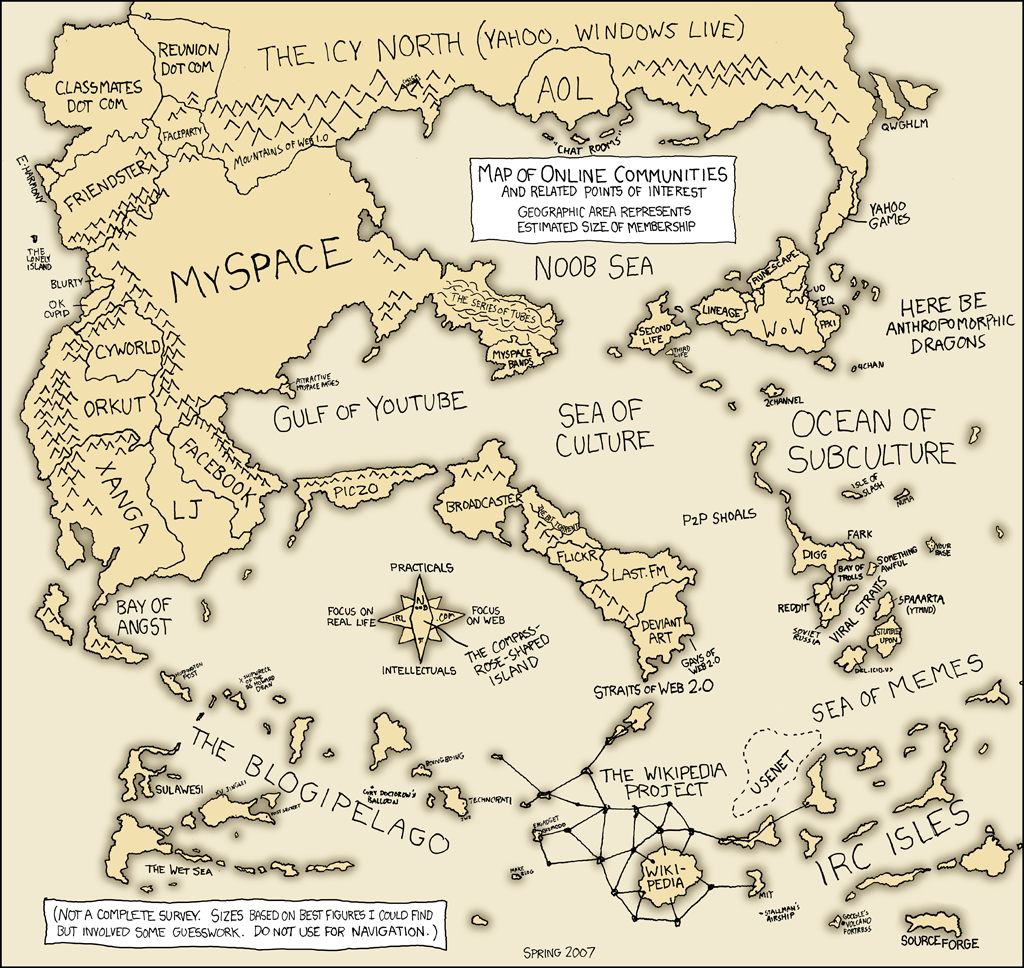
His opening visual used a much blogged about image, "Map of Online Communities," from xkcd, the webcomic of "romance, sarcasm, math, and language." (Click to enlarge.) As Lovink points out, this is "not global picture," but it does reflect the balkanization of all kinds of virtual and physical spaces with the advent of distributed computing. For example, Lovink points to how in Holland the city of Utrecht is focusing on computer games, while other cities have other specializations. (Last year, I visited Delft, which seemed to be a capital of crisis management and risk communication applicaitons of software.) Lovink argues that this creates a situation in which "things are related, but they are not" in an "expanding archipelago."

He also offered more visualizations of "Internet users in the world" to support the numerical dimension of what he called the "critical humanities": Asia 578.5 million, Europe 384.5 million, North America 248.2 million, and Latin America/Caribbean 139.0 million.

In looking at these numbers he spoke about what he called "the empirical turn" in net criticism now that the "wave of French postmodernism has died down" that was epitomized by the work of someone like George Landow. Instead, what Lovink presents is a "mass of practices and stories and diverse cultures of use." To understand some of the "transformations that the field is going through," he pointed to a particular date: August 2008, when China surpassed the U.S. in Internet use. As he asserted, "new media culture will be Asian culture," even though the continent now only tallies 15.3% usage statistics. As the world average of Internet users approaches 21.9% of the occupants of the globe, Lovink noticed that some digital divides were persisting in Europe, particularly along old East/West divides, and that penetration continues to be slow in Africa.

Given the exponential growth of usage, Lovink insists that "research can’t deal with its object any more" with 1.3 billion e-mail users worldwide, 53.8 trillion spam e-mails sent in 2008 alone, a visual culture burgeoning with 10 billion images on Facebook, 3 billion on Flickr, and 6.2 billion on Photobucket, and the growth of the production base of online video, which -- at an average of 3.1 minutes -- are being generated at a rate 34% higher in 2008 than 2007.

What was predicted a decade ago has adopted a very different morphology. Belief in the indymedia model of "grassroots reporting" with political crowds participating in news filtering, fact checking, commentary, and analysis has finally begun to wane in critical circles. Lovink compared "how bloggers thought they would relate to traditional news media in 2003 or 2004" and critiques the paradigm of "circling around old media" in a relationship that was "not parasitic but attached to main body" of "feeding into the larger system from outside." However, blogs are now "integrated into larger social network practice" so that "blogging is something you do." Lovink also pointed to the "integration of blogging into search engines" and its activities of "ratings and ranking" and patterns of "investment and revenue" in a blogosphere in which "over half of blogs have advertising." He also noted the pyramid of participation in which most serve as consumers rather than commentators or producers with the familiar 100% - 10% - 1% distributions as his metric.

As the patterns of production and consumption become less predictable, even the corporate giants who benefit from the system are beginning to give up on being able to offer a macroperspective on the web. He described Technorati as "about ready to give up" since 2006 when 37% posts were in Japanese and only barely edging out the 38% that were in English. The rise of interest in the possibile profitability of locative media in which you "walk past restaurant you review" explains some of the apathy for keeping up with the big picture. He also pointed to the "erratic movements in spats" and "movements of media panics" as a check on any attempts at scientific predictionism. With microblogging this has only accelerated with the rise of the “haiku to the world” approach that inspired him to ask his students to examine Twitter alongside Nietzsche’s aphorisms and consider "how two cultural artifacts can relate."

All this, Lovink insisted was being missed by the "business management literature" that is only capable of expressing confidence that "the global business class will eventually include middle classes" and thus will continue to serve as the exemplar for Internet practices. Among the ideologies held dear is the one that continues to bolster an unwavering faith in the durability of English monolingualism as the paradigm despite evidence to the contrary from charts like "Top 10 languages in the Internet" and what he characterized as a "Polyglot Internet." To see the trends at work, Lovink recommended looking at Ethan Zuckerman and Rebecca MacKinnon's Global Voices, although he cautioned that they may overemphasize what he called the "Berkman Center line of anti-censorship movements that focuses on anti-circumvention software" and thus fail to grapple with the latent libertarianism and neoliberalism of that particular brand of Internet politics. As Lovink argued, efforts to empower national Internet cultures could also prove to be counterproductive to global dialogues

Lovink warned that we were currently entering an era of the growth of "national webs" that were "culturally and technologically isolated" in ways that could transform the Internet into a kind of "echo chamber." He argued that "one of these isolated cultures is the English-speaking world," which represents about 26% of the Internet now but is likely to level out at 15-20%. He also looked at the secession of French speakers represented by a site like Skyrock, which has 10 million profiles and software that immediately traces one's IP address, so in Lovink's case the software decided that he was "trying to date a French girl."

Some national webs are becoming defiant about their separateness and using technological means to endorse their distinctive character. Athough China is often singled out as an example of organizing Internet culture in this way, Lovink claimed that this is "where the Internet itself is going" and observed that a country like Australia, where he regularly resides, is trying to "control in and outgoing gates." Turkey, he explained, is also going in this direction; with 100 million people they are even attempting to get "control over use of YouTube." Lovink highlighted the cynical involvement of "Western consultants" in this lockdown, which has been "fully supported by Silicon Valley." Wryly he noted that Russia was an "ideal country for the national web," given its problem of increased media control and the fact that it was still a bit player in the global Internet at 2%.

On a global scale he raised some of the issues about political reaction to digital culture that I do in the forthcoming Virtualpolitik book on a national scale, since he said the concerns of nation-states were "more about the administration of all this than purely raw growth" and the realization of the "dream of many politicians of carving up cyberspace."

Yet Lovink asserted that scholarly literature had a tendency to get "stuck on issue of censorship" and miss the degree to which this fragmentation was emerging as a response to vernacular patterns of use. As to what humanists should be doing in a field in which social scientists were likely to claim greater expertise, Lovink offered several possibilities for future work. He suggested that young scholars could pursue "comparative study with the techniques of comparative literature" and used the model of "French and German blogosphere" and their "historic clash of cultures" as an example of the kind of research that could be compelling. He noted that in his own homeland there is a Dutch version that epitomizes the national net, Hyves.net, with 7 million users of a national population of 17 million in the Netherlands, so that around 40% of Dutch citizens have a profile on the site, so that "MySpace or Facebook don’t have a chance" in the face of the site's marketing power for metasites. He also analyzed the German site Studiverzeichnis, which has garned 12 million profiles of 80 million Germans, despite the fact that it is "not visual" and appeals to German skeptism of social network sites and the latent fears of participating in discourse in a channel installed by a police state, almost as if a hyperbolic paranoia that the CIA was behind Facebook could be supportable. To illustrate this point, he showed a map of French blogosphere, which was handmade and representative of a "human response to machine data," which was titled "Cartographie Diablement Subjective et Approximative de la Blogarchie Francophone."

During the question-and-answer session it was clear that some hackles had been raised during his ninety minute talk.

Although David Theo Goldberg concurred that China presented fundamental challenges to Internet researchers, even for someone as well regarded Mimi Ito, and that the phenomenon of "linguistic nationalism" that Lovink had expounded upon was real, some resented Lovink's characterization of China as a "black continent" for Internet research and implicitly seemed to be questioning whether he was overly Eurocentric in his outlook. In response, Lovink cited his own involvement in the translation of free software tools into Hindi to better serve the needs of the 450 million people who speak the language as proof of his commitment to global engagement. He also acknowledged that it was a problem that "New Media Studies and Postcolonial Studies" had become "parallel universes" that have grown independently with little dialogue. He suggested that it was "time to open a lot of channels" and resist the "ridiculous rivalry between the different disciplines" and the "competition over scarce resources" in contemporary universities in which the "tremendous transition" of film studies and the movement of television studies "into the mainstream" indicated that disciplinary borders, centers, and peripheries were fungible. Finally, he defended the image as being appropriate for drawing attention to the limitations of the "anthropological and empirical turn" that was taking place in the field of Internet studies, which was "not so interesting from a theory perspective." (I've certainly seen this trend developing in the Association of Internet Researchers myself, as work from the humanities is excluded, and would tend to second Lovink's opinion.) On the other hand, he defended the value of going "back to anthropological tools" and the usefulness of case studies, such as a project that describes Internet access in a particular high school in Zambia. Of course, some argued that his general call for theory may be premature if the prime needs are descriptive not conceptual, given the failure of description Lovink was describing.

Others didn't like the structure of his presentation around the information graphics of marketing share and argued that his emphasis on the latest and greatest and looming future predictions betrayed a latent corporatism in his discourse. He defended himself against this charge by arguing that there was also "a place for genealogy" and historical studies of computers and computer networks, particularly cybernetics. Nonetheless, he expressed reservations about assuming the position that we "can’t deal with the present so let’s focus on the past" and dissastifaction with studies that only see the Internet through the lens of the Cold War and the deeper influence of military technology, which leaves out the global perspective and practices adopted without centralization that are now being organized by national webs. He explained that "we are kind of stuck in a way" because such genealogies would be unlikely to "give us the critical apparatus to study the future" In describing the "state of panic" associated with "trying to keep up," Lovink admitted that he had "left out statistics related to the mobile phone," which is revolutionizing "access to electronic communication."

Mark Poster
questioned the ramifications of pointing out that "we can no longer be Kant writing for all humanity," given the crisis of theory that Lovink described, even though theory is called for in a time in which the nature of subject formation has changed so radically. Lovink responded that the fact that theory no longer guides practice (with the exception of tactical media) should be of concern. Although this "notion of the object as constantly disappearing" might discourage some from attempting serious critical inquiry, he expressed his concern that too often a "technolibertarian agenda" oriented around a few pet issues, such as open access, free software, creative commons licenses, was filling the vacuum at a time when critical concepts that could shape the field were needed, and that a "public domain agenda" in which the Internet merely served as a kind of public space were far too easy to deconstruct. Lovink identified himself as a product of the "Kittler school of German media theory" who was interested in "media materialist approaches" that addressed "infrastructural underpinning" and "historical trends going back to modes of writing." In closing his talk he emphasized that "important media theorists" such as Richard Rogers of Govcom.org, "have that humanities background" and that the objects of study only seemed to "disappear because they are more present and bigger."

Labels: , , ,

Saturday, October 25, 2008

Table Talk

Today I attended a session with graduate students as part of UCSB's LCM Symposium: Careers in New Media and Digital Humanities, which was structured around some of the following questions and issues:

- challenges of working and seeking positions outside one's PhD granting department

-- what do humanities departments mean by "media"?

-- strategies for showcasing technical work in job applications (e.g. RA appts, wiki projects, blogs)

-- nomenclature and the shape of the field: new media, the digital humanities, electronic literacies, et al

-- the place of new media in rhet/comp departments (job opportunities, research questions)

-- what is the place of practical or applied research in the humanities?

-- the place of gaming in new media studies

As a rhetorician who is interested in praxis, I also put together a web page with three main types of sample public appeals that advertise expertise in the field of new media: sites created by graduate students and recent PhDs, sites I had created, and sites for different national and international professional associations, think tanks, philanthropic groups, and conferences in this rapidly changing interdisciplinary field. It was a lively discussion as we talked about how to balance virtuosity with collegiality and how to avoid gaffes such as providing too much personal information or creating websites that are difficult to display, navigate, print, or copy and paste. We also discussed some of the new genres being created by graduate students, such as the dissertation blog. Thanks to Rita Raley and Alan Liu for leading a productive discussion with me.

Update: One of the students present has already created his own site.

Labels: ,

Wednesday, September 10, 2008

Meta Lecture

Yesterday I gave a talk as part of the Annenberg Research Park Colloquium series called "What Could Go Wrong?: The Baked Professor, the Runaway Résumé, and Other Cautionary Tales From the Digital Campus.”

Although I discussed how blogs, social network sites, file-sharing, and cut-and-paste plagiarism by students and faculty is creating conflicts on campuses and magnifying the anxieties of university administrators about new social media, the main focus of my talk was devoted to online lectures and the possible new genres of this traditional form that are being developed for distance learning on the web.

Because the talk was filmed and will eventually be posted on the web, it is odd to think that I gave an online lecture that was largely about online lectures. I hope that my rhetorical performance was at least less embarrassing than the one that I showed part of from the so-called "baked professor."

The riskiest part of the talk probably dealt with the much beloved "Last Lecture" on YouTube by Carnegie Mellon University computer science professor Randy Pausch, which has been seen by over seven million people.

In my talk, I argued that Pausch's "last lecture" may be a problematic model for the distance learning experience, because the primary subject matter of his hour and fifteen minute speech is Pausch himself rather than the transferable knowledge associated with critical reading, scientific demonstration, research, design practices, or the interpretation and representation of data. Although it was a traditional one-to-many form of communication, as "Mourning the Internet Famous: Randy Pausch's Distributed Funeral" argues, many wanted to participate and address Pausch -- sometimes posthumously -- after watching the video.

I also asked some provocative questions -- as respectfully as possible, given that Pausch is deceased, has worked in fields related to my own interests in interactive entertainment, and is deeply admired by many friends and colleagues. Based on a close reading of the actual transcript of the lecture, I speculated about how this particular web genre obscured the fact that Pausch often expressed a surprising amount of hostility toward university rules and conventions governing faculty conduct in the course of his lecture, which was posted on the official Carnegie Mellon YouTube channel.

For example, consider the following sentiments that Pausch expresses and ask yourself if they would have been received so warmly by his faculty superiors and peers if they had appeared in the form of text in a faculty blog.
  • He exults about breaking a NASA rule against faculty joining students in zero gravity experiments.
  • He sides with a corporate collaborator who says that academics are "in the business of telling people stuff and we’re in the business of keeping secrets."
  • He compares his former dean at the University of Virginia to the nefarious "Dean Wormer" of Animal House and calls him "our villain." Furthermore, he describes this confrontation using the terms "pissing match" and "pissed off."
  • He complains about getting "arrows" in his "back" from faculty colleagues who didn't support a student projects course he taught.
  • He advises others to insist on special privileges and exceptions to standards that govern admission when he describes how he overcame not being initially admitted to Brown as an undergraduate or Carnegie Mellon University as a graduate student.
Slides from my talk are here, and a selection of links to video clips is here.

Update:: The IML has written up the talk in a post called "The Baked Professor and More."

Labels: , ,