Tuesday, April 23, 2013

Feminist IT: Legacies (Leigh Star, Beatriz da Costa, and Anne Friedberg)

The Feminist IT conference devoted time to celebrating the legacies of three feminist scholars who represented the group's commitment to doing interdisciplinary work and the interpersonal networking that supports such field building.  Since members of this assembly do research that crosscuts "STS (science and technology studies), film and media studies, sci-art, digital humanities, informatics, and critical media practice" it was also important to emphasize exemplary thinkers who worked in the different traditions of ethnography, media arts practice, and archival criticism represented at the conference.  (In my opening I noted that it was an assembly both in the sense of representing multiple delegations and in the sense of the term "some assembly required.")
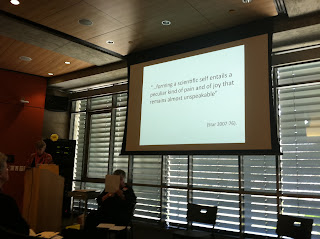


Leigh Star was remembered by Adele Clarke and Martha Lampland.  Clarke noted how Star was a polymath who worked on neuroscience, artificial intelligence, and ecologies of knowledge, but she also humanized her by describing her personal struggles and by showing her at leisure in photos interacting with different types of environments, including a palm tree oasis. Ever the responsible pedagogue Clarke provided a handout and began by providing context for Star's work in Ecologies of Knowledge. She argued that Star rewrote the narratives of scientific discovering by presenting scientists as "citizens neither villains nor heroes" and asked fundamental questions like "Who is doing the dishes?" or "Where is the garbage going?" or "Who owns the means of knowledge production?" This focus on everyday practices, organized what Clarke called her "work commitment."  She also spent some time trying to demystify the "boundary object concept" that was a critical part of Star's intellectual legacy.  She showed its roots in pragmatist philosophy, in the Chicago School, in And in Anselm Strauss's theories about social worlds and arenas, and in the Everett Hughes classic, The Sociological Eye.  Star's conception of workplace as a site of "cooperation without consensus" continues to be extremely influential, and -- as Les Gasser notes -- two thirds of the citations of Star's work actually come from computer science.   Clarke also cautioned that Star's seminal work on "Institutional Ecology," which looks at negotiations among professional and amateur communities working with taxidermy specimens in museums, appears in science studies readers in abridged form.  Often overlooked was the fact that boundary objects are "loosely structured in common practice" and "a sort of arrangement that allows different groups to work together."  She also pointed out that her work on "boundary infrastructures" in Sorting Things Out (co-authored with partner Geof Bowker) was important to consider.  Clark said that "interpretive flexibility" tends to get more attention than structuring and processual dynamics.  She also remarked on the role that "lack of fit" played in creating new boundary objects.  She then focused on the importance of the concept of "torque" in Star's work as a "twisting of time lines."  Clarke closed by returning to the diversity of experiences that Star's life represented, which included "the importance of  writing poetry and fiction" as well as the fact of "being allergic to onions" in a life of "drinking and dancing" as well as "mentoring and loving." In the slide above we see Clarke citing Star on how "forming a scientific self entails a peculiar kind of pain and of joy that remains almost unspeakable" (Star 2007: 76).

Lampland began her remembrance by emphasizing how Star engaged with "fighting for social justice" in ways that recognized the complexity of causes and consequences.  For example, the SAT could be both the test that allowed Star to attend Harvard University without class connections and a potentially discriminatory gatekeeping examination.   Lampland, who co-edited Standards and their Stories with Star, admitted to occasional disagreements and also asserted that Star's method of quickly being able to identify commonalities did not necessarily contradict an engagement with sustained empirical research.  She also emphasized the "mistake of championing transparency" that "could hide what doesn’t fit."

Antoinette LaFarge, who described herself as fortunate to benefit from colleagues in the UC Irvine "brain trust" who have been part of FemTechNet, then remembered critical sci-artist Beatriz da Costa in a talk called "Less Dismal Science" that made a number of implicit connections to the previous discussion of Star's work by noting the role of "standards," "tools," and situations" in her art.  Beatriz da Costa co-edited Tactical Biopolitics with Kavita Philip, one of the PIs for UCFemTechNet, and she was part of conference planning until her untimely death from cancer.

In unpacking the art practice of "Shani" (the name she preferred to Beatriz), LaFarge described how da Costa's projects were often designed around hands-on workshops and situated in a participatory ethos from her beginnings in Critical Art Ensemble.  LaFarge chose to analyze da Costa's work in relationship to Nietzsche's The Gay Science and Carlyle's The Dismal Science to consider science as an end not a means and critique science's "offer for radical truth," which Avital Ronell also challenged in The Test Drive in questioning the ostensibly sovereign presence of truth in science, politics, and religion and the compulsion to dis-identify and deny attachment.  LaFarge also argued against scholars "strip mining Nietzsche" without attention to his chauvinistic remarks about how women are weak, conniving, and characterized by disgusting natural functions and his ideas about the present moment as a time of virility.

In an oeuvre that included microbes, biodiversity, air pollution, RFID tracking, and genetically modified food, da Costa engaged in a series of public actions oriented around expanding the notion of citizen science in ways that were mutually positive for creators and participants.  For example, LaFarge pointed to her work in Invisible Earthlings with CO2-sensing yeast colonies and in Pigeonblog undertaking a "collaborative endeavor between homing pigeons, artists, engineers and pigeon fanciers engaged in a grassroots scientific data gathering initiative."  Like other speakers, LaFarge acknowledged the presence of disagreement among feminists, and the fact that her friend and colleague thought that LaFarge's interest in "computer games was a complete waste of time."   The difficulty that Beatriz da Costa addressed was described by LaFarge as "how much has to be left out in order to make an argument" and "how test results are used to conceal a lie."  Visitors to the conference were encouraged to visit an installation of da Costa's Dying for the Other in the Consume show at the Calit2 Gallery, which interrogates the relationship of the dying artist to the mortality of laboratory animals. 


The final tribute was devoted to Anne Friedberg.  Co-organizer Lisa Cartwright actually had Friedberg as a teaching assistant and recollected being given names like Irigaray, Cixous, Althusser, and Mulvey by this early mentor.  Heidi Rae Cooley gave a tearful and moving remembrance of Friedberg that drew upon the memories of Sheila Murphy as well.  She emphasized the radical rewriting of four centuries of the history of perspective that Friedberg undertook that went far beyond how the work of film historians was traditionally constituted.  (See her digital companion for The Virtual Window for an interactive version of her argument.)

Friedberg founded both the UC Irvine Ph.D. Program in Visual Studies and the IMAP program at USC and launched the careers of many interdisciplinary students.  Cooley pointed to Mark Sample's essay "When Service Becomes Scholarship" to explain the depth of Friedberg's contributions and how she made public and circulated the work of others, even "taking in freeway fliers" who were normally outcasts at the university or sitting on information technology committees.  She also discovered talents by recommending people for one-year contracts that later developed into long term institutional presences, as she did for Daniel Herbert who chronicled the rise and fall of the video store.

A particularly beautiful and lyrical moment in Cooley's talk came when she described how Friedberg made homemade temporary tattoos with "SCMS" for the Society for Cinema and Media Studies when the "media" part was still new.  Friedberg also took on DIY with gusto by making her own pamphlets for an improvised MIT Press booth, since she was not one to hold herself above others, according to Cooley.   As in the case of the other founding mothers remembered, we learned much about the details of Friedberg's passions worthy of remembering: Gil Sans as Friedberg's font of choice, Conan Doyle on camera, stuffed Furbees speaking Furbish, writing about the Aibo robot dog, and Vaucanson's infamous duck.   Although Friedberg changed theories of "windowed visuality" and the mobile virtual gaze, she also recognized the temporality of the apparatus and the impermanence of institutions.

Note that attendee Wikipedia maven Adrianne Wadewitz periodically reminded conference participants that they could improve these three women's entries on Wikipedia.

(Photos from Lisa Parks)

Labels: , , , ,

Friday, April 19, 2013

Feminist IT: Infrastructures


The Feminist IT conference devoted to "Feminist Infrastructures & Technocultures" featured a number of prominent feminist scholars of technology in the morning sessions, which were devoted to questions about infrastructures and legacies.  With over three decades of scholarship to draw upon and a strong concentration of work done in the University of California, this conference tried to facilitate more conversation between people doing interdisciplinary work, specifically those who might be positioned in either the Society for the Social Studies of Science or the Society for Cinema and Media Studies.

In my opening welcome I pointed to the work of fellow organizers and panel moderators who approach questions about mediation from the perspective of material culture, the study of the apparatus and embodiment, and engagement with particular communities of practice, such as Lisa Cartwright on 3D printers that can produce guns, Lisa Parks on drone vision, and Kelly Gates on the truth claims of facial recognition technologies and surveillance footage, which have been much in the news this week in the wake of the Boston Marathon bombings.  I also noted that the particular context of public institutions devoted to big science provides affordances as well as constraints for this work on "making science, designing culture, shaping the technological imagination, sorting things out, and determining 'the right tools for the job.'"

The UC FemTechNet group is a regional research offshoot of the larger and more distributed FemTechNet initiative currently archived at the FemBot Collective and slated to move to new space at a FemTechNet site at The New School.  Many of its members use the UCFemTechNet Facebook page as a site for cross-campus coordination and introductions, although there is also a mailing list for announcements.

The opening panel featured a dialogue between Anne Balsamo and Chandra Mukerji about infrastructure that focused on their shared scholarly interest in uncovering women's roles in the labor force of expert knowledge workers who played a key role in shaping the technocultures of the modern administrative state.  Balsamo famously wrote about how her mother was a "computer" or person who performed mathematical communications, a topic that I also wrote about in the last chapter of the Virtualpolitik book and that was memorialized in N. Katherine Hayles' classic text My Mother Was a Computer.  To commemorate the occasion, we included a non-human participant on the panel, "Nancy," the actual type of comptometer that Balsamo describes.  (The machine is literally labeled "Nancy," presumably with the name of its former operator.)

The first question posed by disability activist Louise Hickman asked "How can we slow down time to shape participation in discussions?"  Mukerji, who does research on how female engineers played a vital role in hydrology projects in Bourbon France, laughed about the fact that mostly she lived in the 17th century and was well aware of how time functioned as a technology as well, particularly when the cyclical time of women's labor differs so radically from linear time.  Balsamo talked about how members of the FemTechNet initiative struggled to coordinate with each other and talked about how to align schedules at professional scholarly conferences in order to gain critical mass.  Balsamo also recast Marx with feminist temporality, by pointing out that women make the present and the future, but not under conditions of their own making.  Temporality has also been a concern for the panel's third moderator, Lilly Irani, whose recent work on hackathons looks at the bias toward action in the compressed time of such events.

In addressing the main topic of infrastructure, which Mukerji defined as the "structure of impersonal rule," panelists discussed how even social infrastructures, such as laws and regulations, had connections to material culture, in that they were written down.  Balsamo acknowledged the work of Leigh Star and many other feminist scholars who published important work on infrastructure, as as way to think about the challenges and opportunities of feminist networking.  As Mukerji pointed out, the actions of largely female staff members in human resources charged with the Weberian task of the maintenance of files, played a more important role in implementing affirmative action than any piece of legislation or judicial decision.  Codes of politeness that allow flexibility in infrastructure that make continual function possible are also infrastructural, as I noted, where women's labor also mattered.  Such codes are also important to FemTechNet, as are the peer promotion practices of those who might be maintaining tenure and promotion files, but the object-oriented character of the panel was also emphasized with Mukerji's object, which was also passed around, a rock and leaf to demonstrate the laundry techniques that she argued were important for understanding the cultural innovations associated with daily life.  (She is famed for arguing that the Canal du Midi is much more than the sole achievement of Pierre-Paul Riquet, a tax farmer and entrepreneur, because it was also the product of collective intelligence, depending on peasant women and artisans--unrecognized heirs to Roman traditions of engineering--who came to labor on the waterway in collaboration with military and academic supervisors.)

Labels: , , ,

Monday, May 21, 2012

Program or Be Programmed: Computers and Writing 2012 Town Hall 2

The central concept of this panel “Program or Be Programmed” might immediately bring up performance anxiety issues for many people in this audience. As Stephen Ramsay put it recently, the very notion of the tech-savvy digital humanities as the newest “hot thing” tends to bring up “terrible, soul-crushing anxiety about peoples’ place in the world.” For those in composition, the anxiety might be even more acutely soul-crushing in light of existing labor politics. Every time the subject of learning code comes up, one can almost see the thought balloons appearing: “How can I learn Python in my spare time when I can’t even see over the top of the stack of first-year papers that I have to grade?” And for those who care about inclusion, what does it mean to choose the paradigm of computer programming culture, where women and people of color so frequently feel marginalized? Furthermore, if all these powerful feelings are being stirred up, what questions should we be asking about ideology as an object of study. For example, Wendy Chun has argued that a desire for mastery over blackboxed systems or access to originary source code shows how a particular dialectic of freedom and control makes it difficult for us to have meaningful discussions about technology and to acknowledge our own limited access to totalizing understanding, even if you are a software engineer.

Fortunately, after hearing these talks, people in the audience should feel a little less anxious. They should know that doing-it-yourself means doing-it-with-others, whether it is imagining Picasso and Braque building a flying machine, as David Rieder suggests, or installing Ubuntu with the help of a neighbor, as Alexandria Lockett describes. The message to instructors in this panel is comforting: relax, be confident in your own abilities to learn new things, ask questions, facilitate the questions of others, and network in ways that help you make new friends.

However, if you are an administrator as well as an instructor, don’t get too relaxed just yet. These talks also bring up some very thorny questions about disciplinary turf. After all, who defines how digital literacy should be taught and who will teach it? Computer scientists? Media artists? Librarians? Us?

Although he uses the word “craft,” Karl Stolley asserts that “source literacy” doesn’t require an elaborate apprenticeship. All it takes is moving toward a set of everyday common-sense practices involving command lines and file structures. Mark Sample suggests the term “code competency” as an alternative to “code literacy,” because of all the cultural baggage associated with the word “literacy” itself. Trebor Scholz has suggested “fluency” as a better characterization of what we are trying to teach, but Sample notes the limitations of that term.

 In a 2010 essay called “Whose Literacy Is It Anyway?” Jonathan Alexander and I pointed to Michael Mateas’s work on “procedural literacy” as a way for compositionists to begin to engage with these issues. Mateas worries that universities are often too eager to adopt the training regimes of computer science departments, which is great for graduating computer science majors but not so great for teaching students in other majors or with other passions to use code. So what should be the relationship between writing studies and computer science in the academy?

People at this conference are probably more likely to be able to say that line about “some-of-my-best-friends-are-computer-scientists” than those at the MLA. (I personally carpooled with computer science faculty for ten years when I worked at UC Irvine and learned something about discrete math and number theory in the process.) But what does that collegiality get us? Both Sample and Vee mention Edsger Dijkstra, who was also the author of “On the Cruelty of Really Teaching Computer Science,” a decidedly anti-humanistic diatribe on the superiority of formal logic and mathematics as the keys to supposedly real knowledge.

 Given the fact that badly written code can overdose patients with radiation or knock out someone’s retirement savings, I’m not sure that I always agree with Vee that clean, legible, rationalized code is not worth teaching to everyone, but I’ll put in my own GOTO command for writing studies to keep this spaghetti-like discussion going with our colleagues elsewhere long after this panel concludes.

Labels:

Sunday, December 04, 2011

Can Public Education Co-Exist with Participatory Culture?


At Mobility Shifts: An International Future of Learning Summit Henry Jenkins (Team Cultural Studies) and Elizabeth Losh (Team Critical Theory) offer a progress report on whether and in what ways the public schools and universities are going to be able to absorb or meaningfully deploy what Jenkins calls “participatory culture.” Rather than an abstract discussion of a theoretical construct drawn from their supposedly opposite positions studying fan culture and institutional rhetoric respectively, the two will discuss concrete experiences of young people acting appropriately or not, inside or outside the classroom. What might a participatory learning culture look like? What policies make it hard for even supportive teachers to achieve in their classrooms? What stakeholders would need to be engaged in order to change the current cultures of our school? How might participatory learning take place beyond the schoolhouse gates? What is everyone afraid of?

Labels: ,

Sunday, June 19, 2011

Mobility Shifts

There are only a few more days before the call for Mobility Shifts: An International Future of Learning Summit closes. Like the previous conference organized by Trebor Scholz on digital labor, The Internet as Playground and Factory, pre-conference discussion is already an important part of the critical discourse around the event, and the mailing list for the Institute for Distributed Creativity is already abuzz with introductions from keynoters like Cathy Davidson of HASTAC.

Matt Gold and I are co-chairing the "Digital Fluencies" track at the conference, and we're interested in expanding the meaning of what digital learning means on a very fundamental level to get away from the charity-case after-school computer lab paradigm and the romance with the digital native and to look seriously at forms of learning that involve mobile devices, political engagement, and much more ambiguous narratives.

What are new pedagogic approaches for learning with mobile platforms? What are the limitations of the “digital literacies” paradigm and its first world/third world assumptions?

How do we promulgate digital fluency as an understanding of the particular features of global information flows in which data, attention, capital, and reputation might move both to and from individual actors and communities?

How can mobile media platforms be used for more than the one-way delivery of content? What are new pedagogical approaches for real-time mobile learning that make full use of the potential of mobile phones, iPods, laptops, PDAs, smart phones, Tablet PCs, and netbooks in formal and informal contexts? How can global participants use mobile media to create rich social contexts around important learning tasks? How can such platforms be leveraged to teach digital rights and the value of collaboration across cultures?

How can we dispel the myth of the digital native?

How can mobile networks reshape our experiences of space and place through interactive architecture, locative art, geo-caching games, and real-time object recognition? What opportunities for networked teaching and learning might we find in such media-rich, responsive environments?

Check out the call for participation here. The deadline is July 1.

(Sixth College is one of the partners of the project and plans to sponsor faculty and TAs from the Culture, Art, and Technology program to attend the event.)

Labels: , ,

Friday, October 01, 2010

Theory as Storytelling

The closing talk at the conference for the Institute for Money, Technology, and Financial Inclusion on "The impact of M-PESA: results from a panel survey of Kenyan households"
was delivered by Billy Jack, who described the rapid adoption of the popular cell-phone based mobile money service by eight million people in country of thirty million, which was accompanied by a growth of M-PESA agents in a place in the developing world with better cell phone coverage than Westchester county.

Jack described how a number of indicators about customers unable to withdraw money, unable to deposit money, not being asked by agent to show ID, or not trusting agent had been steadily improving. Unlike some cyber-utopians, he also explained that the focus of his research was not on "getting rich" but on a potential "gain in insurance" that could be important for "smoothing shocks." He described how M-PESA was "not the bank for the unbanked" exclusively, because many different populations -- rural, urban, unbanked, and banked -- all showed growth in using M-PESA, although the service was definitely expanding to those not as well off.

He also asked a fundamental question often not asked in mobile money circles: "Is sending money important?" He noted that users are more likely to send and receive money but that economists should be careful not to see causation in correlation. Among so-called "early adopters" Jack observed that there was not much change between sending and receiving money, but late adopters did change remittance behavior. (Most people in Kenya are paid monthly, so that was a particularly important unit of use.)

Kenyans still used traditional means of storing money among the unbanked, according to one of Jack's bar graphs. In fact, mattresses beats out M-PESA among Kenyans. Like others with an economics background at the conference he spent little time on formulae. When skipping over regression results, Jack said, "we’re at a beach after all."

Although Jack said that "theory is just storytelling," he argued that the data showed that M-PESA users were better at smoothing positive and negative shocks. However, he was also cautious about these results, particularly since the effects of M-KESHO were still unknown. He was also wary of claiming too much about macro-economic effects and monetary policy, particularly since M-PESA actually causes there to be less money out in the system. At the level of everyday life it also creates challenges for users in a culture that expects contributions. Furthermore, he noted that M-PESA's parent company Safaricom was a monopology.

What are the lessons learned? For Jack, M-PESA is a story about "not designing for the poor" and the value of thinking about financial inclusion inclusively. When people in the audience asked why bother researching something that was a success, Jack joked about the Microsoft analogy but defended the nuanced picture that he was presenting.

In closing the proceedings, organizer Bill Maurer argued that designers had been urging him and other conference participants to get "less noun-y and more verb-y" in two days of research that was more about "moneying" than "money" in asking "what's the user interface for money?" and "what is money if it would be more democratizing?" And then what he described as a conference about "tearing," "throwing," "converting," "hiding," "interring," "celebrating," "securing," "exploiting," and "trusting" came to an end.

Labels: , , ,

Placing Trust in Kiva

Digital rhetoric is not exclusively the domain of rhetoricians. Seminal work in digital rhetoric is appearing all the time from scholars in communication, linguistics, informatics, sociology, and anthropology.

For example, yesterday, as the annual conference for the Institute for Money, Technology, and Financial Inclusion began to wrap-up, Anke Schwittay and Paul Braund of the Rios Institute presented an interesting rhetorical analysis of the appeals of a popular microloan service in "'Democratizing Capital:' Digital Lending Networks, Mobile Technologies and Women’s Solidarity Groups in Chiapas, Mexico and Guatemala."

As investigators, Schwittay and Braund explained that they were initially interested in the difference between what they saw as the commercialization of microfinance in Latin America and the so-called Grameen model represented in the "Bangladesh Consensus." Soon, however, they drilled down to find complex issues of trust at work and found themselves also working with meta-theories about trust from Amartya Sen, Anthony Giddens, Niklas Luhmann, and Lynne Zucker.

Case study research, netography, and ethnography were all parts of their analysis of Kiva, the online loan service for Americans who are interested in microfinance rather than charity in the developing world. They noted the importance of prominently placed faces on the website, minimal and clean on-screen presentation, and plug-ins for social network sites like Facebook as ways to engender trusts and foster a P2P illusion. They observed that the arrows connecting lender to the borrower on the Kiva web page didn't adequately represent the indirect nature of the transactions. An exposé in the New York Times that showed that Kiva was not all that it seemed, "Confusion on Where Money Lent via Kiva Goes," indicated that there was considerable backfilling of loans from MFIs and that the simplicity presented on the website masked considerable complexity.

In examining issues of representation and how Kiva is represented as an agency handling 120 MFIs in 52 countries, Schwittay and Braund also considered how their public database was structured and how it offered a way to think about credibility in the case of a "mobile credit bureau." Apparently Kiva uses a star-rating as risk-rating system to engender trust and played off familiar tropes rooted in the technology and entrepreneurship culture of Silicon Valley. The researchers gave them credit for thinking about the connection between the "back end" and the "legal end" in creating a system with 38 indicators in 10 different categories, which Kiva's Matt Flannery compared to an E-bay credibility score

Researchers studied AlSol in Chiapas, a Grameen partner that stopped being a Kiva partner because of Kiva's onerous reporting requirements in a time when revenues from artisans' embroidery were already cut by a decline in tourism during a period marked by swine flu and narcotrafficking in Mexico. Although they found interest in mobile phones as a way to cut interest rates, they discovered no awareness of Kiva among its former borrowers. Their research also raised significant issues about the privacy, given the seeming one-way nature of the interchange.

They also sought out an Kiva partner in Blimbingsari, a Christian area of Bali, which was called MUK. This Christian NGO on a Hindu island in a nation with a largely Muslim population functioned in a system of multiply contradictions in basic jurisdiction. The success that was had was credited by Schwittay and Braund to the Kiva Fellows, a group of over 600 volunteers, assigned at a rate of thirty fellows every three months, from a professional corps of Westerners with technology, finance or business backgrounds who also spurred regular media production activities showing successful loan results with blogs, pictures, and videos. Yet these borrowers engaged in raising pigs, making bricks, selling religious items, or pursuing other trades also weren't aware of Kiva's role. MUK feared that if the women knew the money was coming from abroad they would feel less obligation to pay back. Furthermore, the client waver that women signed surrendered many aspects of their privacy, because they were more concerned that their immediate neighbors not know about their financial transactions than strangers on the Internet.

Schwittay and Braund described how pressure to produce success stories about "happy entrepreneurs" generated odd discrepancies, in which women shown as busy and productive online might actually be ill or overwhelmed with problems. Stores that were shuttered were presented as open for business on the Internet. And garbage dumps that didn't match the clean image presented on Kiva were carefully omitted from the scene.

Labels: , , ,

Thursday, September 30, 2010

The Dead Live in America

Recently I was in England for an American Studies conference. It was strange to hear presenters from Europe so comfortably overgeneralize about "Americans," "America," and "American-ness." Occasionally I felt compelled to assert my native knowledge about my home country in these discussions, but often I just listened silently as the exotic behaviors of the strange inhabitants of my land were discussed with a mix of amusement and distain.

During today's session at the annual research conference for the Institute for Money, Technology, and Financial Inclusion the emphasis was frequently upon showcasing presentations from researchers working in geographical regions in which they already know the language and cultural practices. Given how easy it would be to be to leave the field to techno-missionaries with one-size-fits-all one-laptop-per-child ideas that emphasize American enthusiasm for individual enterprise, consumer electronics, and ideologies of novelty rather than treat indigenous people as stakeholders, the efforts of the Institute to bring this range of researchers to the United States are particularly noteworthy.

The first talk on the second day of the conference, "Understanding Social Payments and Relationships among Poor People in Ethiopia," was presented by Woldmariam Mesfin Fikre who asked if designers of mobile money should "create new people for new technologies" or "create new technologies for people." He pointed out that individuals had interconnected social networks among themselves, but that there were also intermediaries like priests and shamans who could connect to a supernatural realm populated on the one hand by Christ, the Virgin Mary, and the saints and by gods, including evil spirits, on the other.

How should a mobile phone be designed for people in Ethiopia and for the kinds of transactions in which mobile money might be needed? Too much research, Fikre argued, was focused on the technical aspects of mobile money not its social and cultural aspects. He detailed a number of basic questions that should be asked. What are the major relationships among people? How will these relationships be established and terminated? Why do people make social payments? What are gift procedures?

In introducing the evidence of his case study and the literature review, Fikre lamented the fact that "the most important articles" in his field "were difficult to access because of subscriptions and fees" charged by scholarly digital archives. (See John Willinsky's The Access Principle, which is available online in its entirety, for more about this issue.) Fikre's informants were Christian Orthodox Amhara and Oromo farmers with no access to electricity, who faced a 110 km round trip if they wished to travel to the closest financial institution in the area.

Fikre observed a high demand for mobile phones among this population, because they were a sign of prestige, a sign of modernization, and a sign of financial wellness. However, owners of these phones had to deal with a major problem with battery recharging.

He also enumerated a number of culturally specific financial practices that involved more complex forms of reciprocity than mobile phones generally can accommodate. For example, an "edir" serves as a traditional micro-insurance association to assist families facing the consequences of the death of a family member and participates in mourning rituals and provides cash payments. There were also payments for marriage and forms of tithing that were important to the focus groups that Fikre studied.

Fikre also raised a number of tricky issues that resisted simple technological solutions. For example, there were situations in which refusing money is important in social relations, which passive connective processes can not easily accommodate. Certain payments are conventionally recorded, while others are not recorded. In considering the design of mobile money it would be important to the culture to enable the giving of secret money, transactions involving confidential money, and gifts to the church without an amount visible.

Sirimevan S.S. Colombage presented on "Financial Inclusion in Sri Lanka: Constraints and Prospects." He described a financial landscape dominated by two state banks that hold sixty percent of the country's total asset base and his mix of research methods that drew from qualitative investigations (household interviews, focus group discussions, etc.) and a quantitative survey to understand the financial inclusion experienced by those who earn around one dollar a day in Sri Lanka. He described this group as "underbanked" not "unbanked," because even among the ultra-poor, 68.8% reported having an account, and 54.3% had financial transactions with a microfinance institution.

Americans were also among the IMTFI's line-up for the day. U.C. Berkeley's Joshua Blumenstock showed preliminary research from a massive study of cell phone records that added up to two-and-a-half terabytes of data. "Banking on the Phone: Using Novel Sources of Data to Understand the Impact of Mobile Banking in Rwanda" used anonymous call records, third party survey data, and structured phone interviews to get more precise information about cultural practices in a society in which people just buy anonymous SIM cards on the street corner.

As one of the creators of the website Hot or Not, which launched a series of similar Internet memes, Blumenstock comes to academia with a complex pedigree that includes developing sites like If I Die that offer to deliver notes from the dead to the living. Of course, Blumenstock also has a more conventional research profile, so it is somewhat less surprising that he was entrusted with so much personal data on so many people in Rwanda.

Blumenstock has examined how the use of mobile phones and mobile banking is distributed through the population and looks at the role of gender, age, and wealth. His empirical research strategy also contrasted phone users from non-phone users. Phone owners earned more than twice the income of non-phone owners. Among those with phones, men and women made about the same number of calls, but men made more outgoing calls while women received more incoming ones. Apparently people in Kigali talked to more different people during a given time period than those living outside urban areas. "Risk sharing" was another important phenomenon.

In one of the more striking moments of visual rhetoric at the conference, Blumenthal showed an animation of calls made on the day of the February 2008 earthquake and what regions of the country were most active in the time following the disaster. His other moment of visual rhetoric involved showing on equation; its configuration of Greek letters was described as a "simple method of estimating difference that you wouldn’t expect."

Shaozeng Zhang also came to the IMTFI conference from an American university context in explaining "Financial inclusion or developmental exclusion? The carbon credit payment to forest inhabitants in Brazilian Amazon." He described how REDD programs aimed at Reducing Emissions from Deforestation and Forest Degradation worked for forest residents who were to be compensated for not deforesting in Brazil as part of the larger global carbon credits market, Zhang focused on the Juma Reserve where "coboclos" or immigrants from drought-plagued Northeastern Brazil had become subsistence farmers dependent on slash-and-burn agriculture after enduring the decline the of rubber economy after World War II.

Zhang pointed out that this was purportedly a successful REDD program, because of the effects of a shortage of financial resources elsewhere in the voluntary carbon market that involved the carbon credits of Marriot Hotel International. In that sense the program was "running faster" and thus was "in some sense more successful" in dispensing its four forms of assistance: 1) the family forest allowance that provided monthly cash, 2) the income forest allowance that provided support for non-timber forest product extraction with commodities like Brazil nuts, 3) the social forest allowance, and 4) forest associations that covered operational costs.

Yet Zhang noted that the cost of gasoline for the canoes to reach the nearest Bradesco Bank greatly reduced potential profits for the indigenous inhabitants. He argued that the carbon market may be subject to the same economic cycles of boom and bust in which the residents of the rain forest had little to say. In asking about the valuation of the forest by whom and for whom, Zhang reminded the audience of the long history of colonial and post-colonial exploitation in financial schemes involving gold, sugar cane, and coffee in Brazil. Zhang asked if low-cost carbon credit might just be another system of harvesting.

"Gender and Money: Case Studies from Philippine Indigenous Communities" by Mary Janet Arnado was the next research study presented, which highlighted differences in how a man and a woman stores money. She also described family conflicts around money and the lack of attention to interest rates among low-income – Igorots, Tagbanua, and Higaonaon. Themes of visibility and invisibility also appeared as she showed the women's communal bathhouse, a sulfur hot spring where money and family matters could be discussed.

As Arnado explained marriage and death can be expensive in the rural Philippines because of the need for men in the family to feed the whole village. Furthermore, gender segregation and related patterns of social spending also made saving difficult for those who often bought goods in very small quantities in a "sari-sari store."

American Eric Silverman followed with "Moni, Marginality, and Modernization in Postcolonial Papua New Guinea." He began his narrative dramatically with an account of a disastrous flood that decimated the village that he had studied and disrupted the life of his local "brother." Silverman described a lack state money now that the inhabitants had abandoned traditional shell currency. Yams were not enough to support currency exchange, and the situation had become worse since the buying of tourist art depicted in the film Cannibal Tours had been lost. He described how all village trade stores were shuttered, and there was no petty capitalism, so that there were more poor and more unbanked than in the village two decades earlier.

Silverman's method included collecting children’s drawings of money and their consumer desires. He explained how moral imperitives around reciprocity and kinship often made money flow difficult. In summary, "a good capitalist is a lousy kinsman; a good kinsman is poor." He described shame in asking for cash, women struggling to save for the future, and instability introduced by transitioning to the nuclear family. In this environment there was little fiscal planning, and all decisions were immediate and ad hoc. As he pointed out traditional structures don’t map neatly onto imported models for capital, particularly when who to give to and who to share with was not clear. He described how the inhabitants now even charge interest when loaning money to kin, and how women were more successful in this struggling informal economy because they made baskets used by local people on an everyday basis not tourist goods like men.

The title for this blog post comes from Silverman's narrative about the villagers insisting with him that "the dead live in America." These dead had once traveled to the village to buy goods, but now perhaps the Australian were preventing this trade and perhaps even selling goods to Asian countries. "Unblock the road to the dead!" they demanded. Even his local brother asked "What are we doing wrong that we live like this? We have no money."

Economic anthropologist Julia Elyachar wove together a number of threads from these panels. As she pointed out, they were "ending with roads":roads to the dead, roads to the forest, global flows to the indigenous. She also discussed the "rediscovery of the informal economy" in the presentations and the role of nature as outside of markets and outside of the economy. She noted the themes of secrecy and visibility in these presentations as well, since they included open baskets of cash in convenience stores, money buried by a man to be hidden from his wife, and coins in a Coke bottle to handle daily expenses.

In the afternoon presentations, another visiting researcher from Malawi, Chinyamata Chipeta, gave a talk entitled "Adapting and extending the use of accumulating savings and credit associations through village savings and loan associations," which explained the promotion of local VS and LA institutions. He explained that it was easier for villagers to bank through their own banks and use their own social capital. The structure of these institutions were organized with a country coordinator at the top of the hierarcy, officers, village agents, and VS & LA committees. He noted the sequential nature of borrowing, the brief one-month loan period, the variations in capital contributions among members, the use of cash boxes and passbooks, and the checks and balances in operation, which included a mechanism in which three keys were required to open a cash box. Chipeta closed his talk with a video in which village women sang,"If this bank ends, we are going to complain."

Kurt von Mettenheim and Lauro Gonzalez presented research on Brazil that included a type of institution often overlooked by neoliberal mobile money enthusiasts, the government bank or "those old things." They showed a number of spreadsheets with largest banks in Brazil represented on their rosters. They also praised the "Bill Maurer method of looking in your wallet" and displayed one of the 110 million citizenship cards that had been issued, which were not identity cards. Their final visual aid was a Sao Paulo Google map to encourage the audience to visualize the three million unbanked people and their need for family grants from the government. More information about their presentation on "Banking and Microfinance in Brazil" can be found here.

Labels: , , ,

Wednesday, September 29, 2010

The End of Banking

Imagine the protagonist of It's a Wonderful Life with no tellers' windows at which to hand out cash during the Depression. Imagine the children of Mary Poppins having no sanctuary with stuffy bowler-hatted bankers to disrupt. Imagine the anti-heroes of Dog Day Afternoon with no place in which to make a last stand.

It might not take much imagining soon, as we begin to think about the end of banking.

South Africa's Leon Perlman's talk about "Aspects of Legal and Regulatory Issues in Mobile Financial Services in the Developing World" provided a comprehensive overview of the current economic landscape in which mobile money or e-money or stored value functions. Perlman also was serving as a representative of WASPA or the Wireless Applications Service Provider's Association in sketching out the financial frameworks and state infrastructure that might be needed if the end of banking should arrive.

Perlman began by leading the audience through the alphabet soup of WAP, SMS, and USSD transactions for which the * and # keys come into play. In talking about "the unbanked" or "the underbanked," he admitted that his focus should be realistically more on payments than savings. Such payments could include POS or point-of-sale purchases, MFI payments to microfinance institutions, remittances, and low-value micro payments. He also argued that the issues were fundamentally about transactions not banking. As he put it simply, "about a billion people don’t have a bank account but do have a mobile phone."

Perlman explained why mobile operators "want a piece of the action" and how MNOs were eager to enter the MFS market, given the fact that minutes were merely commodities now, and the offering of financial services could be a new way to ensure customers' loyalties. He also discussed some of the more futuristic practices with mobile money technologies that were now being tried in Europe, such as NFC or "near field communication" proximity payment methods. However, for Perlman, answering basic definitional questions was far more important than prototyping new gadgets.

When talking about "stored value," Perlman suggested that the first question may be "is it a deposit or not?" He claimed that we know how to license banks and how to license mobile network operators, but we don't understand what happens in the space in which these businesses overlap. In grappling with the legal characteristics of prepaid "money," Perlman asked about the proportionality of regulation and the need for regulatory coordination between supra/national government departments and for sensible policy for the treatment of cash in/out agents.

In trying to answer the most basic question, "Is it money?," Perlman pointed to a fundamental controversy about how money is defined and the competing philosophical schools behind the different premises that shape possible definitions. He argued that there were many possible repercussions from how money was defined from consumer protection law to money laundering enforcement to family understanding of contracts about how "money."

In the heart of his talk, he distinguished between 1) the "Common law definition of money," which was an "orthodox" economic position dating back to Aristotle and fully formalized by F.A. Mann, which presents money as GAME or a "generally accepted means of exchange" and 2) a "New(ish) definition of money" derived from Keynes and the Austrian School. In the latter definition, money was conceived in terms of debt when imagining it as a unit of account, a store of value, a means of exchange. Perlman argued that this so-called "claim school of money" was a much more appropriate way to think about contemporary mobile money.

In arguing for "enabling branchless banking," Perlman expressed his own concerns about "systemic risk" after global collapse. He also argued for a focus on services that will rapidly attract a critical mass and attention to the role of agents.

Perlman also tried to explain the regulatory nightmare that mobile money raises. Is it banking supervision and/or payment supervision and/or telecoms supervision? He strongly argued that other countries should avoid the "regulatory mistakes of the European Union" and their "definitional errors in 2000" that would have forced all airtime purses to register as banks. Even if he acknowledged a need for oversight when it came to cost of access to services disclosures and SIM Card registration, he was leery of overregulation that would exclude the unbanked and underbanked. He also made a strong argument for "proportional regulation" in which KYC (or "Know Your Customer") rules could be addressed sensibly, although he granted that questions of taxation, agency commissions, and Forex rules would remain complicated.

Although "interoperability" is often seen as a technical problem, Perlman tried to unpack it as a regulatory one. He argued that "walled gardens" and "islands of excellence" might be difficult to avoid, as regulators faced the challenge of reducing costs and growing markets without penalizing early innovators.

He closed with a number of national case studies, including one of the best known implementations in Kenya with M-PESA. He contrasted the Kenya case with India's unsuccessful bank-only model and the efforts of MNO Barti Airtel to get beyond the "semi-closed wallet" paradigm around goods and services that limits financial transactions. Perlman asserted that attention to such regulation at country-specific level was critical.

Bill Maurer closed the day's session by talking about how Perlman's talk could illuminate his own interests in the "hacking of infrastructure" and "legal and regulatory workarounds," used much like the claw to get electricity off the grid that is deployed in many places around the world.

Labels: , , ,

Live Networks, Dead Zones, and the Transnational Deceased


In "A Declaration of Independence for Cyberspace," John Perry Barlow declares the independence of netizens from state power but also of the constraints of "flesh and steel" that the governance of the material world represents. Often the ads of telecommunications companies depict transactions automagically as unfettered contacts between disembodied minds free of geography, landscape, labor, and existing structures of power. Or, in the case of this Citibank ad, embodiment is unobstructed by blockages: the young, affluent traveler uses mobile money in a fantasy unconstrained by the family that pays him; no reciprocity is expected, and the transaction happens instantly.

The panel at the conference for the Institute for Money, Technology, and Financial Inclusion about "The Circulation of People and Commodities," moderated by my Sixth College colleague anthropologist David Pedersen, focused on how existing circuits of exchange complicated the notion that a globalized economy could effect all its transactions instantaneously with handy ubiquitous computing devices as though traditional practices around money never existed.

From the standpoint of a would-be designer of mobile money technologies, Melissa Cliver of Sustainable Seattle offered a strategy that she called "Follow the Bean," which focused on ICTs or information and communication technologies that were oriented around what was "useful, usable, and desirable" for people in the developing world. (Learn more about Cliver's team here.)

Her group had begun the project with a series of elegant visual protoypes, which included an aggregation of colorful pie charts representing debt in a scheme of visual-based management in which categories like "clothes," "food," "music," "bills," and "going out." As they moved toward working with cooperative farmers in a potentially sustainable fair trade industry like coffee, they refocused their efforts on a method of co-design involving stakeholders.

To demonstrate her point Cliver showed coffee farmers holding up pages of paper with their own diagrams and written explanations. She asserted that in addition to observing people in the coffee industry on a day-to-day basis -- and capturing the difference between what they do and what they say they do that such observation entails -- it was important for her project to be engaged in "sharing intention" when it came to their research on designing financial services that made sense for them. She described them as a group who were "experts of their own experience."

From her group's fieldwork Cliver described how they discovered that there were cash stream “personalities” among the population that they were studying. For example, according to a principle of analogous labor, extra money earned selling flowers should be spent on similarly enjoyable things. In this way money from welfare or social programs was for school; crops provided money for day-t0-day needs; remittances were for building; and loans were for equipment and supplies.

In visualizing a transition from terms and images associated with the current state to those associated with the desired state, Cliver explained that the co-op served as the intermediary between the financier and the day worker. She characterized her design work as being intended to make a "tool for translating behavior" that followed a journey model that encompassed the day laborer, the farmer, the consumer, and the financier. To do so, she chose three impact areas: savings, communication, and community. To begin the process, her team generated blue-sky concepts with titles like "farmshares," "m-sharing," "round-up for livelihood," "skype sisters," and "food friends" working together in an interlocking system.

Then Cliver's team developed more pragmatic working prototypes. In "Send the Change" the co-op receives a partnered cash stream for savings via text, the corporation who finances the coffee trade gets a tax deduction, and the consumer becomes more connected to point of origin information. Cliver insisted that "consumers want to participate" and not to be left out of the financier-importer loop. Other concepts had titles like "work ready," "community builder," and "visual summary."

Cliver talked about the value of data visualization oriented around "data linking" based on suitable cooperatives. She explained how she had used Microsoft Pivot, which supported both mobile and web-based interactions, to show day laborers when and where they need to be, which farmers need help, and how monetization and service providers could work more effectively, although she also used non-digital storyboards to generate visualization. Like others on the panel, she thought that much of this activity was about learning. Now Cliver is moving toward "concept validation" by testing her design work with Starbucks, TransFair USA, and Root Capital.

Heather Horst opened her presentation on "Mobiles, Migrants and Money: A Study of Mobility at the Haitian-Dominican Republic Border" by reminding the audience about the trauma of the January 12, 2010 earthquake in Haiti and the importance of money in efforts both to respond to the disaster and to support the process of eventual rebuilding. When banks were closed for weeks after the earthquake, the failures in the financial infrastructure were particularly marked. (Horst is also part of the Digital Media and Learning Central research hub, where I am a blogger.)

Espelencia Baptiste provided some of the most memorable details about the life of money in Haiti. She described how she interviewed moneychangers, who characterized themselves as "semi-broken eggs" that were vulnerable because they had to deal with the travails of moving, storing, and dealing with money. Specifically, this involved negotiating visibility and invisibility, since they had to sit in clusters for protection in public places. Baptiste also explained how women carried money in a girdle, and even showed a slide of the kind of garment that she described. Among her female informants, currency might be divided between a bag, a bra, and underwear to keep money safe.

Photo credit: Espelencia Baptiste, 2010

Baptiste also did undercover work that examined what it would take to deposit $20. After joining one of three huge lines early in the morning, she waited out the trip to the teller that entailed three hours for a single three-minute transaction. A combination of time spent, bribery faced, alienation endured, and teller micromanagement aimed at illiterate customers undergone apparently kept many potential bank customers away, according to Baptiste.

The final panelist in the Haiti group, Erin Taylor, mapped the movements of commodities and people round the island. Electronics, coconuts, plantains, and money were all part of this economy, but there were also many forms of interference in these circuits of exchange, given the difficulties of sending money and role of boats, buses, and traditional modes of transportation in the lives of Haitians. As Taylor explained, many Haitians travel into the Dominican Republic on a daily basis, but language difficulties, racism, and the exchange rates charged by transfer offices discouraged these Haitians from using e-money. Instead, as Taylor explained it, these people preferred "to take long way around." Furthermore, most did not own a cell phone, and those who had them might have to walk miles to get a decent signal. Thus, even the Haitians in borders actively engaged in transborder trade might be disconnected from emergent money practices.

Horst concluded by emphasizing the importance of social networks and social support, even as mobile financial service providers emphasized their promotions and potential reach. In Haiti intermediaries with longstanding social connections were responsible for carrying deposits, entering in phone numbers, or helping people buy airtime minutes on the street. Those who push for new technological solutions should not focus on "replacing middleman or middlewoman," according to Horst, because "we need to see these individuals as central to success." As she put it, "people in social networks are the infrastructure," even in a time of what she called "dynamic" change, as the Haiti Mobile Money Initiative moves forward.

The last panelist, AKM Ahsan Ullah of the University of Cairo, began his presentation by explaining his own woes with the financial transactions of the IMTFI grant, which prevented starting his research any sooner than the very recent date of July 1st. In "Unknown remittances of the migrants died abroad: A study on the recovery and dynamics of usage of remittances," Ullah painted a grim picture of the thousands of migrants from Bangladesh, Sri Lanka, the Philippines, Thailand, and Indonesia who perish every year and their unaccounted for earnings that seem to perish with them. Ullah had planned to interview the familes of two hundred migrants from Bangladesh to understand the 14,000 migrants from that country who die abroad every year. The families find themselves bearing the costs of transporting the body home, after they sent a family member to a foreign country, often after that person had borrowed money from multiple sources to finance their migration. His preliminary research showed that most families disagreed with the listed cause of death, there was no assistance from the government, and loved ones were unable to recover money earned by the deceased.

In transitioning to a conversation with the audience, Pedersen reminisced about his own experiences with the informality of life in El Salvador decades ago and reminded those in attendance that the circulation of people and products was actually more like waves in the ocean not marbles in a box. In describing what they were aiming to do collectively in thinking about the design problems of money, Cliver said that this was not just about alleviating poverty. She described her goals as aiding knowledge, improving transparency, providing access to power, and interrogating the very meaning of financial inclusion.

Although, this advertisement depicts the financial transaction itself as effortless, the difficult problems of the purchase of material goods, of the emotional attachments between people and between people and objects, and of the disappointments of commodity capitalism more generally come into focus.

Labels: , , ,

The Middle-Aged Technology

As someone now directing a series of courses on Culture, Art, and Technology, including a first-quarter sequence on material culture and artifacts, money is a subject about which I feel considerable pedagogical investment. After all, we are teaching a lot about money this quarter in all our CAT courses: cowry shells, ancient coins, bank notes, and e-barter are all subjects discussed from the podium by our faculty team.

So I was delighted to be asked to be the official blogger for the annual research conference of the Institute for Money, Technology, and Financial Inclusion. (I wrote about their Bottom of the Pyramid conference last year too.)

My former UCI colleague Bill Maurer leads the institute and gave the welcome address at the conference. In his opening remarks, Maurer reviewed "what I bought yesterday and how I paid for it." Maurer's repertoire of monetary transactions from a single day began with a breakfast with cash, moved on to lunch with a swiped credit card, continued with a free coffee acquired with loyalty card, was temporarily stalled when an attempt to pay for a Coke for another conference participant with coupon failed before the problem was resolved by charging the hotel room for the drink, resumed again smoothly with a text message that a cell phone bill had been automatically paid with a deduction from Maurer's bank account, and concluded with a dinner charged to UC Irvine corporate card. Maurer pointed out that this process of self-maintenance largely devoted to keeping himself "caffeinated and awake" entailed engagement with "six different payment methods and technologies."

As Maurer put it, in the affluent contemporary culture of the United States "we generally have a choice of payment," but our range of ways to imagine money in the developed world actually could be seen as impoverished compared to the developing world where creative monetary improvisation, informal monetary schemes, and highly formalized non-Western cultural practices that could include credit or merit with a religious figure, which was a real value that could be cashed, could be instructive as money is reimagined worldwide. Maurer also noted the importance of paying attention to the sometimes invisible monetary practices associated with payment methods among the U.S. poor, including EBT food stamps systems, rather than only focusing on the practices of an exoticized other.

He also admitted that his previous optimism about starting the IMFTI with the support of the Bill and Melinda Gates Foundation had been modulated by a worldwide financial crisis in which "the unbanked might have made do better." However, since its launch, the IMFTI generally has become known for countering the romance with purely technological solutions that appears on magazine cover stories about e-money or mobile money, because in the "new world of financial inclusion," people often used a mixed approach that keeps old practices and emphasizes supplementation rather than replacement of a supposedly outmoded monetary technology.

His think-tank also addresses the fact that "surprisingly little data on people’s existing practices having to do with money" exists, despite the long history in academic of disciplines like economics and economic anthropology. This "surprisingly thin" record might seem unlikely, given the obviously symbolic characteristics of money. Maurer cited the fact that we retain coupons that are never redeemed and receipts that are never reimbursed as evidence of our own systems of belief at work. Although there is "quite a lot of data on the diverse use cases of the mobile phone," even social practices involving the material equipment and swapping out SIM cards and sharing phones is often less documented.

Maurer explained that his group is "mainly supporting researchers from the developing world," and he acknowledge that he "had no idea of how things would go" beyond "interesting little case studies." However, he was pleased to report a real "hunger" for IMTFI research that "drilled down" into daily practices. In particular he said that the IMTFI's document on "design principles," which he described as partly serious and tongue in cheek, was nonetheless getting a lot of attention from different sectors in academia, industry, and the NGO sector.

In thinking about how this research could be disseminated, Maurer praised the "virtues of the public university system" that could spread the research of those like Melissa Cliver from the EPIC conference in Tokyo on Open Source Financial Services Research.

Often when I personally think about money as a technology, I think about it as a middle-aged technology, and one for which its temporality is often poorly understood. Money is an old technology, but not one of the oldest, so I often prefer to think of it as middle-aged.

For example, during the screening of the blockbuster misadaptation of Homer's Iliad, the Brad Pitt-vehicle Troy, I had to be sharply elbowed in order to stop loudly expressing my irritation in the movie theater at the constant presence of currency in this supposedly period piece. Somehow all of the other anachronisms bothered me less than the coins dramatically placed on the eyes of departed heroes at key moments. "They didn't have money!" I would exclaim. "Why can't they imagine a world without money and what it means!" After all, I had taught enough Homeric literature to know how central elaborate systems of hospitality were to the plot lines of epics and how these systems were necessary to manage cultural contact in the pre-monetary age.

As my new colleague, Guillermo Algaze teaches, it is important to think about technology very broadly and to include organizational systems that have nothing to do with machines or digital inventions when thinking about technology, an argument that Jared Diamond also makes in the text that Algaze teaches.

Organizational systems were central in the first set of papers about "Money and Life Course" at the conference, which was moderated by Intel's Scott Mainwaring, who frequently appears in research circles about infrastructure and exchange associated with the Intel People and Practices research group and its successor Interaction and Experience research lab led by Genevieve Bell.

The first paper of the day by Robert Tembo on "Money, Conflict, and Reciprocity in Rural Families in Zambia: The Case of Female University Students" focused on "money as experience" despite the fact that it was "mostly considered in an economic sense" that ignored deeper social and cultural meanings. By looking at money and conflict in rural families and the relationships between family members around how they organize money and the nature of conflict around money that his group of fifty college student described, Tembo hoped to address four research questions: 1) "What were some of the characteristic practices and attitudes about money?" 2) "Are family members designated particular rights, roles, and responsibilities?", 3) "To what extend does money emerge as a source of conflict?" and 4) "Does gender play a role?"

By focusing on qualitative research that centers on the “sense of reality that individuals have about their own world," Tembo hoped that his semi-structured individual interviews and the exploratory descriptive summary that he derived from it would continue to produce interesting results. His thematic content analysis emphasized the family's understanding of the hierarchy of priorities, the system of earmarking money itself, and the presence of the generalized norm of reciprocity. As he described it, this reciprocity was both horizontal and vertical, and assistance occurred both within generations and across generations.

Tembo noted that money is often set aside for particular uses in his Zambia case studies, because "money is practical way to accomplish reciprocity." Given his informants and their role as undergraduate students, the concepts of cooperation, education, and the importance of the family were central. Tembo explained that "breadwinners" and "money managers" might not be embodied in the same individuals, although "money is the domain of adults," and parents could be described as “executive directors.” Although outsiders might see a family environment that is hierarchical, with an authoritarian parenting structure, Tembo observed that the lack of conflict around money in such families did not necessarily disadvantage women, and there was also no gender based favoritism when it came to allocating resources for tertiary education, although "incidental money" might be more likely to go to male children.

Tembo was followed by a team from Chile looking at "Consumption smoothening, financial literacy and old age vulnerability: Experiences of success and failure with a private pension system in Chile," which focused on how private social security and its associated ideology of individual responsibility didn't always serve the poorest citizens asked to adapt to cultural change when a pay-as-you-go system was replaced with the individual retirement accounts of the AFP system. Suddenly Chilean workers were confronted with a choice of four different systems with varying risk factors that effectively asked them to invest money in China or India. The resulting social, economic, and institutional problems were the focus of the group. The Chilean researchers detailed the differences between "systematic perspectives" that govern the relationship between pension funds and financial markets, "institutional perspectives" that address how to enforce market-driven governance mechanisms), and "rational choice perspectives" that deal with how rational agents make decisions with the available information.

Missing in all these perspectives, according to the Chilean group, was answers to questions about why people have difficulties, how are differences in relation explained, what is the role of individual life cycle trajectories and social constraints in these processes, and what is the role played by information, learning and interpretation. (This last category has also been of interest to the group looking at new learning ecologies with Trebor Scholz, because financial literacy and improvisation provides an interesting model for informal learning more generally and digital learning in particular in which social media play a key role.)

The Chilean researchers presented data from group interviews and individual in-depth interviews and mapped out a constellation of key factors that included the "life cycle" of work trajectories added to institutional/societal events, "subjective processes," and "cognitive processes" when considering a population of low-income economic participants who do not "believe in economic security" but rather focus on "living for today" in a view of the world in which retirement issues are evaded, the future is seen as prolongation of the present, and in the current system for social pensions savings is desirable but not possible.

In the question-and-answer session Mainwaring opened by observing that "technology can hide things and also make visible certain things." Thus these seemingly non-technological opening presentations still might say something about neoliberalism that bears on designing e-money and its gadgets and platforms. Although Maslow’s hierarchy of needs was raised by the audience, the presenters were much more interested in conventions around decision-making driven by class and gender on the panel.

The panel that followed was moderated by Mark Pickens, who also blogs at the CGap technology blog. (See his introduction to the conference here.)

Research from the University of Ado-Ekiti on "Small Ruminants as a Source of Financial Security: a Case Study of Women in Rural Southwest Nigeria" was presented by Maurer, because the authors of the case study, Isaac Oluwatayo and Titilayo Busayo Oluwatayo were unable to attend the conference because of a visa snafu. The study described how money could literally be animate, given that animals were often the most immediately accessible sources of credit and were very cost-effective because they could be fed kitchen waste and graze on shrubs. In analyzing such animals as a guarantor of financial security, the Oluwatayos also examined other accessible assets and constraints to move toward policy recommendations in their research that legitimated support for traditional forms of animal husbandry involving goats.

The Oluwatayos looked at women involved in other enterprises and activities for which the goat served not just as food security but as financial security. The women were categorized using the Coping Strategies Index and and the FGT poverty index. Their informants were mostly married, from households averaging seven people. These fifty-two-year-old averaged women were relatively economically active. For them, the goat was the preferred ruminant asset, since the goat has no special religious or cultural restrictions, and everyone can eat it and store it in Nigeria. (Maurer at this point reminded audience members that the IMTFI also was interested in the study of religious and ritual uses of currency and cash.)

Farming was the main source of employment for these women's families, and over two-thirds of them were living on less than a dollar a day. The Oluwatayos discovered that the years of formal education that these women possessed proved to be a key factor, because they were better able to work the system of "livestock currency interface." In other words, as Maurer put it, "math matters."

(Having purchased a goat for an Indian village from IWantAGoat.com after seeing this YouTube video, I was particularly sorry that the Oluwatayos could not attend. My family was apparently horrified by the non-traditional nature of this virtual gift, although they could have just as easily have been horrified by the explicit language and cultural ventriloquism of the video.)

Lakshmi Kumar was the next speaker with her work on the "Evaluation of Money Management Strategies between the Urban and Rural Ultra Poor," which was based on her fieldwork in Tamil Nadu and was intended to enrich current work on microfinance in rural areas. In comparing the experiences of the urban ultra poor, she noted a number of areas of interest: 1) "mobility," 2) "urban heterogeneity" in their range of trades, 3) the "lack of government support," because aid efforts tends to be aimed at rural populations, 4) the "replication of Grameen Model that is aimed at rural areas that are less heterogeneous, and 5) "habitat" because they are different in that the urban ultra poor live and work on unauthorized land. Thus their money-management strategies are different, both in how the groups smooth consumption and in how they seek technology help.

Kumar explained how a government program from the Indian government, NREGS, which offered to set up accounts for workers who would be offered 100 days of work per year at the rate of $2 per day. (In the question-and-answer session, Kumar referred the audience to the work Jean Dreze of the Delhi School of Economics on NREGS.) She also described the cultural importance of the cell phone to the urban poor population. Both systems had the potential to mitigate theft and fraud, but Kumar suggested that the practices might tell a different story. Kumar had these practices documented in the financial diaries of her informants and then analyzed them with Q-squared research that employed a mix of qualitative and quantitative tools. Mark Shreiner’s poverty scorecard was used. (One thing that repeatedly came up during the morning session was the fact that there were many ways to measure poverty.)

Kumar's urban dwellers had many occupations (saree/cloth sales, milk, flower, or vegetable fruit selling, etc.) and were mostly literate, earning about $90 per month. Kumar found evidence of "low frequency" saving, because her research subject might be able to save two dollars per month through a microfinance institutions and two to four dollars a month more at home. Residents also invested $15 per annum in accident insurance, and were even willing to invest in health coverage to plan for "health shocks," although Kumar was still trying to capture how effective this financial services was. She also argued for a need for "high frequency savings" to adapt to the volatility in the wages of people earning $1.25 to $2.25 a day.

Some of the people she studied had access to mechanisms for "smoothing consumption" with government food subsidies, free television, and access to unauthorized accommodation, She discovered that even the very poor tended to have cell phones that cost them $2-3 per month, ironically mostly from missed calls.

She also said that these people had needs related to borrowing, since they might borrow $100-200 at 3% interest per month for festivals or marriage, ceremonies, health crises, and other needs that microfinance institutions didn’t support, although MFIs would finance educational expenses if the borrower had good credit.

The final paper on the panel,"Post Redenomination and Money Management among Ghana’s Urban Poor," was presented by Edwin Clifford Mensah and Vivian Afi Dzokoto. It emphasized how low-income Ghanaians were responding to the introduction on new forms of currency in the country. The Ghanaian researchers showed slides of the hawkers, "Kayaye" or people who offered to carry loads, street beggars, and shoe shine boys who were among their informants for their thematic analysis of the transcribed interviews.

Their research emphasized both creative solutions and strange phenomena around so-called "money illusion" that was caused by the drop of four zeroes from the currency of Ghana. For example, this redenomination affected those who traditionally showered a bride with money, since the substitution of coins for paper money could harm the newly married woman. Ghanains responded by changing the practice to use Nigerian currency or by gifting soap or tinned milk. This population was also faced with a problem of storage in the move from paper to paper and coins, since the older money could be easily stuffed in a bra. Finally, visually impaired people needed an extra step in making the changeover to the new currency, since the medium and material of the money itself had changed with the introduction of coins.

Mensah and Dzokoto described a number of gaps that had resulted from redenomination. These gaps included an "access gap" because people lacked ID cards, lacked utility bills, might not be literate, might be wary of the alien atmosphere of a bank, and might not have enough money to open accounts. Thus they were left with a "love-hate relationship" with "susu dealers," the non-bank moneylenders who go from door-to-door. These susu dealers could dupe trusting people, but they might also prove to be a gateway to formal baking system. The researchers also observed a "saving gap" that occurred because of a tendency to spend coins and save notes. More significantly, the Ghanaian researchers found a "knowledge gap," since people were unaware of the reasons that the redenomination happened, overestimated the minimum amounts required by financial institutions to have an account by four to ten times, and assumed that the one pesewa coin was out of circulation.

In the discussion afterward about "branchless banking," Pickens opened by noting the risk in many of these schemes, the ways that people might decide to switch from one instrument to another, and the ways that social value played into the acceptability of a given currency. Many of these talks were about the emotional connection to objects, since the Ghana case was about not being emotionally attached to coins, while the Indian case was about being emotionally attached to cell phones. (There were also practical factors: coins made money, and there were no vending machines to remind inhabitants of the potential value of coins.)

Toward the end of the discussion, Mainwaring tried to move the discussion to emphasize financial inclusion rather than poverty. He argued that the success of the M-PESA mobile money system could be traced to the fact that this financial service was used by both rich and poor. Mainwaring questioned the vocabulary around poverty itself. As he asked, "Do we want to saw 'low-income' or 'unbanked' rather than 'poor'?"

Labels: , ,