Sunday, April 11, 2010

Hands Down


This afternoon Virtualpolitik pal Mark Marino put on a staged performance of his story A Show of Hands, which originally appeared as a hypertext novel about three sisters, a family drama of murder and daily labor, and the May 1st 2006 pro-immigration demonstrations that mobilized tens of thousands of migrant laborers of all classes in U.S. cities.

Marino had a series of questions for audience members: "were there portions that you did not need or want to hear?" and "which story lines left you wanting to see more dramatized?" and "what questions do you have about the plot?"

I've written about questions raised by adapting traditional dramatic works to new media genres, so it was interesting to see the reverse process in play.

Labels:

Tuesday, August 11, 2009

Near Life Experiences


The Flash website Golpe de Gracia, which can be translated from Spanish as "coup de grâce," depicts a near-death experience with a cast of characters created by Colombian hypertext author Jaime Alejandro Rodríguez. Hosted on the servers of the Pontificia Universidad Javeriana, Rodriguez's text also plays with the idea of the "exquisite corpse" and "digital death," as it includes both deathbed drama and everyday digital desktops in its storytelling milieu.

(Thanks to Mark Marino for the link.)

Labels: ,

Monday, April 13, 2009

If Wishes Were Horses

Kudos to Aaron Winter who has created a great Michael Kohlhaas mash-up with Google maps to illustrate events in Kleist's great novella about the crises of justice, equivalency, and interoperability that the story represents in its tale about a horse-trader turned leader of a peasant rebellion who engages in a fictional debate about human rights with Martin Luther.

Social media channels are also used to represent the narrative elements in literature and mythology humorously. "If Homer's Odyssey Was Written On Twitter" makes fun of both the large temporal scope of the original masterpiece and the caffeinated rapid-fire timescale of microblogging updates. "Moses is Departing Egypt: A Facebook Haggadah" uses the site's emphasis on group norms, gifting, quizzing, and wall-writing to mock elements of its even more epic tale.

Labels: , , , ,

Saturday, December 13, 2008

Structuralism Lives

Last month French theorist Claude Lévi-Strauss celebrated his 100th birthday with worldwide felicitations including good wishes from poet Pierre Joris and journalists at NPR. As a graduate student, I wrote an encyclopedia entry about the famed structuralist and anthropologist and was impressed with his generosity in responding to queries and gently augmenting the piece.

Despite its advanced age, the structuralist legacy that Lévi-Strauss's life represents remains relevant for those who use computational media to create interactive narratives, since -- even though he complained of the destructive effects of Western technologies -- what could be called Lévi-Strauss's unit operations way of seeing the world can still be applied to creating cultural narratives and ways of knowing.

Labels:

Friday, December 05, 2008

Playing Nice

At the other "Theory/Social Impact panel" at ACE 2008, which I chaired, the emphasis was either on the use of interactive technologies to simulate realistic conversations and interpersonal social exchanges or on integrating better games for children with the public welfare agendas of the state. However, because play is often subversive, in many ways it could be argued that the former goal is less problematic than the latter, although Joseph Weizenbaum -- the creator of ELIZA -- famously argued that encouraging people to converse with computers could also have corrosive social effects.

Chris Swain started the session with a talk about ELECT BiLAT, a military training game for improving bilateral negotiations in the Iraq war that I mention briefly in the forthcoming Virtualpolitik book and discuss at considerable length in an essay in the forthcoming Joystick Soldiers collection. (In writing the article, I interviewed Swain and three other designers who worked on the game and discussed how competing interface design philosophies shaped how trust was represented in the game.) Swain's presentation on "The Augmented Conversation Engine – A System for Achieving Believable Conversation in Games and Interactive Stories" argued that the game was designed to teach "soft skills" in the theatre of war to foster "culturally sensitive and better negotiation."

Like many teachers of game design, Swain began by defending his medium with a familiar argument by looking to the primitive aesthetic and dramatic products of early silent cinema. In particular, he emphasized those from the decade that saw the technical novelty of Edward Muybridge's 1884 photographic sequences evolve into the more intimate close-up of "Fred Ott's Sneeze." He argued that imitation of a prior medium is a strong tendency in all new media and that, just as early filmmakers reproduced the representative techniques of plays, videogames would become more realistic as a result of creative and not technical breakthroughs. If film ultimately arguably became "the literature of the twentieth century," Swain argued that a 1960 game of Spacewar makes it difficult to imagine videogames as "the literature of the 21st century."

In explaining the rationale of his team's ELECT BiLAT game and what Swain saw as its larger significance, he emphasized the fact that physical choice plays a large role in videogames, while verbal choice plays a very small one, which is almost the exact inverse of the situation of real people making significant conversational choices constantly as part of their daily lives. Conversation is also obviously something that is hard to simulate, a fact that I can attest to since I carpool to work with a specialist in artificial intelligence who sometimes observes that our everyday conversational moves and the inferences deployed in the language we use in the carpool lane would be impossible for a contemporary computer to simulate.

Swain argued that more realistic player-to-NPC dialogue could prove to be as revolutionary for videogames as "adding sound to movies." Currently, he complained that too often conversations were too obviously "on rails" in the branching tree of that came down to little more than "which porridge Goldilocks should taste." To illustrate his point about the nuances of spoken discourse, he showed stills of a mobster from the Sopranos both giving information and lying to an FBI agent. Unfortunately, the alternative of sophisticated AI-based programs were susceptible to language tie-ups, Swain claimed. In demonstrating the conversation engine in the game he showed how it modeled a "sea of possible actions," which could be particularly important for a "high-context culture" like Iraq. Swain showed a whole range of conversational gambits with just one character that included "Tell GIs to dig hole," "Ask about the curse, and "Talk about soccer." (His approach, which required seven writers, was apparently critiqued by computer scientists, who objected that little computational ingenuity was required for this brute force discursive approach.)

To continue the discussion about the potential for designing compelling conversational intelligent agents, next up was Stanford's Steven Dow who designed the locative graveyard installation "Voices of Oakland" when he was a graduate student at Georgia Tech and was presenting at ACE about his experiences playtesting the 3-D augmented reality version of the interactive drama Façade, which was originally created for the keyboard interface by Michael Mateas and Andrew Stern. (When Dow's installation was part of the Grand Text Auto exhibit at the Beall Center, I took my digital rhetoric class for a tour of the works in the gallery.) Based on 33 participants, Dow argued that he had isolated five specific styles of play in AR Façade, which were somewhat different from Bartle's classic four player types, and included the following stock characters: Engager, Performer, Tinkerer, Observer and Partaker. To demonstrate the relevance of his typology, he showed video of users in the installation. In Dow's talk, I was most interested to find out that the system wasn't run by natural language input, as one would assume, because there was actually a Wizard of Oz behind the scenes who input the player's phrases and gestures.

Perhaps the youngest presenter at the conference was MIT junior Eletha Flores who talked about games for stroke rehabilitation, a subject that I've talked about some here before, in connection with the LIRT system. Flores argued that groups like the Elder Games Project were conducting research on how to make the repetitive elements of stroke rehabilitation more enjoyable. However, Flores argued that many elderly people preferred games like Trivial Pursuit to whack-a-mole/whack-a-mouse pastimes. She also reviewed the ARMin System to argue that her collaborators at fatronik tecnalia may be pursuing more user-centered design.

Given the moral panics about videogames in the United States, it was particularly interesting to see the presentation of Jordi Sánchez-Navarro about the role of non-formal education taking place in Esplais, which is what state-sanctioned leisure associations for children and young people are called in Spain, where the contribution of ideas, creativity, imagination, helping, participation, and cooperation are valued as social objectives by local government. Sánchez-Navarro argued that local officials and even the PTA understood that traditional playing and gaming would need to be updated for digital society and culture. He also pointed to Henry Jenkins's 8 myths about videogames to legitimate their efforts. Of course, critics familiar with the work of the researchers associated with the Grand Theft Childhood study might question if it was really "free choice" for the students in the group if M-games were prohibited.

Finally Tilde Bekker argued that technology could enhanced traditional play in ways that invited more imagination than conventional videogames. In a talk illustrated with a juice box with a straw, she argued that similar devices for interactions such as rolling, shaking, and tilting could provide feedback about behavior that had intuitive appeal for young people. She showed images of children playing with very simple devices, such as red/green/blue game parts with changing colors and black boxes with embedded simple technologies for skate parks.

The closing keynote was provided by Ryuta Kawashima who presented research associated with the popular serious game Brain Age 2, which is aimed to mitigate the depressing fact that as we increase in semantic competence during our lifetimes, we face a linear cognitive decline after age twenty. (You can see how Kawashima is a character in the game, by looking at the website for the Japanese version.)

The game is a rare success in the serious games movement, one which has been both lucrative and well-reviewed, with the exception of this interesting critique by Ian Bogost. Like many Internet celebrities, Kawashima has treated himself as an experimental subject and showed pictures of his own brain as he engaged in complex tasks such as riding a motorcycle. He noted, however, that the critical prefrontal cortex could also be stimulated by mundane tasks such as reading aloud, handwriting, and simple arithmetic that light up many parts of brain. He also presented research intended to make more nuanced arguments about recreational videogames than Akio Mori's negative image of videogame-playing brains atrophying in a state of "game brain" with studies on both fighting games and role-playing games.

Labels: , ,

Wednesday, November 12, 2008

Generator Theatre

Virtualpolitik pal Nick Diakopoulos noted that one live theater group has incorporated some of elements of computational media by staging iProv in which computer generators play a role in the dramatic/comedic action. Geeky thespians can note also the existence of the Westmark Improv Generator for those who can't get enough of procedural entertainment.

For those not tired of election generators, you can check out Attack Ad Generator to relive the campaign in the name of nostalgia.

Labels: , ,

Friday, September 12, 2008

Tea Party

An interesting example of a meditation on what Ian Bogost calls "procedural rhetoric" has to do with reflecting on the seemingly straightforward process of making tea. Joe Davis's stretchtext piece, Telescopic Text, provides its own kind of electronic tea ceremony as the individual components of a cup of tea are expanded upon. Over the years I've seen several versions of Ted Nelson's concept, from the Tinderbox Stretchtext Template to an opening of file-folders version of "He Began. She Ended." by Jeremy Douglass, but this was a particularly interesting connection of the content to the form. After all, I used to carpool to work with a philosopher who once studied assembly language, although he felt that his most memorable project was an algorithm for making tea.

(Thanks to Dan Lockton of the always readable Architectures of Control for the link, where you can also learn about health-conscious salt shaker design in fish and chips shops in the U.K.)

Labels: ,

Sunday, July 06, 2008

My First Hypertext Primer

One of the charges leveled against e-literature is that too often it is divorced from the rhetorical, pedagogical, or social issues that make other kinds of literature relevant to those outside of a small coterie of academics and artists. Recently, however, bloggers have been drawing attention to examples of how these forms of computer-mediated expression could be used in the classroom and among friends. Deena Larsen's Fundamentals: Rhetorical Devices for Electronic Literature uses the ephemera of traditional education as metaphors with which to explore this relatively recent canon. Designed for high school or college learners, it includes a "hornbook," a "coloring book," a "reader," and a "prompter."

Over at WRT: Writer Response Theory, Virtualpolitik pal Mark Marino is assembling a bibliography of works of electronic literature that use social media applications. Elit 2.0 (a guide to literary works on social software) is missing Ian Bogost's Wandering Rocks on Twitter but is otherwise a good summary of works.

Labels: , , ,

Saturday, April 26, 2008

Open Mic/Open Mouse


As this video from "nox traction" indicated, this weekend the Electronic Literature Organization hosted an Open Mic/Open Mouse evening at the Institute for Multimedia Literacy at USC. To those familiar with the offerings of many "new media" readers as teachers, there were some homages to classic writers among the readings that were inspired by classics in information theory from the postwar period from many disciplines: among the referenced authors were Jorge Luis Borges, Alan Turing, and Ted Nelson.

Mark Marino performed a piece of "Marginalia in the Library of Babel" that charted a course of Diigo bookmarks across Wikipedia and Amazon.com. Jeremy Douglass created a "stretch text" poem with nested file folders in tribute to one of the ideas described in Ted Nelson's "Dream Machines." Finally, with the creator in absentia, Peggy Weil's "Mr. Mind" was shown to the crowd under the stars, in which a chatbot predicated on the procedures of the Turing test attempts to demonstrate -- without success -- that people are indeed human.

Although I've been working on a computer game about being the Attorney General of the United States, in which the first level involves John Ashcroft shooting eagles at "bad" statues of unclothed women in Washington D.C. while avoiding firing at "good" statues of the Ten Commandments, I wasn't able to demo it because of the old PC-to-Mac problem. Instead I showed some of Media Manifesto and a poem called "answering." Ironically, mine was not the only piece of the evening that played with voice-t0-speech technologies.

Labels: , , ,

Wednesday, December 05, 2007

Twenty-First-Century English Majors

Although we'll have a project critique during finals week, today was the last formal meeting of the current digital rhetoric course that I've been teaching this quarter.

Our guest speaker was Mark Marino, who walked students through a range of his e-literature works and collaborative efforts, which he had organized as Diigo bookmarks.

Other guests have included Jonathan Alexander, David Familian, Joshua Fouts, James Kotecki, Peter Krapp, Julia Lupton, and Nedra Weinreich. In connection with their coursework, students also attended talks by Nick Montfort, Noah Wardrip-Fruin, Tom Boellstorff, Ian Bogost, and Virgil Griffith.

Despite the fact that I invited a range of speakers in connection with the umbrella topic of "digital rhetoric," I found that privileging a certain amount of literary analysis and creative writing made sense, given that the audience for the course was composed of English majors who were graduating seniors. Although they eventually became able bloggers and video essayists, the "adaptation" assignments that played to their strengths as book-lovers had much less steep learning curves and efficiently illustrated points from the media theory that they were reading about hypertext writing or game design by exploiting their pre-existing knowledge of literary studies. For example, I asked them to translate a poem into an electronic hypertext and a book-length work of literature into a game, which turned out to be surprisingly successful prompts for composition.

I try not to foist political engagement on my students, even though my own objects of study reflect my personal interests in state rhetoric and activist protest. Although my approach is typified by a recent article in media/culture on "Artificial Intelligence: Media Illiteracy and the SonicJihad Debacle in Congress," which was reviewed for mainstream audiences by Gameology, Kotaku, and Game Politics, I find myself teaching a lot more canonical e-lit to my students, so that they can bring the tools that they use with twentieth-century literature (periods, schools, genres, methodologies, etc.) to the twenty-first.

Thus, Marino was a natural choice for our closing session for a group of students who say that they now wish they could take more courses that study digital texts. He opened by appealing to their interests and asking where they might want to go with an English degree. Among the answers were "novel-writing," "law school," "advertising," "journalism," "teaching," "government service," and "business school," although at least two students were interested in graduate study in a digital media degree program. He put forth what they found to be a persuasive claim that English majors were particularly well-suited to interpret code in ways that even programmers could not, because they could see what code says as well as what it does.

Marino argued that the same interfaces that are used to "purchase tickets" or "buy books" could be repurposed for literary applications. He introduced students to the website for the Electronic Literature Organization, which he described as a kind of hospitable and welcoming "guild," and the portal for Critical Code Studies. He also showed only a small amount of the decade of material developed at his brainchild Bunk Magazine, which he argued used digital media much more creatively than commercial mainstream humor publications like The Onion, whose lack of interactivity Marino compared to showing pictures that you've taken of your television screen.

He described his enthusiasm for using any new technology to write a story, whether "Excel, PowerPoint, or Twitter." He pointed to Bunk's recent iPod stories issue as an example of his explorations of form and function. With Jeremy Douglass, he has been working on the concept of "Benchmark Fiction" and adaptations of the classic short story "The Lady, or the Tiger?" The tale of the man facing the uncertainties behind the two doors was retold with a chatbot, staged as a Google Fight, etc. He also showed a Borges story told through Diigo virtual sticky notes, "Marginalia in the Library of Babel." He also explained how a desire to break systems -- including customer service phone trees with live human beings -- had shaped a lot of his critical sensibility.

From a Virtualpolitik standpoint, I was particularly interested in his project with the actual code of a terrorist surveillance project in which he had to learn LISP and the relevant database structures in order to understand how -- as a cultural artifact -- it expresses the "logic of a culture" about matters of national security.

Labels: , , , ,

Sunday, October 07, 2007

Is There a Rhetorician in the House?


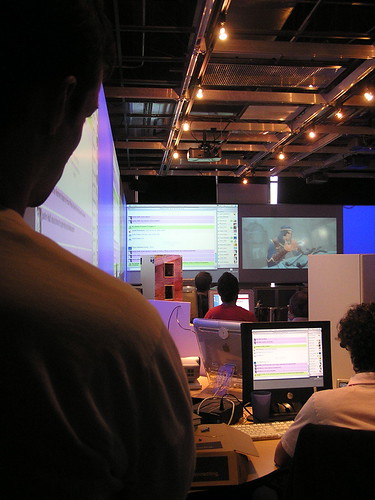
I'm going to try not to say too much about the visit of the team from Grand Text Auto to UCI right now and the installation, symposium, and performance associated with their visit to the Beall Center, since I've assigned my students to write about their impressions for the class blog. These undergraduates might not have been as willing to explore these unfamiliar interactive narratives as Mark Marino was in trying out a 3D reconstruction of Facade, as shown above, but they were certainly enthusiastic spectators.

But there were enough references to "rhetoric" and "expression" during the day, that it seems wrong not to document the events of last Friday. So check back here next week for more of a write-up, after I've given others their say.

We're actually teaching Aristotle this month in the Humanities Core Course, so I'm particularly conscious of the ways that rhetoric can be seen as a set of rules or procedures for carrying out discourse, much as computers operate formally and procedurally. Most interesting in this regard were perhaps the two performances of Terminal Time by Michael Mateas in which the computer selects from thousands of historical facts and hundreds of video clips and images to create a documentary about the last thousand years that responds to the audience's input and their preferences, which might be shaped by ideologies about gender, race, class, or other influencing factors. As Matteas explains it, the computer must also be a rhetorician, since the program is stocked with tropes and phrases to create causal connections between chunks of assembled material that would otherwise appear logically disconnected. See below for photos of a performance of the hypertext narrative The Unknown with VP pal Scott Rettberg.

Labels: , ,

Saturday, September 29, 2007

What You Can't Put Down

Yesterday's Op-Ed in The New York Times encapsulates much of the discussion that's been going on at international game studies conferences for the past few years. In "The Play's the Thing," Daniel Radosh complains that videogames are failing to evolve, even as they produce more visually dazzling graphics, because players are ultimately let down by games that rely on cinematic cut scenes and derivative media that are graphics-intensive rather than process-intensive and thus defer interesting design questions about creating original player-experiences of procedural play. This isn't news to anyone who has heard Greg Costikyan, Warren Spector, Raph Koster, Scot Osterweil, or anyone affiliated with the studio producing Will Wright's Spore at a conference, but it may be a new argument to readers of the mainstream press, where video game reviews still play a relatively minor role in comparison to film criticism.

What I thought was interesting was how Radosh tried to convey the gripping qualities of the two big critically acclaimed games of this summer: BioShock and Halo 3. As I write, BioShock is next to me at my PC, since I write about games of crisis and contamination in the context of government media production. Sadly, I have to put off installing it in my machine, given that I have two articles to deliver in the next two days. One of the ironies about Radosh's criticism of the dearth of games that are "profound" and "resonate" with players is that one of the games that's winning awards and critical attention for doing this -- Bill Viola and Tracy Fullerton's The Night Journey -- owes some of its user-friendliness to Halo 2.

The relationship of perceived addictiveness or intensity or immersion in game play to media merit is certainly one in literary studies as well, in which "page turners" rarely make it into the canon.

Labels: , , , ,

Wednesday, September 12, 2007

Sob Stories


One of the most cohesive panels at Hypertext 2007 was the panel about “Hypertext Tragedy.” Nick Lowe (who also happened to have a cool keyboard) introduced the subject with a good overview of the genre in the classical world and the argument that Aristotle’s Poetics was “XML for literary theory.” He also provided an interesting meditation on print culture, in that it was Aristotle’s works that weren’t intended for publication that happened to survive. Much of his talk was devoted to less relevant – if anecdotally engaging – examples of creative misreadings of Aristotle with “the unities,” the “tragic hero,’ the “fatal flaw,” and anything written by screenwriting mentor Robert McKee. Following Lowe, Kieron O'Hara, the author of Plato and the Internet presented an analysis of twentieth century tragic models. Then one of our Manchester hosts, Dave Millard, attempted to answer the question “Why is Narrative Important to Engineers?” He argued that it was both potentially profitable as a research area to be retasked for the game industry and that it had cultural value since humans were “storytelling animals” who gather around the water cooler for critical exchanges. He showed some of the classic rhetorical circuit diagrams in his PowerPoint presentation and then turned the podium over to hypertext author Emily Short. She looked at examples of computerized text adventures that could fit into the paradigm of the tragic genre, including Shade (a dark favorite of my Facebook friend Jeremey Douglass about death by thirst), Rendition (about a torture scenario), and other examples.

Labels: , ,

Saturday, April 28, 2007

Boo!

This morning I poked around Amnesty International's House of Horror, an interactive Flash site designed to raise awareness about human rights abuses by taking the viewer through two spaces: one, a well-lit and coherent view of what appears to be a decaying torture facility, and a second viewer-driven experience of a dark room lit by a match, where one is encouraged to use the computer's arrow keys to find the source of a given sound.

It's an interesting premise for a number of reasons. At the Philosophy of Computer Games conference, which was held earlier this academic year in Italy, there was considerable talk about how papers were privileging sight and weren't giving enough consideration to games of darkness, blindness, or text-driven games. In connection with the publication of Second Person, there was also an interesting panel that discussed the differences between text-based and more "intuitive" arrow-key interfaces in the similarly claustrophobic text-based experience, "Shade."

Unfortunately, the actual site reminds me more of a right-wing Christian "Hell House" in which socio-political spectacles of horror pop up unexpectedly. It even included a stock character in such haunted houses, the drug addict. Both times, when trying to follow the sounds of moans and groans in the blacked room, I got to "Lizzie, a 28-year old prostitute lost in her addiction to drugs."

Labels: , , ,

Wednesday, April 04, 2007

Second Person


Tonight I sat in on an evening of discussion around "writing and gameplay" to commemorate the book Second Person with Noah Wardrip-Fruin, Jordan Mechner, Mark Marino, and Jeremy Douglass.

Although Mechner was there discussing the challenging of turning a videogame -- Sands of Time of the Prince of Persia series -- into a feature film devoted to more than killing monsters, he's done work that celebrates the regional and the political in his documentary Chavez Ravine. Mechner, like many of the other presenters that evening, was interested in the procedurality of a "bad choice," which in the case of completing a puzzle that activates the castle's defense system, may be your only one. The way that choice-making still remains dramatically important, even when the media is no longer an interactive one, could be seen as one way to approach the old Narratology vs. Ludology debate.

I had seen Marino's 12 Easy Lessons to Better Time Travel before, but I think his choice to combine it with course management software was a witty improvement. Obviously, as someone who sat through nine hours of Tom Stoppard's The Coast of Utopia, I have a lot of patience with nonlinear plots, but Marino's sense of humor serves the project well. As someone fascinated with chatbots going back to the "Horses of Elberfeld," I also liked the fake interactivity of his chatbot in the story "Ticky." (Marino also created monologues for the notorious Grand Theft Auto game that include an army recruiter, a driver's ed instructor, and a controlling Italian mother.)

In keeping with the "bad choices" theme, Douglass discussed the text-based interactive work of fiction "Shade," which takes place in the existential trap of an apartment. Audience member and innovative game designer Tracy Fullerton, however, talked about the problems with the game interface and its irritating protocols that make the equivalent of tying a shoe into an elaborate algorithm of discrete instructions. Douglass didn't disagree that this lack of intuitiveness could be frustrating, but he did advocate for the pleasures of this particular form of literacy. With other audience members, there was also some discussion of the much lauded "Facade," in connection with the question of whether it was a true story simulation or merely a chatbot.

Wardrip-Fruin is also hosting what looks to be a great panel with Jesper Juul and Judith Faifman at UCSD on the 18th. Info is here.

(Picture above courtesy of Jenny Cool of The Participant Observer.)

Labels: , , , , ,