Tuesday, April 23, 2013

Feminist IT: Legacies (Leigh Star, Beatriz da Costa, and Anne Friedberg)

The Feminist IT conference devoted time to celebrating the legacies of three feminist scholars who represented the group's commitment to doing interdisciplinary work and the interpersonal networking that supports such field building.  Since members of this assembly do research that crosscuts "STS (science and technology studies), film and media studies, sci-art, digital humanities, informatics, and critical media practice" it was also important to emphasize exemplary thinkers who worked in the different traditions of ethnography, media arts practice, and archival criticism represented at the conference.  (In my opening I noted that it was an assembly both in the sense of representing multiple delegations and in the sense of the term "some assembly required.")
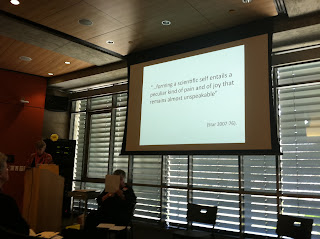


Leigh Star was remembered by Adele Clarke and Martha Lampland.  Clarke noted how Star was a polymath who worked on neuroscience, artificial intelligence, and ecologies of knowledge, but she also humanized her by describing her personal struggles and by showing her at leisure in photos interacting with different types of environments, including a palm tree oasis. Ever the responsible pedagogue Clarke provided a handout and began by providing context for Star's work in Ecologies of Knowledge. She argued that Star rewrote the narratives of scientific discovering by presenting scientists as "citizens neither villains nor heroes" and asked fundamental questions like "Who is doing the dishes?" or "Where is the garbage going?" or "Who owns the means of knowledge production?" This focus on everyday practices, organized what Clarke called her "work commitment."  She also spent some time trying to demystify the "boundary object concept" that was a critical part of Star's intellectual legacy.  She showed its roots in pragmatist philosophy, in the Chicago School, in And in Anselm Strauss's theories about social worlds and arenas, and in the Everett Hughes classic, The Sociological Eye.  Star's conception of workplace as a site of "cooperation without consensus" continues to be extremely influential, and -- as Les Gasser notes -- two thirds of the citations of Star's work actually come from computer science.   Clarke also cautioned that Star's seminal work on "Institutional Ecology," which looks at negotiations among professional and amateur communities working with taxidermy specimens in museums, appears in science studies readers in abridged form.  Often overlooked was the fact that boundary objects are "loosely structured in common practice" and "a sort of arrangement that allows different groups to work together."  She also pointed out that her work on "boundary infrastructures" in Sorting Things Out (co-authored with partner Geof Bowker) was important to consider.  Clark said that "interpretive flexibility" tends to get more attention than structuring and processual dynamics.  She also remarked on the role that "lack of fit" played in creating new boundary objects.  She then focused on the importance of the concept of "torque" in Star's work as a "twisting of time lines."  Clarke closed by returning to the diversity of experiences that Star's life represented, which included "the importance of  writing poetry and fiction" as well as the fact of "being allergic to onions" in a life of "drinking and dancing" as well as "mentoring and loving." In the slide above we see Clarke citing Star on how "forming a scientific self entails a peculiar kind of pain and of joy that remains almost unspeakable" (Star 2007: 76).

Lampland began her remembrance by emphasizing how Star engaged with "fighting for social justice" in ways that recognized the complexity of causes and consequences.  For example, the SAT could be both the test that allowed Star to attend Harvard University without class connections and a potentially discriminatory gatekeeping examination.   Lampland, who co-edited Standards and their Stories with Star, admitted to occasional disagreements and also asserted that Star's method of quickly being able to identify commonalities did not necessarily contradict an engagement with sustained empirical research.  She also emphasized the "mistake of championing transparency" that "could hide what doesn’t fit."

Antoinette LaFarge, who described herself as fortunate to benefit from colleagues in the UC Irvine "brain trust" who have been part of FemTechNet, then remembered critical sci-artist Beatriz da Costa in a talk called "Less Dismal Science" that made a number of implicit connections to the previous discussion of Star's work by noting the role of "standards," "tools," and situations" in her art.  Beatriz da Costa co-edited Tactical Biopolitics with Kavita Philip, one of the PIs for UCFemTechNet, and she was part of conference planning until her untimely death from cancer.

In unpacking the art practice of "Shani" (the name she preferred to Beatriz), LaFarge described how da Costa's projects were often designed around hands-on workshops and situated in a participatory ethos from her beginnings in Critical Art Ensemble.  LaFarge chose to analyze da Costa's work in relationship to Nietzsche's The Gay Science and Carlyle's The Dismal Science to consider science as an end not a means and critique science's "offer for radical truth," which Avital Ronell also challenged in The Test Drive in questioning the ostensibly sovereign presence of truth in science, politics, and religion and the compulsion to dis-identify and deny attachment.  LaFarge also argued against scholars "strip mining Nietzsche" without attention to his chauvinistic remarks about how women are weak, conniving, and characterized by disgusting natural functions and his ideas about the present moment as a time of virility.

In an oeuvre that included microbes, biodiversity, air pollution, RFID tracking, and genetically modified food, da Costa engaged in a series of public actions oriented around expanding the notion of citizen science in ways that were mutually positive for creators and participants.  For example, LaFarge pointed to her work in Invisible Earthlings with CO2-sensing yeast colonies and in Pigeonblog undertaking a "collaborative endeavor between homing pigeons, artists, engineers and pigeon fanciers engaged in a grassroots scientific data gathering initiative."  Like other speakers, LaFarge acknowledged the presence of disagreement among feminists, and the fact that her friend and colleague thought that LaFarge's interest in "computer games was a complete waste of time."   The difficulty that Beatriz da Costa addressed was described by LaFarge as "how much has to be left out in order to make an argument" and "how test results are used to conceal a lie."  Visitors to the conference were encouraged to visit an installation of da Costa's Dying for the Other in the Consume show at the Calit2 Gallery, which interrogates the relationship of the dying artist to the mortality of laboratory animals. 


The final tribute was devoted to Anne Friedberg.  Co-organizer Lisa Cartwright actually had Friedberg as a teaching assistant and recollected being given names like Irigaray, Cixous, Althusser, and Mulvey by this early mentor.  Heidi Rae Cooley gave a tearful and moving remembrance of Friedberg that drew upon the memories of Sheila Murphy as well.  She emphasized the radical rewriting of four centuries of the history of perspective that Friedberg undertook that went far beyond how the work of film historians was traditionally constituted.  (See her digital companion for The Virtual Window for an interactive version of her argument.)

Friedberg founded both the UC Irvine Ph.D. Program in Visual Studies and the IMAP program at USC and launched the careers of many interdisciplinary students.  Cooley pointed to Mark Sample's essay "When Service Becomes Scholarship" to explain the depth of Friedberg's contributions and how she made public and circulated the work of others, even "taking in freeway fliers" who were normally outcasts at the university or sitting on information technology committees.  She also discovered talents by recommending people for one-year contracts that later developed into long term institutional presences, as she did for Daniel Herbert who chronicled the rise and fall of the video store.

A particularly beautiful and lyrical moment in Cooley's talk came when she described how Friedberg made homemade temporary tattoos with "SCMS" for the Society for Cinema and Media Studies when the "media" part was still new.  Friedberg also took on DIY with gusto by making her own pamphlets for an improvised MIT Press booth, since she was not one to hold herself above others, according to Cooley.   As in the case of the other founding mothers remembered, we learned much about the details of Friedberg's passions worthy of remembering: Gil Sans as Friedberg's font of choice, Conan Doyle on camera, stuffed Furbees speaking Furbish, writing about the Aibo robot dog, and Vaucanson's infamous duck.   Although Friedberg changed theories of "windowed visuality" and the mobile virtual gaze, she also recognized the temporality of the apparatus and the impermanence of institutions.

Note that attendee Wikipedia maven Adrianne Wadewitz periodically reminded conference participants that they could improve these three women's entries on Wikipedia.

(Photos from Lisa Parks)

Labels: , , , ,

Friday, April 19, 2013

Feminist IT: Infrastructures


The Feminist IT conference devoted to "Feminist Infrastructures & Technocultures" featured a number of prominent feminist scholars of technology in the morning sessions, which were devoted to questions about infrastructures and legacies.  With over three decades of scholarship to draw upon and a strong concentration of work done in the University of California, this conference tried to facilitate more conversation between people doing interdisciplinary work, specifically those who might be positioned in either the Society for the Social Studies of Science or the Society for Cinema and Media Studies.

In my opening welcome I pointed to the work of fellow organizers and panel moderators who approach questions about mediation from the perspective of material culture, the study of the apparatus and embodiment, and engagement with particular communities of practice, such as Lisa Cartwright on 3D printers that can produce guns, Lisa Parks on drone vision, and Kelly Gates on the truth claims of facial recognition technologies and surveillance footage, which have been much in the news this week in the wake of the Boston Marathon bombings.  I also noted that the particular context of public institutions devoted to big science provides affordances as well as constraints for this work on "making science, designing culture, shaping the technological imagination, sorting things out, and determining 'the right tools for the job.'"

The UC FemTechNet group is a regional research offshoot of the larger and more distributed FemTechNet initiative currently archived at the FemBot Collective and slated to move to new space at a FemTechNet site at The New School.  Many of its members use the UCFemTechNet Facebook page as a site for cross-campus coordination and introductions, although there is also a mailing list for announcements.

The opening panel featured a dialogue between Anne Balsamo and Chandra Mukerji about infrastructure that focused on their shared scholarly interest in uncovering women's roles in the labor force of expert knowledge workers who played a key role in shaping the technocultures of the modern administrative state.  Balsamo famously wrote about how her mother was a "computer" or person who performed mathematical communications, a topic that I also wrote about in the last chapter of the Virtualpolitik book and that was memorialized in N. Katherine Hayles' classic text My Mother Was a Computer.  To commemorate the occasion, we included a non-human participant on the panel, "Nancy," the actual type of comptometer that Balsamo describes.  (The machine is literally labeled "Nancy," presumably with the name of its former operator.)

The first question posed by disability activist Louise Hickman asked "How can we slow down time to shape participation in discussions?"  Mukerji, who does research on how female engineers played a vital role in hydrology projects in Bourbon France, laughed about the fact that mostly she lived in the 17th century and was well aware of how time functioned as a technology as well, particularly when the cyclical time of women's labor differs so radically from linear time.  Balsamo talked about how members of the FemTechNet initiative struggled to coordinate with each other and talked about how to align schedules at professional scholarly conferences in order to gain critical mass.  Balsamo also recast Marx with feminist temporality, by pointing out that women make the present and the future, but not under conditions of their own making.  Temporality has also been a concern for the panel's third moderator, Lilly Irani, whose recent work on hackathons looks at the bias toward action in the compressed time of such events.

In addressing the main topic of infrastructure, which Mukerji defined as the "structure of impersonal rule," panelists discussed how even social infrastructures, such as laws and regulations, had connections to material culture, in that they were written down.  Balsamo acknowledged the work of Leigh Star and many other feminist scholars who published important work on infrastructure, as as way to think about the challenges and opportunities of feminist networking.  As Mukerji pointed out, the actions of largely female staff members in human resources charged with the Weberian task of the maintenance of files, played a more important role in implementing affirmative action than any piece of legislation or judicial decision.  Codes of politeness that allow flexibility in infrastructure that make continual function possible are also infrastructural, as I noted, where women's labor also mattered.  Such codes are also important to FemTechNet, as are the peer promotion practices of those who might be maintaining tenure and promotion files, but the object-oriented character of the panel was also emphasized with Mukerji's object, which was also passed around, a rock and leaf to demonstrate the laundry techniques that she argued were important for understanding the cultural innovations associated with daily life.  (She is famed for arguing that the Canal du Midi is much more than the sole achievement of Pierre-Paul Riquet, a tax farmer and entrepreneur, because it was also the product of collective intelligence, depending on peasant women and artisans--unrecognized heirs to Roman traditions of engineering--who came to labor on the waterway in collaboration with military and academic supervisors.)

Labels: , , ,

Saturday, July 03, 2010

Reporting for Duty


After a decade as the Writing Director of the Humanities Core Course at UC Irvine, I will be moving on in the next academic year to UC San Diego, where I will direct academic programs in the Culture, Art, and Technology program at Sixth College. I'll be teaching courses on new media and digital nonfiction on that campus. I will also be exploring new approaches to interdisciplinary instruction and teaching with technology and developing pedagogical collaborations with Calit2 (the California Institute for Telecommunications and Information Technology) and CRCA (the Center for Research in Computing and the Arts), so it should be an exciting year.

Labels: , ,

Wednesday, June 04, 2008

Orders of Magnitude

I have a friend, cosmologist Ned Wright, who studies the universe. He teaches a graduate course in astrophysics at UCLA called "Order of Magnitude." As I understand it, the point of the class is to have the student who is assigned a problem not reach an actual definitive numerical solution, as laypeople might expect experts to do, but merely approach the correct "order of magnitude" for the situation involved. After all, when you are studying the universe, knowing the right order of magnitude can be the critical piece of information.

This kind of thinking may be more common in the sciences than in the humanities, but today's expansive talk about "Cultural Analytics" by Lev Manovich was designed to address these kinds of questions of scale as they apply to the millions of objects of study of interest to those in the humanities. Like Franco Moretti, Alan Liu, Todd Presner, and other faculty on California campuses, Manovich has become associated with ambitious plans for data visualization that involve multiple times, places, texts, and artifacts. Although he didn't get to it in his disquisition on "crazy ideas," he has also been affiliated with the Blue Brain project in Lausanne, which has been working on elaborate brain simulations that give researchers over thirty million synapses with which to experiment.

Manovich established his ethos with the largely undergraduate audience by citing his own social networking credentials, which he said included a presence on Facebook, MySpace, and Flickr. Laptop-bearing students were soon checking out his various online personae as he talked. He frequently situated social media in relationship to discursive exchanges, such as the "conversation around" "production, reception, distribution, remixing, uploading, and downloading" and the need for an "intelligent discussion about cultural production."

Although he's a major figure in the field, in the past I've criticized Manovich for discounting the importance of the rhetorical in software studies, particularly in one regrettable passage on page seventy-seven in the otherwise excellent The Language of New Media. But Manovich has clearly come a long way on the subject since the book's initial publication in 2001, as evidenced by his inclusion in the Software Studies group of Ian Bogost, known for his theories of "procedural rhetoric," and Michael Mateas, who recently gave a talk about the relationship of "code machines and rhetorical machines."

Manovich sketched out what he had seen of a "culture mediated by software" since the end of the Cold War in 1990. Along with the rise of user-generated content, he drew attention to a
"shift in production tools" as designers and editors across the globe embraced common proprietary software packages such as Final Cut Pro, Flash, After Effects, Maya and 3D Studio MAX.

Rather than be "interested in particular masterpieces" of our era, Manovich argued that we should be interpreting the emergent software techniques "as a kind of language" like "Chinese or English in the 10th century." He described himself as intellectually engaged with such "global cultural flows and patterns" as a way to understand what affects our imagination. Scholars, he insisted, should be doing more than just "using intuitions," which -- in the case of more traditional film faculty -- might be based on nothing more than arbitrary "subscriptions to Netflicks" from which one can "try to make some theories." He reminded his audience that "none of us have the physical ability to see" more than ".0001 percent of what is produced." Thus, Manovich asked, "How can we have an intelligent conversation about contemporary cultural production?"

(For another perspective on the problem of the mathematical sublime in digital research, see this talk by Jeffrey Bardzell, which argues that there are limits to the relevance of number-crunching in interpretive fields.)

To solve the problem, Manovich said that he had coined the term "cultural analytics" three years ago. Unlike conventionally "small data sets" used in the Humanities, such as "classical Hollywood cinema" and "Italian Renaissance," he suggested that we should be looking across genres, cultures, traditions, disciplines, and types of subject matter with very large samples in mind. He argued that the Humanities should follow the lead of "linguistics, economics, life sciences, and genetics" and be working closely with "huge amounts of data."

During his talk, he launched into a series of examples, illustrations, anecdotes, hypotheses, mock-ups, and prototypes, many of which were derived from his enviable jet-setting lifestyle as an arbiter of academic taste. (Unfortunately, not all of us can get away with wearing black leather to work, although -- as this blurry image shows -- Manovich apparently does.) For example, he asserted that a country like Japan "had culture as its most important export." And he showed a slide of a map of fashion weeks that already had covered the globe in 2005 to illustrate the concept of "global culture space."

In Manovich's vision of the world, it seems that "everybody has access to the same cultural software." Moreover, the mobile students that he meets across the globe might be "working in any other city" when they grow up. Of course, Manuel Castells has argued that there are still certain kinds of more subtle "digital divides" with which to contend, particularly between "the interacting" and "the interacted upon." As someone who studies digital rhetoric, I have noticed that 3D models, animations, simulations, and games have significant rhetorical force as means of persuasion in the public sphere. There are many genres that incorporate these cultural imaginaries.

For example, the software package Maya may be used to create digital film effects, buttress a scholarly argument in archeology or evolutionary biology, provide an illustration of the testimony of an expert witness in a courtroom, reenact a violent altercation in news coverage, elaborate a proposal for urban development, churn out gimmicky graphics in advertising and corporate promotion, provide hyperreal imagery for satire or political rhetoric, and build CGI environments for spectacle, deliberation, and pedagogy. Yet I've watched relatively sophisticated designers and computer users open Maya on their desktops as novices, and for them it might not be easy as autodidacts to "drive it around" for the first time without crashing into a few things while they are at it. Thus, even less computer-literate citizens are unlikely to be able to assess how this software creates artifacts of visual culture that may be constrained (or enabled) by certain features. The way that proprietary software may manifest certain architectures of control is worth attending to, as is the fact that young designers in the United States -- even those on U.C. campuses -- often don't have access to machines with these programs because such training is relegated to vocational institutions.

Manovich opined that the "humanities is the one area that isn’t globalized," and he noted that professors of English rarely come from India and China unlike the faculty in other disciplines. Speaking metaphorically, he talked about this circulation of information as being "like a new ecology" in which "cultural ideas spread like viruses." In contrast, he noted, "When I was growing up in the Soviet Union," one needed "access to a special library" even to read the works of Freud.

Manovich observed that "social activities leave digital traces" and that while a cellular telephone provider like Verizon may "only keep this information so they can bill you," many other kinds of data about communicative actions are being tracked for many possible purposes. Because "all this information is digital," it is possible to see the "digital shadow" that constitutes having a "public persona" with a "cultural identity." As he also noted, artists can use similar software to provide an alternative to corporate-controlled tools for data visualizations. (For more on this concept from another source, see "disruptive technologist" Virgil Griffith's work on "amateur data mining.") To illustrate Manovich's point about how these digital traces can be assembled into a "trend history," he showed a sample result screen from Blogpulse live that included "diaries" and "memes" along with "sports" and "politics" as a categories with which to understand our current fluctuating economy of attention or "mindshare."

Manovich also argued that one could no longer visit a few cultural capitals to know what might be happening in painting or architecture, because of the presence of young artists and designers who are "hungry for knowledge" in places around the world, such as Singapore and Mexico City. As opposed to the argument in Thomas Friedman's popular 2000 book, The World is Flat, Manovich is making what he called an "Inverted World" argument in which speaking English, using the same software, having access to the Internet, and being able to fly on discount airlines (which he admitted may be an era that is ending) means that "the margins are taking over the center." He noted that the U.S. is now far behind many other countries in its broadband access, and that whole countries -- such as Estonia and Singapore -- have free wireless, which he attributed to the fact that there are "thirty-five and forty-year-old decision makers" rather than "elite cultural institutions run by seventy-year-olds."

So "how do you tell the stories," Manovich asked, when there are no longer "a small number of capitals and schools"? He continued this line of inquiry by asking the following questions:

Can we create quantitative measures of cultural innovations? Can we have real-time detailed interactive maps of global cultural production, consumption, remix, and collaborations?
Can we visualize flows of cultural ideas, images, and trends?
Can we visually represent how cultural and lifestyle preferences – whether for music, forms, designs, or products -- gradually change over time?

After lobbing out these questions, he asked if it were possible to use interactive graphics to "predict future development" as well. As he said, the humanities tends to be occupied with "interpreting the past," which "doesn’t make for a dynamic field." He argued that humanities scholars could be "prototyping the future" in ways that would be much more ambitious than the kind of marketing model currently in use to sell commercial products such as Lexus cars. According to Manovich, "the joint availability of large cultural data sets" that is growing exponentially and being facilitated by the digitization efforts of museums and libraries makes it possible to treat "culture as data" and study "social media that can be mined and visualized."

To introduce the work that he was doing with the HIPerWall, he emphasized the concept of "situational awareness." He pointed out the irony that there were "innovative solutions for command centers" for security and for the military that capitalized on new computer interfaces, and yet history lectures were little more than a matter of showing "two slides and then two more slides." He argued that this technology could be used for more than visualizing obvious needs like "global patterns of global warming or economics" by being applied to a kind of "real time traffic display" for cultural production.

He pointed to the work of researchers working with anime music videos, commonly knowns as AMVs, and suggested that computer vision software would be able to manage the hundreds of thousands of videos and identify ones that are "statistically improbable" through descriptions and markers. The data aggregated could include fan-creators, places of origin, video lengths, years of composition, and even original authors, although this marker of initial intellectual property ownership also raised the issue of potential copyright policing by multinational media conglomerates, which could prove to be repressive to the very cultural production being studied.

Manovich indicated that the model of history promulgated by important thinkers such as Foucault and Kuhn frequently presented cultural production over time in terms of breaks and radical reconfigurations. Inspired by the example of calculus, he also argued that it was important to be able to visualize continuous functions as well, such as how "hip hop becomes techno."

In his HIPerWall slides, Manovich was careful to resist overemphasizing either high or low culture. For example, in one visualization, the object of study seen in close-up was a twin photograph of similar postmodern dual skyscrapers in different cities; in another image he showed contrasting "vernacular architecture" from Mexico city and paid tribute to the cultural contributions of favelas and shantytowns. Unlike Jane Jacobs, who dismissed "pervert parks," such as the one in Philadelphia, Manovich indicated that he wanted to include cultural production that leaves "no glamorous traces in public squares," which may include the work of "sex services" and "servants," as well as social service agencies. Further on in his lecture, he discussed how Amazon.com could be mined for "books about the Iraq war" to show "different genres" and "connections between different books."

At one point, Manovich also showed a citation matrix derived from the Web of Science in which different colors represented different disciplines. As he wryly commented, "people in the humanities don’t talk to anyone." He also displayed how this distribution could be visualized in terms of different countries. From this example, he suggested a kind of "art project" that looked at "influences" rather than producing a paper with clear citations. What he suggested was what he called "relationship maps" that showed a "response to particular aesthetic or cultural teachers," which could encompass oppositional patterns, images, metaphors, camera moves, and types of characters in computer games. As Manovich implied, such influence maps might free humanities scholars from the simple-minded periodicity that goes from "early" manifestations of a given phenomena to the cultural product in "decline."

He concluded by looking at his own undergraduate teaching and the ways that students in one class can work on visualizing data sets created by students in a previous class. To build from more simple stages to an eventual “global educational platform,” Manovich used freely available tools at Many Eyes for starters. He also showed how students mapped "connections between subcultures" that visualized how "people connected through cultural brands" that could be sliced according to "casual" or "trendy" orientations.

As an academic married to a designer, I think that I know what Manovich means when he talks about the million or so people who serve as "cultural producers" on this planet, since even my teenager creates street art and mixes beats in ways that have involved mentoring from professionals at Cal Arts and the Grammy Foundation. By having some sense of the connections between members of this distributed population, however, I wonder how much this kind of first-stage mapping can reveal of the often substantive covert connections between persons and even between their ideas.

In other words, will only collaboration be visualized in Manovich's cultural analytics? What about competition, which also serves as an important creative engine, particularly in battling niche technologies? Even seemingly counterproductive dynamics like pecking orders and petty rivalries are important in artistic and activist communities and large bureaucratic organizations alike. Furthermore, should Manovich's Web of Science visualization eventually include less obviously institutional forms of relatedness and tag individuals who are spouses, ex-lovers, childhood friends, and classmates to help novices with navigating the social landscape of public intellectuals?

Finally, what about software that doesn't just represent how social actors are related but fundamentally determines the nature of their relationship? Right now we might not think much about how the algorithms of social bookmarking and social networking sites may connect cultural producers, but in the future this might actually be important. For example, what is my kinship to the conference chair and editor of scholarly publications that I happened to have dated at sixteen during the punk rock era with whom I reestablished contact after the Amazon.com algorithm suggested that I should be interested in his work on cyberspace? In many ways, the latter connection of the marketing logic of the online bookseller is much more important to us in our present collegial (and platonic) relationship than the former tie. And what about Alice Robison to whom I am closely related in Facebook genealogy, although we have never met in person? See my blog posting and her blog response to see the nature of our kinship and how the interface design of the social networking site brought us together.

This talk also concluded Peter Krapp's Software Culture lecture series at U.C. Irvine, which was covered here, here, here, here, and here. Regular readers in the lay population can now look forward to summer and three months without conferences or talks during which I can provide more coverage of public displays of affection, taxpayer-funded cartoon characters, awards for really bad government websites, and even information about the erstwhile subject of this blog: institutions as digital media makers, such as universities and government agencies, who must simultaneously serve as regulators and content-creators.

Labels: , , ,

Wednesday, May 21, 2008

Speed Dating

To my regular readers, I apologize.

I'm afraid I've written a very long post about a series of very short presentations.

In any case, I've decided that I suffer from attention surplus disorder, so that all attempts to enlighten and entertain me in faster formats are inevitably lost on me as an audience member.

In the upcoming Virtualpolitik book about digital rhetoric, in the chapter about PowerPoint, I write about the transnational "pecha kucha" speed presentation style that the lore says was developed by Astrid Klein and Mark Dytham for designers and architects in Japan, which has since become a global phenomenon. I still have yet to see a real full-blown pecha kucha event, but this year's "SoftWhere" conference at the Software Studies Workshop was intended -- at least in principle -- to emulate the image-laden twenty-slides-of-twenty-seconds-each ideal. I'm also reading the new book Software Studies: A Lexicon this week, which incorporates selections from many of the presenters, so I made sure to make the trip south to attend this pre-HASTAC event at UC San Diego today.

Although a surprising amount of Warren Sack's talk was strangely taken up with images of book covers, such as The Postmodern Condition or Machine Dreams, he did have a number of provocative observations about the difference between what he called "digital ideology" and "digital life" or the vernacular experience of daily culture. As Sack described this cultural shift, “It is not only possible but usual” for a person to be in "two places at the same time." He also noted that area codes no longer indicate "where we live" but rather "where we bought the phone." For those teaching the grand narratives of the Western canon, such as my colleagues in the Humanties Core Course, Sack argued that certain kinds of stories about epics, quests, allegories of being lost, and separation from family members may eventually become "strange to future generations" with GPS-enabled cellular telephones and other ubiquitous computing devices. Sack claimed that "the digital" is "not just a condition of scientific knowledge" but a phenomenon that changes what we know as "common sense.” Of course, given the black-box nature of many programs and the ways that popular culture often mistranslates ideas from computational sciences, there are ways that this "common sense" can also be read differently.

When Sack argued that there was a critical role to be played by software studies to get beyond what he characterized as the limitations of “the aesthetics of computer scientists," he was using a very specific disciplinary lens intentionally to further his critique of those who generally teach software in the academy. For example, his definition of "functionalism," which for Sack was a negative term, hearkened back to Adorno's criticism of early twentieth-century art that eschewed ornament and yet couldn't recognize that avoiding style was a style itself, and effaced the role that the word "functionalism" has played in cybernetics and systems theory. In our discussion afterward, Sack quite reasonably argued that these interdisciplinary discourses between anthropologists and information scientists ultimately played a relatively minor role in teaching computer science as a profession and that it was necessary for artists to assert their pedagogical role as well. In his talk he argued that software instruction was often limited to "speed," "efficiency," and "correctness" borrowed from the worlds of business and mathematics, and that even concepts like "interactivity," "user-friendliness," and "realism" were generally treated in a cursory manner.

When it came to pretty pictures, there was much more to be seen in the presentation by conference impresario Lev Manovich, who shared his cosmopolitan impressions of the "new architectural and spatial imagination" Given the current fascination among academics for DIY production, Manovich made a particularly apt point that all the "excitement about amateur content" misses the importance of the role of the "global professional culture universe" in shaping a "software society" that may be distinct from a "knowledge society." This interest in "support networks" and "contemporary lifestyles" creates a somewhat different transnational map of the culture industry from the narratives of Manuel Castells and one that is oriented around design questions dear to my heart, such as this blog posting that asks about why one of my favorite things in the world (literally) can't be better designed: the overly humble hotel minibar. Manovich seemed to be almost riffing on Henry Jenkins's famously fan-oriented invitation to the reader, "Welcome to Convergence Culture," with his own explicit "Welcome to Cultural Analytics" after he sketched out seven trends. As he pointed out, statistics are becoming a part of "personal life" for many people in social media environments where data can be mined and graphed.

In the visuals for Ian Bogost's talk, there wasn't as much evidence of the rhetorical way he uses his Leica, but it was a noteworthy presentation nonetheless, which previewed his upcoming MIT Press book, c0-authored with Nick Montfort, in the new "platform studies" series. As a person trained in the study of literature, Bogost is well aware of the importance of "material constraint" to "expression" and cited a range of examples that included mnemonic devices for oral-formulaic poetry, the language experiments of the Oulipo, and the chemical properties of film emulsion. Bogost also offered a helpful taxonomy for software studies at which my work tends to be at the upper and -- probably fair to say -- superficial level: 1) Reception/operation 2) Interface, 3) Form/function, 4) Code, 5) Platform.

In the book with Montfort, Bogost looks closely at the Atari system and how cost considerations played a role in how software was written, particularly because of the position played by a piece of equipment called the television interface adapter or TIA. Because the early Atari lacked a frame buffer, the programmer had to construct every scan line and thus create displays that depended upon rows of color. Bogost argued that this was particularly significant because it shaped the very genre of many seminal games. In the case of the adaptation of Adventure, which had been a text-based game, these constraints were particularly important in shaping the history of videogame design.

This engagement with what has been for too long denigrated as "technological determinism" continued with the next presentation by Anne Helmond of the Institute for Networked Cultures, which sent me a wonderful surprise package of their publications a few months ago, thanks to Geert Lovink. Helmond is involved in research that looks how blogging engines may be shaping the very rhetorical practices of blogging itself, particularly when it comes to the topographies of what has been called "the commentosphere." On the practical level of pedagogy and publication, Cynthia Nie also discussed this issue at a meeting of the Digital Educators Consortium in December of last year.

DEC colleague Mark Marino followed up with a presentation about work being done on the collaborative blog Critical Code Studies. However Marino was also willing to undermine the gravitas that otherwise might be claimed by his new field by joking about the pretensions of yet another the field in the Critical _____ Studies mold, which The Valve has called the "Critical X Studies" paradigm. Certainly, as someone affiliated with the Critical Information Studies movement with Siva Vaidhyanathan, I also find myself interrogating this model as well. At the end of the Virtualpolitik book, I look at how postwar "Information Science" became "Information Studies" and the resultant loss in ithe field's interdisciplinary ambitions and possibilities for collaboration, so that -- although this move away from the absolutist ideology of science may have been salutory -- it also came with certain costs in that it encouraged a centrifugal tendency toward intellectual fragmentation. Marino also reminded audience members of how Espen Aarseth pushed against the colonization of game studies by critical theory. Although Marino felt that including "rhetoric, economics, and politics" is important, he is willing to acknowledge his own anxiety that maybe it is it all "just a metaphor." As Marino said, “Why don’t I just use cooking?” as a semiotically rich code system through which to understand the world.

In "#include Genre," Jeremy Douglass, Marino's frequent collaborator at the blog WRT: Writer Response Theory talked about the role that "quotation, intertextuality, and transclusion" plays in understanding how particular genres of digital media evolve. As models, Douglass looked at Raph Koster's work on the development of the 3D shooter or Jesper Juul's research on matching tile games.

Since media theorist Benjamin H. Bratton is recently the editor of the study of Paul Virillio, Speed and Politics, it was perhaps somewhat ironic that the accelerated pecha kucha format seemed to undermine the impact of his idea-rich talk, which was often illustrated with stock figures whose eyes were covered with anonymizing rectangles. On the Tarde/Durkheim balance, Bratton announced himself as being in favor of "more Tarde" and "less Durkheim" and thus more interested in emergent networks than in the nation-state. (He also cited the work of Bruno Latour. ) As examples he pointed to the conditions of late modernity in which "maps are instrumental mechanisms for the chain of representation."

Yet it could be argued that by declaring that "All Design is Interface Design," Bratton simultaneously privileged the "point of contact that governs the conditions of exchange" and nullified the prospects of treating it as a discrete object of study in relation to the underlying source code. Instead his work focuses on different conjugations of assemblages and the "distribution of the sensible and insensible" across many types of interface. In other words, instead of turtles all the way down, one could say that perhaps for Bratton it seemed to be a matter of interfaces all the way down. Instead of a hierarchy like the Bogost/Montfort ordering, Bratton provided a series of interpretive approaches to interfaces that included those for "groups of people" and "groups of groups of people" that indicated a much more sophisticated cultural analytics approach than the available time allowed for explication.

As a rhetorician interested in how government institutions simultaneously serve as regulators and media-makers, there were obvious reasons to take notes on the talk by Kelly Gates about how the Ocean systems line of products for the Avid video editing system's "government solutions" and more specifically the dTective software package was used to transform surveillance video into evidence admissible in a court of law through nonlinear editing techniques. She argued that "postproduction enables an emerging class of law enforcement specialists" who share media in collaborative work environments. For Gates, this involves optimizing both "visual opacity" and "visual acuity," although she also claimed that these Hollywood-style editing techniques were not necessarily "disruptive to the relationship between image and reality."

Many years ago, while still a graduate student, I was a research assistant for a Joyce scholar, so I was utterly charmed by the fact that Nick Montfort abandoned the pecha kucha format entirely in favor of running a Python computer program, which can be download here, that emitted variations of little but Molly Bloom style "yeses" for his appointed time. For electronic authors, Montfort argued that the challenge was not writing a sentence or a series of sentences but rather composing a "distribution."

When it came to snappy academic one-liners, Peter Lunenfeld's talk on "Counterprogramming" had perhaps too many to write down in six and a half minutes. He also was unafraid to pay homage to the visual power of kitsch in his slides, which included a Bruce Lee statue erected in honor of "universal peace" that was unveiled in Bosnia. Yet bon mots aside, Lunenfeld was certainly willing to give serious credit to three previous conferences as inspiration: Street Talk: An Urban Computing Happening in 2004, the UCLA workshop on Design for Forgetting and Exclusion in 2007, and a 2008 conference on The Workaround as a Social Relation.

He also previewed his forthcoming book from MIT Press, The Secret War Between Downloading & Uploading, which looks at a long history of the computer as a culture machine. He divides this chronology into a pageant that is ordered as follows into six sections: "The Patriarchs" (Vannevar Bush and J.C.R. Licklider), "The Plutocrats" (Thomas Watson Sr. and Thomas Watson Jr.), "The Aquarians" (Alan Kay Douglas Engelbart), "The Hustlers" (Bill Gates and Steve Jobs, "The Hosts" (Linus Torvalds and Tim Berners-Lee), and "The Searchers" (Larry Page and Sergey Brin).

As I argue in the following passage of the Virtualpolitik book, there is another sense in which Bush and Licklider can be seen as "patriarchs."

It is noteworthy that – even in Bush’s wildest imagination – the Memex owner does not know how to type, since the man inserts “longhand analysis” into the burgeoning hypertextual document that Bush describes. After all, typing was considered a skill consigned to women in the twentieth-century workplace. Even fifteen years later, J.C. R. Licklider was still assuming
that hand drawn symbols and speech recognition technologies would be necessary to achieve what he called “man-computer symbiosis,” since “one can hardly take a military commander or a corporation president away from his work to teach him to type."

Because Bush discusses how cultural prejudices and institutional forms of blindness can stymie technological innovation, it is particularly ironic that he can not see the consequences of his own gender ideologies and what may well be an unconscious set of beliefs that he holds about the femininity of certain labor practices. Although Bush’s interest in perfecting voice input devices and writing tablets may seem prescient in the current age of ubiquitous computing and intuitive interface design, at the time it meant that many of the inventions that he imagined would be unable to get off the drawing board for decades, so that Bush was essentially arguing that funding and effort be directed to impractical pie-in-the-sky technologies.


Although Lunenfeld well understood the appeal of the digital humanities movement that emulates "big science" by producing "big humanities," he argued that there was "still a lot that can be done on the small." In particular he cautioned against a "rush to replace psychoanalysis with cognitive science" exemplified in humanists' current fascination with brain mapping, the most dubious of which he singled out for criticism: the "godscan." For Lunenfeld, there are also other political and cultural stakes to be attuned to outside the academy, particularly when "the market is out there and pushing machines" to become a mobile mix of shopping mall and television screen.

Unfortunately, by the time we got to the double-serving presentation by Casey Reas and Ben Fry, I could do little more that promise myself that I would order their book Processing from MIT Press and check out their website for open source creative tools at Processing.org, which explains the goal of their software as follows:

Processing is an open source programming language and environment for people who want to program images, animation, and interactions. It is used by students, artists, designers, researchers, and hobbyists for learning, prototyping, and production. It is created to teach fundamentals of computer programming within a visual context and to serve as a software sketchbook and professional production tool.


Given my work on digital libraries, I was also sorry that Matthew Kirschenbaum only had six and a half minutes to talk about what he jokingly called "Critical Storage Studies," which involved scholarship about "storage, inscription, forensics, and materiality" and allows for the fact that software exist as physical inscribed objects, which can even be seen as palimpsests. Kirschenbaum has a major role in the big-budget Preserving Virtual Worlds Project with Illinois, Maryland, Stanford, and RIT.

Michael Mateas's talk about "Authoring and Expression" touched on some of the connections between rhetoric and software studies that he was just beginning to work with when I met him at the Digital Arts and Culture conference in 2005. By suggesting that "an architecture is a machine to think with," Mateas examines "authorial and interpretive affordances" and takes the traditional triad of author-text-audience in classic rhetoric into the realm of artist–system–audience. Furthermore, as a creator keenly aware of the role of ideology, Mateas asks: if “the space of the sayable” is constrained, "what does it mean to consciously design this?" He followed up this idea by pointing out that "establishing a sign system" is a privileging activity, although audiences can still play an active role. Although there is a risk of solipsism by asserting that it is "narrating to ourselves that defines progress and representation," Mateas is not necessarily a radical relativist. For him, "computation is always double" and involves the "relation between code machine and rhetorical machine" in which there is an active circulation of signs. In what could be read as a gentle jab at the serious games with which his work is often associated, Mateas noted that there are problems to claiming to know about "learning" and "planning" in AI architecture, since this certainty kills the very circulation of signs. As his final examples of the importance of thinking about "craft practices" and "representational practices," he pointed to "weird languages" that include esoteric programming languages such as Chef and Shakespeare.

As the day concluded, Noah Wardrip-Fruin, who is experimenting with blog-based peer review for his book Expressive Processing, had the final words. Since government and institutional rhetoric is my specialty, I'm not sure that I entirely agreed with his reading that asserted the superiority of The Restaurant Game to the ACM's letter of protest about the "Total Information Awareness Program," given the relative sizes of their constituencies, but Wardrip-Fruin's willingness to test out ideas in open forums certainly shows his sensitivity to public sphere issues. He also earned points for bravery by using automated timing for his slides so that the session ended with a strict-construction pecha kucha presentation.

Update: In addition to some interesting conversations about the conference that are linked to this posting on Facebook, there have been some noteworthy reactions in the blogosphere. Benjamin Bratton's reflections about the bifurcations of the project, along with his own definition of software, are here. Anne Helmond had a more concise review of the day's proceedings for the Institute of Network Cultures here.

Labels: , , , , , ,

Friday, May 11, 2007

n00b Tube

Maybe it was all that talk in the ARG about the looming gas crisis and the fact that I'm off to Holland tomorrow, but I decided not to drive to UC San Diego yesterday. I had intended to see the latest round of CalIT2 talks with the rather unfortunate title of Californovation, which may sound a little too much like a Red Hot Chili Peppers album to my taste. Thankfully, I didn't miss it, since the event was webcast live and should soon also be posted to their YouTube channel. I had tuned in primarily to hear Lev Manovich's talk, who argued that Humanists should rethink the tools that they use for teaching and research to capitalize on new data visualization techniques and powerful analytics that can represent primary sources that document the human experience on a much larger scale than was ever before possible. Manovich argued that we should grapple with more "big data" and "real-time simulations." He claims that using a common language and sharing methods of analysis could improve the conversations going on within the academy and the research being done on behalf of a larger citizenry. As someone who is slated to teach in the experimental teaching classroom in Fall, in our Teaching, Learning & Technology Center, I feel like the rich multiscreen multimedia learning experience that Manovich modeled still is not coming soon enough. I also was surprised that no one suggested that his commitment to making very large databases of the world's photography, music, and film easily available for comparison and close reading in the space of the classroom might be thwarted by anxious copyright holders. From a Virtualpolitik standpoint, I thought that his attention to the use of digital media by Transparency International to fight corruption globally was a particularly interesting case study. He also announced the formation of an interesting new critical code studies program with VP pal Noah Wardrip-Fruin.

Not everyone was as sure about Manovich's program of action, and the topic of "epistemological humility" came up several times in the discussion. Cathy Davidson of Duke, who recently hosted the HASTAC conference, pointed out that this exchange should work both ways, so that humanistic tools and methods are also valued. She also argued that certain economies of specialization may be at work and that she couldn't contribute much very efficiently to coding projects with her ancient programming skills in FORTRAN. A few minutes afterwards, ironically, I signed up for a summer course in 3-D design using Maya. After a semester learning ActionScript for Flash, I'm not nearly as intimidated by the prospect, and it may actually help me better understand some of my objects of study. Maya is also a software package that Manovich has pointed to as a further example of his transcoding thesis, since soon we will all be driving Maya-looking cars and work in Maya-looking buildings.

Labels: , , , , ,

Wednesday, April 04, 2007

Second Person


Tonight I sat in on an evening of discussion around "writing and gameplay" to commemorate the book Second Person with Noah Wardrip-Fruin, Jordan Mechner, Mark Marino, and Jeremy Douglass.

Although Mechner was there discussing the challenging of turning a videogame -- Sands of Time of the Prince of Persia series -- into a feature film devoted to more than killing monsters, he's done work that celebrates the regional and the political in his documentary Chavez Ravine. Mechner, like many of the other presenters that evening, was interested in the procedurality of a "bad choice," which in the case of completing a puzzle that activates the castle's defense system, may be your only one. The way that choice-making still remains dramatically important, even when the media is no longer an interactive one, could be seen as one way to approach the old Narratology vs. Ludology debate.

I had seen Marino's 12 Easy Lessons to Better Time Travel before, but I think his choice to combine it with course management software was a witty improvement. Obviously, as someone who sat through nine hours of Tom Stoppard's The Coast of Utopia, I have a lot of patience with nonlinear plots, but Marino's sense of humor serves the project well. As someone fascinated with chatbots going back to the "Horses of Elberfeld," I also liked the fake interactivity of his chatbot in the story "Ticky." (Marino also created monologues for the notorious Grand Theft Auto game that include an army recruiter, a driver's ed instructor, and a controlling Italian mother.)

In keeping with the "bad choices" theme, Douglass discussed the text-based interactive work of fiction "Shade," which takes place in the existential trap of an apartment. Audience member and innovative game designer Tracy Fullerton, however, talked about the problems with the game interface and its irritating protocols that make the equivalent of tying a shoe into an elaborate algorithm of discrete instructions. Douglass didn't disagree that this lack of intuitiveness could be frustrating, but he did advocate for the pleasures of this particular form of literacy. With other audience members, there was also some discussion of the much lauded "Facade," in connection with the question of whether it was a true story simulation or merely a chatbot.

Wardrip-Fruin is also hosting what looks to be a great panel with Jesper Juul and Judith Faifman at UCSD on the 18th. Info is here.

(Picture above courtesy of Jenny Cool of The Participant Observer.)

Labels: , , , , ,

Thursday, February 08, 2007

Virtual Gold Mountain

Tonight I attended a panel discussion about Serious Play: MMO gaming, real money, and social worlds. The first presenter, writer Julian Dibbell, explored the theme of "play money" in virtual online environments to draw attention to the dematerialization of hard currency, goods, and labor in current conditions of what he calls "ludocapitalism." (I won't attempt to summarize his critique of game studies, however, which focused on what he considered to be the self-defeating disciplinary assertions of mutual exclusivity that are represented by Jesper Juul's Game Liberation game.) Dibbell described his experiences trying to earn his living for a year trading virtual objects in Ultimate Online toward the end of participating in real money trading (RMT) through Internet auction sites like eBay. Dibbell also discussed the experiences of Chinese "gold farmers" who earn game capital in the currencies of massively multiplayer online role-playing games and by "leveling up" the avatars of others.

We watched fascinating footage of these gold farmers from Ge Jin a.k.a. "Jingle," who showed how the workers in what would appear to be online sweatshops actually choose to pursue gaming during off hours as well. I found the Chinese players wistful discussions of "communication" problems with foreign players and the fact that vigilante squads of American players try to locate and exterminate these low-wage professional players particularly affecting. Given that our course, the Humanities Core Course at U.C. Irvine, will be welcoming noted Chinese-American author Maxine Hong Kington next week, who describes the hardships of immigrants to "Gold Mountain" in her book China Men, these conflicts and exclusions in virtual landscapes seemed like a particularly relevant subject.

Respondent game-designer Ralph Koster seemed aghast that these un-gamelike emergent behaviors were being rewarded by the market. In contrast, a voluble spectre in the audience, who appeared perhaps to be Lev Manovich, seemed to accept the proposition that capitalism was always already virtual pretty readily. Furthermore, Koster seemed particularly irritated by the taxonomy of game players in Final Fantasy XI that William Huber had outlined. I enjoyed learning about the political dimension of the game from Huber in which demonstrations of nationalistic fervor had led to denial of service attacks. Kudos to UCSD organizer Noah Wardrip-Fruin for an event well worth the drive.

Update: Check out Terra Nova for a wrap-up from Edward Castronova on reactions to statistics on virtual trading recently released by Sony in a white paper.

Labels: , , , , ,