Tuesday, April 06, 2010

Neutral No More


Of course the big digital politics story today is the D.C. Circuit Court of Appeals decision against network neutrality in Comcast v. Federal Communications Commission. There are a number of factors involved, which include prevailing attitudes about the FCC's authority to regulate the Internet and cultural skepticism about the value of file-sharing technologies that are seen as infringing upon copyright in the company's attempt to restrict BitTorrent use among their customers. As the EFF explains in "Court Rejects FCC Authority Over the Internet," the issue is likely to be bounced back to the legislature.

Here's the problem: Congress has never given the FCC any authority to regulate the Internet for the purpose of ensuring net neutrality. In place of explicit congressional authority, the FCC decided to rely on its "ancillary jurisdiction," a catchall source of authority that amounts to “we can regulate without waiting for Congress so long a the regulations are related to something else that Congress told us to do.” Of course, this line of reasoning could translate into carte blanche authority for unelected bureaucrats to regulate the Internet long after Chairman Genachowski has moved on.

Champions of network neutrality Save the Internet argue in "The Courts Can’t Take Away Our Internet" that the issue shouldn't stay within the judicial branch. They are encouraging supporters to reclassify broadband as follows:

There’s an easy fix here: The FCC can change broadband back to a “communications service,” which is where it should have been in the first place. By reclassifying broadband, all of these questions about authority will fall away and the FCC can pick up where it left off – protecting the Internet for the public and bridging the digital divide.

Supporters of network neutrality are urged to sign this online petition during a rapidly shrinking 72-hour comment period. This YouTube video with motion graphics champions network neutrality to the unconverted.


Ironically, the website for the district appeals court deciding the fate of the Internet is still "powered by IBM Lotus Workplace Web Content Management," while the FCC seems to be trying to improve its digital rhetoric at FCC Reboot. Maybe they won't actual win a Foley Award this year.

Labels: ,

Monday, September 21, 2009

The Rhetoric of Neutrality

The website of the FCC has not done much to embrace the practices of social computing or even the kinds of information design strategies that have made other government websites more aesthetically appealing. But something has changed dramatically at the FCC since the Bush administration: the commission's stand on network neutrality. As a press release entitled FCC CHAIRMAN JULIUS GENACHOWSKI OUTLINES ACTIONS TO PRESERVE THE FREE AND OPEN INTERNET indicates, the federal government may be getting serious about finally formalizing the idea of digital rights beyond simple first amendment anti-censorship initiatives. In the remarks of the Chairman before the Brookings Institution, he makes the case for the economic and cultural value of access and seems to imply that regulation may be needed, given the lack of competition in the telecommunications industry and their desire to maintain their current market advantage in the face of services like Skype that could radically reduce costs to consumers. Of course, by the time the newspapers had picked up the story industry lobbyists were already on the offensive, so it is certain to be a long battle ahead.

Labels: ,

Tuesday, January 13, 2009

Fair-Aired Boy?

As the Wall Street Journal reports in "Obama to Tap Tech Adviser as FCC Chief," the next president has chosen Julius Genachowski to lead the troubled Federal Communication Commision in the new administration. Because he's been a proponent of Network Neutrality, unlike the outgoing FCC head, many digital rights activists have been encouraged by the Genachowski appointment, and his stand on media ownership rules has heartened local and independent media.

Personally, I'm very worried that Genachowski's ties to the entertainment industry might make him an unlikely advocate for consumers. He's also been a board member of Common Sense Media, which is certainly not the worst of the parent panic sites about videogame play, file-sharing, and social network sites, but it certainly isn't the best either.

I wish that I could say that I didn't think any of Christopher Soghoian's predictions for 2009 would come true, but I fear that a climate of inaction on important issues like privacy law, price gouging on services like text messages, or the need for a revision of the DMCA may be almost as bad as the climate of reaction we leave behind.

(For more 2009 predictions, you can check out this Twitter feed.)

Labels: , , ,

Tuesday, January 06, 2009

Kangaroo Justice

In recent years, there have been a number of important international conferences about digital culture located in Australia, which is a schlep for academic researchers from the United States but a boon for an English-speaking continent close to many technological developments involving ubiquitous computing and massive gaming. Now digital rights advocates are concerned about a new proposal for a "clean feed" driven by cyber-safety fears that could seriously undermine basic principles about open networks as Electronic Frontiers Australia explains. The No Clean Feed campaign is designed to use a number of social computing platforms, such as Twitter and Blogger, to raise consciousness about the issue. Constituents are also encouraged to write to Stephen Conroy, Minister for Broadband, Communications and the Digital Economy, who has a minimal Web 1.0 site with little more than links to press releases. (See above, where the image of trusting children occupies the center position on his banner.)

Labels: ,

Tuesday, June 10, 2008

Lights! Camera! Actionscript!

Today, online content took center stage as the Screen Actors Guild held a rally to protest the labor agreement negotiated by rival thespian union AFTRA. Although AFTRA assures their membership that their electronic media agreements "have you covered," SAG argues that AFTRA is too willing to tapdance to the tune of producers when it comes to Internet-based entertainment. From the perspective of media theory, it is interesting also to note that SAG's page on New Media Contracts reminds their constituency that they are "screen" actors, no matter how the technologies of that "screen" evolve.

Unlike the Writers Guild, SAG's legislative agenda with the FCC doesn't explicitly include the issue of network neutrality, although -- like the WGA -- they do take stands against monopolistic practices in media consolidation and product integration. In contrast, WGA President and Virtualpolitik pal Patric Verrone has been busy championing the principle that networks should continue to be free of onerous restrictions that might inhibit access to websites or platforms that refuse to pay for inclusion in ISP "tiered services." In other words, without network neutrality, broadband companies and their corporate partners could effectively create toll roads on the information superhighway.

In this interview with C-SPAN Verrone points to the irony of having Hollywood's content-creators play an active role in congressional hearings a half-century after their disastrous experience in the HUAC witchhunts. Since having attended to more obvious forms of fairness to content-creators with monetary compensation, Verrone argues that the "logical next step" for the WGA involves scrutiny of how control by content-distributors may be capable of "limiting that distribution" or "discriminating in terms of the speed or the bandwidth." Verrone also appears in this long Filmnut episode that discusses network neutrality, where he also uses the "pipe" metaphor that was taken literally by Senator Ted Stevens.

Labels: , ,

Wednesday, April 30, 2008

Mr. Verrone Goes to Washington

Before the month is out, I don't want to neglect the fact that Virtualpolitik pal WGA president Patric Verrone continues to fight the good fight for Network Neutrality in support of the bipartisan Internet Freedom Preservation Act, which is sponsored by Byron Dorgan and Olympia Snowe. Last week Verrone spoke in a hearing of the Senate Committee on Commerce, Science & Transportation. I particularly liked the fact that his official statement ended with this line:

IN AN INDUSTRY FILLED WITH OXYMORONS FROM JUMBO SHRIMP TO HOLLYWOOD ACCOUNTING, WE MUST WIN THE “FIGHT FOR NEUTRALITY.”

From the webcast, Verrone's statement starts at 1:46. Unfortunately you have to use RealPlayer to view what should be the easily playable, sharable, and downloadable clips from this Senate hearing. Since Senator Maria Cantwell of Washington owns RealPlayer, unfortunately this obstacle to fair use is unlikely to change any time soon.

Chair Daniel K. Inouye pronounces Verrone's name as "Varoni" at the start of his testimony. But his real problem is Senator Ted Stevens, of the "Internet is a series of tubes" fame, who continues to make stupid statements such as this one, which name drops several Ivy League universities in the name of legitimating nonsense positions that no one in academia holds, such as the concept that users don't want their right to access online resources without onerous fees or invisible barriers protected.

Labels: ,

Monday, August 20, 2007

Jamming Pearl Jam

AT&T officially apologized for editing out lyrics critical of President Bush from a Lollapalooza webcast. On its blog, Pearl Jam posted YouTube videos with "before" and "after" versions of the transmission and encouraged fans to gather collective intelligence about other examples of censored rock webcasts with political content on the Pearl Jam Message Pit. The band also warned about the dangers of media consolidation and published links to the web pages of groups advocating network neutrality. Lawrence Lessig weighs in on the case here, and Wired reveals that the telecommunications giant also cut material critical of the government's handling of Hurricane Katrina from a Flaming Lips webcast.

Labels: ,

Friday, October 13, 2006

You Tube Round-Up

Considering the big buy-out story, there's been a lot of media coverage on YouTube and the online video industry. Instead of attempting to summarize it all here, what I'd rather do is point out some interesting recent cases for why the YouTube model has been so different from traditional broadcasting.

If you don't know what YouTube is, you can watch this YouTube montage. But whatever you do, don't accidentally type in U Tube.

The other wonderful thing about YouTube is that it allows stories that the mainstream media avoids, like DRM or Network Neutrality. Often they explain technology-related issues with analogies to traditional sociality or the infrastructure everyday life, as these videos demonstrate with their comparisons to household items or public roads.

Now the minority political party has gotten into the act. As this Los Angeles Times story "Political Tracker is Looking for Err Time" demonstrates, which tells about videocamera operatives following Republican candidates and waiting for gaffes. (I do actually like seeing how candidates interact with smaller audiences in more informal circumstances, so I actually think that without the "gotcha" component, this could be a good idea.) Congressional testimony is also online, for issues being underplayed like the Voting Rights Act amendment, which minority leader Nancy Pelosi posts regularly. Some of it contains dramatic accusations, like this election-rigging testimony.

Now even LonelyGirl15 has gotten into political consciousness raising, now that she's publicizing issues about poverty for the UN.

Labels: ,

Wednesday, August 16, 2006

I Want a Digital Rights Candidate

I'm starting on my wishlist for 2008, and here's what's at the top of my agenda: I want a digital rights candidate for president.

I'm sure this will raise the hackles of those who might -- quite reasonably -- put the environment or the social safety net or the war or human rights or civil liberties first, but I honestly think it might be the only winning strategy for taking the White House in a country in which the administration is threatening long-held Constitutional principles, and media monopolies have made so many incursions into the public sphere.

Digital rights issues have the potential to engage many independent voters and could even threaten the bastions of the right wing. Look at the position of the Christian Coalition on Net Neutrality to see why partisan politics could be seriously undermined.

Frankly, although I'm a card-carrying feminist, I've been disappointed with Hillary Clinton thus far. Her Checklist for Change doesn't address any of the fundamental political, economic, or civic issues of our information culture, and her recent positions on privacy and Net Neutrality strike me as too little too late. As I've said before, I was underwhelmed by her Media Safety Guide, which emphasizes ratings and filtering software rather than real family media literacy. And the Entertainment Ratings Safety Act, which she co-sponsored with Joe Lieberman, clearly earned him nowhere near enough political capital to fend off a challenger from his own party in the recent Connecticut primary.

At least, I'm glad that she's distanced herself from the National Institute for Media and the Family, whose work on the "adolescent brain" sounds more like nineteenth century racist sociobiology than a plausible explanation for teenage disaffection from the dominant culture. Her current ally, Common Sense Media, makes some gestures toward common sense by including reviews from kids themselves of digital media and acknowledging that commercialism can be as harmful as sex and violence.

I don't think that any of the 15 congressmen who voted against the anti-social networking Deleting Online Predators Act could win a race for the highest national office, although Dennis Kucinich has tried in the past.

On the face of it, I might pick Byron Dorgan of North Dakota, sponsor of the latest Network Neutrality bill, as a progressive who could win in the heartland. But his tendency to utter Dorganisms may doom his candidacy.

In any case, Democrats are really in trouble when the words of Sam Brownback sound more progressive than many of their policy statements. In fact, when I googled "digital rights Senate," the top results were all linked to Republican rhetoric.

And certainly nobody is talking about funding the large-scale digital library projects that will be critical for the future, particularly when most policymakers are tacitly handing this responsibility over to for-profit corporations like Google and Yahoo and Microsoft.

So who will it be? Can somebody tell me who to vote for?

In the mid-eighties one of my fellow Ivy League classmates told me that a little known governor from Arkansas would one day be Commander in Chief. (She knew this because she had interned with him, although apparently there was no funny stuff involved.) If I can't shape the outcome, I at least want to be able to have a degree of certainty about how future events will unfold, so I can seem particularly prescient, sort of like Michael Bérubé accurately predicting the outcome of the Superbowl based on the colors of the team jerseys.

And don't say someone like Jon Stewart will be the winner, because that's already coming out as a Hollywood film.

But, seriously folks, we should all be concerned by the fact that copyright law can be used to constrain certain forms of political speech, that common file-sharing and life hacking practices are being associated with terrorists and pedophiles, that these rhetorical monsters are being used to justify unheard-of forms of surveillance of the civilian population, that threats to Net Neutrality are undermining the democratic potential of the Internet, and that low-income users dependent on schools and libraries will have their content further filtered and the reach of their peer-to-peer networks even more constricted than more affluent Americans.

Labels: , , ,

Saturday, August 12, 2006

A Rose by Any Other Name

Common Cause has just released the latest list of anti-net neutrality front groups. Although funded by large telecommunications conglomerates, these organizations very deliberately appropriate the rhetoric of Net Neutrality proponents, down to borrowing specific presentation strategies from viral webtoons.

The full report is here. Check out who former White House Press Secretary Mike McMurry is working for now.

Labels: ,

Saturday, June 10, 2006

Do You Want the Good News First or the Bad News?

Is the glass half-empty or half-full? There were mixed results in Congress this week for political progressives. I'll start with the good news: the senate rebuffed a discriminatory Constitutional amendment to prohibit same-sex marriage. Of course, this victory is largely a moot point, since most states outlaw legal recognition of such partnerships anyway and even in the political and legal discourse that regulates their conduct, gays and lesbians become the unmentionable rhetorical Other.

Those who might be prevented from marrying in the face-to-face world governed by statutory law might seek out alternative digital public spheres in which to wed. Yet there is also controversy about allowing gay matrimony in virtual environments. While some videogames include the celebration of gay marriage among their social rituals, and activists are encouraged by game-makers' sympathetic responses to the problem of online homophobic discrimination more generally, as the story of the Lambda letter to the makers of World of Warcraft demonstrates, nonetheless, game companies still reflect the sexual conservatism of the larger society, which they simulate and on which they depend for revenue. For example, the Sims 2 disabled the opportunity to choose a sexual preference other than a default setting. Furthermore, Yes Men Andy Bichlbaum was famously fired for inserting a gay "easter egg" in the code of SimCopter.

Since June is Entertainment and Ratings Month, it's worth remembering that watchdog organizations often enforce heteronormativity more stringently than community standards about obscenity.

The bad news from the legislative branch, of course, is that a Network Neutrality rider, introduced by Edward Markey, the blogging Congressman, was also defeated by the House this week. Similar and yet competing web-based rhetorical appeals may have confused those following the issue. As a specialist in digital rhetoric, my concern is that this will have a chilling effect on both communication technology and communication more generally, because multi-megabyte video webcasts made by average citizens might not be viewable if connectivity becomes an issue. Although it has been accused of being a form of vanity publication, the relatively low production costs of YouTube presentation allow D.I.Y. expert amateurs to share their results with the public when they actually test out their personal thought experiments.

As a case study, consider Adam Scott, Canadian softball-playing self-described "angry young man," who decided to forego many of the hassles of bachelor living -- such as shopping, food preparation, cooking, and kitchen cleaning -- by trying to live on nothing but inexpensive bulk monkey chow for a week. What is interesting is that Scott's sophomoric stunt ultimately ended up producing a serious meditation that included thoughts about addiction, dependency, community, public health, and world hunger. It might not have as much socially redeeming value as Barbara Ehrenreich's exposé on minimum wage work in Nickel and Dimed, but it does have a similar investigative spirit. Without the guarantee of Network Neutrality, Scott's surprisingly thought-provoking YouTube video might become eventually inaccessible.

Perhaps it is because I am supervising the research projects of 1,300+ lower division writing students this month that I am concerned not only about how easily future young people will be able to access the resources of the Internet but also how readily they will be able to display and share their findings.

Labels: , ,

Saturday, May 13, 2006

Devil's Advocate


There has been a lot of digital rhetoric about net neutrality lately as Congress prepares to vote on pending legislation.

Ironically, those opposed to network neutrality (and in favor of "tiered service" or "preferential service" models) have also formulated appeals designed to capitalize on the same anti-corporate and libertarian sentiments that net neutrality advocates trumpet. For example, the webtoon at DontRegulate.org uses a sound-alike spokesman with the same narrating cadence as a popular pro-neutrality video from Public Knowledge. They even use a similar primer style that is punctuated with corporate logos.

By using gimmicks like a singing mountie, the DontRegulate webtoon shows that it can also deploy humor, as the opposition does at shows like Ask a Ninja or This Spartan Life.

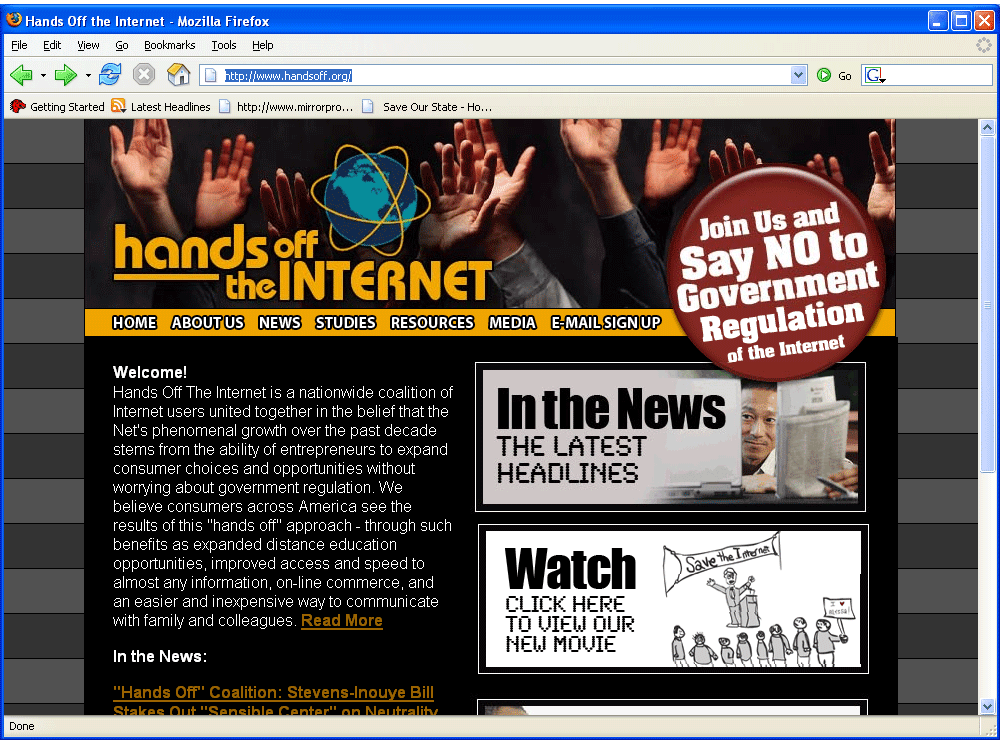
Because this pitch appears in banner ads on politically progressive sites for the visually literate like BagNews Notes, it can be difficult to figure out who really is behind it. The webpage of the webtoon's sponsor Hands Off the Internet looks authentically grassroots with its bad graphics, but a few mouseclicks spells out an ABC of corporate sponsors like Alcatel, Bell South, and Cingular.

Labels: ,

Tuesday, May 09, 2006

More Network Neus

Still more imaginative digital rhetoric has appeared to explain the network neutrality principle in the simplest possible language to consumers and legislators.

This week's offerings on BoingBoing includes a machinima video from This Spartan Life and a podcast of David Eisenberg reading a Dr. Seuss-style poem against potential ISP robber barons.

To me, the interesting question may be why everyone is assuming that network neutrality is such a complex issue that it requires primers on procedural literacy. See last week on this blog for more about the didactic project of net neutrality advocates.

Update: My personal favorite YouTube celebrity, Ask a Ninja, has come up with an episode on Net Neutrality as well! You can also see a dramatization at the Net Neutrality and Internet Freedom Report, which uses the D.I.Y. presentation techniques that are popular on YouTube.

Labels:

Tuesday, May 02, 2006

Network Neutrality

Several public interest groups are employing digital rhetoric this month to get legislators to commit to the principle of "network neutrality," so that Internet Service Providers won't privilege some sites over others with faster connections and cleaner data streaming. There have been some innovative efforts to educate legislators about consumers' concerns, such as giving senators iPods, but the target audience remains their electorate.

Save the Internet has intellectual property intellectual heavyweight Lawrence Lessig on their side and has switched to an upbeat approach that emphasizes blog citations and myspace friends rather than the depressing scoreboard that shows that as more legislators have made their network neutrality positions public, they are on the losing side.

In contrast, Public Knowledge has made this simple, didactic video about Net Neutrality that actually has a Lessig-style delivery to it.

Mainstream Internet-based liberal political groups have become involved as well, like cyber-leviathan MoveOn.org, which urges those on its giant e-mail list to sign an electronic petition, which unfortunately -- from an information design standpoint -- looks just like all its others. At least MoveOn is now dressing up its petition drive to include a contest to win an iPod nano!

Of course, since I'm interested in strange political bedfellows, I like to see headlines like "Gun owners, librarians unite against Bells" in the blogosphere. Unfortunately, both Democratic and Republican policymakers have been listening to the lobbyists and not the librarians again.

Labels: