Monday, February 15, 2010

Spacetime in Winter Time

Labels: ,

Sunday, October 18, 2009

Slice of Life


Yesterday I appeared on a panel hosted by trendwatch site Flavorpill and design critic Frances Anderton about Jay Mark Johnson and his latest show at the ACE gallery. I was happy do do it, since I see a lot of bad digital art on the job, and I think that Johnson's work and the audience's reaction shows how it successfully presents a point of view and speaks to lived experience. As a rhetorician, I also like to hear the way that he speaks about the images as commentaries on shared public space, mobility, and violence to the environment. Joining me on the panel about SPACETIME was high energy physicist Barry Barish, art writer Shana Nys Dambrot, and artist and author Christopher Finch, whose expertise ranges from Jim Henson to Chuck Close.

I had been discussing Johnson's work, which is created using slit-scan photography, with Lev Manovich, who is also working with x=time images that combine information visualization with traditional representation of objects. Unlike Muybridge's work that presents motion studies as a series of discrete frames, Johnson's images are characterized by the morph that has replaced collage and montage in much contemporary imagery. Barish was scandalized that the art critics weren't engaging with the temporal dimension of the images and could only apprehend them spatially or engage with the scientific questions about perception that they raise. Finch and I agreed that what was compelling about the images, however, was often their use of existing conventions and genres such as landscape and nude, so that viewers inserted perspective and vanishing points in the images that weren't really there.

Labels: ,

Tuesday, November 25, 2008

The Breakfast Club

I was honored to be included in a panel discussion that will be featured in an upcoming issue of the Journal of Virtual Worlds Research with Mia Consalvo, Mark Bell, Sarah "Intellagirl" Robbins, Nick Yee, T.L. Taylor, and Ren Reynolds that took place in Second Life. Most of them I knew from face-to-face interactions on the conference circuit, so it was interesting to have a sense of both the continuity with and the differences from these ongoing face-to-face conversations. Stay tuned for more as publication approaches.

Labels: ,

Monday, September 08, 2008

Publishers Turn the Page

Today's session, "The Future of Academic Publishing in the Digital Age: Two Views" stimulated a lively discussion based on presentations by Lynn Withey, the Director of the University of California Press, and Duke professor N. Katherine Hayles, who is known for her scholarship on electronic literature and theories of the posthuman.

Much of Withey's talk was structured around the following functions, which she argued were central to the publishing enterprise:
  • Selection
  • Shaping
  • Dissemination
  • Promotion
  • Cost Recovery
  • Preservation
As she noted, although scholarly journals and reference works have moved rapidly toward electronic presentation and distribution models, the "resistance of books" was worth examining. Because Withey had seen a number of trends in reader-oriented software come and go, she argued that this skepticism may be understandable. However, she insisted that the iPhone and the Kindle e-book reader may have the user base and the content catalog to alter this pattern of failure.

In the case of the University of California Press, she declared that in some ways the "collection" paradigm had become "old fashioned" in the age of "advanced search." According to Withey, the press placed 2000 books online that were accessible to the UC community and 500 books on the Internet with no restrictions at all, and what they discovered was that the average number of pages viewed was 5. Thus, she surmised that sustained reading of book-length scholarly texts continued to be associated with the ink and paper interface of the material artifact. Furthermore, Withey asserted that "replicating print" is pointless.

Instead Withey said that academic publishers are now responding to a "noisy minority" and pursuing projects for which "originality in technology" is as important as originality of the scholarly work it represents. Projects that exploit the availability of primary source material which is difficult to bind in books or interactive maps and 3-D modeling are particularly good candidates, she observed. For example, Withy pointed to the St. Gall Monastery Plan, the Encyclopedia of Egyptian Archeology, Hypermedia Berlin, and the Vectors journal as models.

In the past, she said the typical organizational arrangement involved "enterprising scholars" working with instructional technology personnel for projects housed on university servers and funded by grants. Publishers were notably absent in the mix. If works weren't offered free online, they were disseminated in "high priced packages" that could only reach 250 to 300 institutions with the research library budgets necessary. To expand upon the limitations of this approach, she pointed the audience to the Ithaka Group report on Sustainability and Revenue Models for Online Academic Resources. She argued that there might be a number of still unexplored strategies for cost recovery that could be useful in the future, which included advertising, licensed content, and various publication spin-offs. For example, the UC Atlas of Global Inequality also issues a more portable and tangible paper version. For publishers, she argued that that they would need to focus on creating "templates" that could "scale" and facilitate "collaborations."

Unlike Withey, Hayles' talk focused on how digital scholarship was "changing how humanities scholars think." She focused on two case studies: current Duke colleague Tim Lenoir and former UCLA colleague Todd Presner.

In Lenoir's case, she discussed how he had been influenced by the work of Bruno Latour on laboratory life and the study of its practices. However, at first, she said he did little to examine the material conditions of his own production other than integrating PowerPoint into his scholarly presentations on topics such as robotic surgery. Yet once he began looking at complicated questions about predicting the emergence of new paradigms, including the Kuhnian advent of new platforms, such as RFID technologies, in which venture capitalists might be interested, he developed a very different research and publication model. She described a process in which Lenoir helped develop software that sorted through five million patents and "read" seven thousand articles. This kind of scholarship was characterized by Hayles as being one "against ontologies," so that meaning could be introduced late in the process, and a minimum number of initial assumptions could be made.

Her other case study, Presner, creator of Hypermedia Berlin, had apparently been accused by some of being "in bed with the devil," because his projects rely on corporate software. Hayles defended Presner by citing the work of Anne Balsamo, author of Designing Culture: The Technological Imagination at Work, to make the argument that software is inevitably "negotiated" and "contested" by designers rather than merely "inherited," so that the issue becomes "why save the world when you can design it." Hayles also pointed to Bruce Sterling's Shaping Things as a key text.

She discussed how some academics, such as Trevor Pinch, have even adopted the role of programmer to pursue their research interests. She also alluded to the work of Susan Sontag "against interpretation" to consider how the existence of things has value and how some information-intensive environments should be left in what could be called their natural state, so that we have more opportunities to consider "the datasphere in which we are in intimate contact." In conclusion, she pointed to several implications: the decentering of the individual human, the push toward collaboration, the shift in expertise, and the privileging of data first over meaning.

It was a lively question and answer session afterwards. Anne Friedberg, who has an online extension of her book The Virtual Window from Alberti to Microsoft, The Virtual Window Interactive, discussed how her earlier book from the University of California Press, Window Shopping, suddenly showed a bump in her royalty checks from digital use in the form of classroom fees.

Mark Marino asked about using blog-style feedback mechanisms as an alternative to traditional more limited peer review and the experiments in publishing being sponsored by The Institute for the Future of the Book being done by McKenzie Wark and Virtualpolitik friends Noah Wardrip-Fruin and Siva Vaidhyanathan. Although Marino expressed enthusiasm for creating "a space for commenting and publishing in stages" with a "working paper" model, Withey sounded lukewarm about participating in these kinds of "non-standard peer review" projects at this point.

Update: Mark Marino posted his account of the panel at Writer Response Theory. Note also that Virtualpolitik pal Marino was featured in the Wired Campus blog of the Chronicle of Higher Education in an item called "Professor Uses Web 'Widgets' to Share Course Content."

Labels: , , ,

Friday, August 22, 2008

Free . . . As in Labor

Call for Papers

Free…as in Labor
Popular Culture Association/American Culture Association
National Conference
New Orleans, LA
April 8-11, 2009

The Communication and Digital Culture Area of the Popular Culture Association is soliciting proposals for panels and individual papers that explore online participatory culture and the problematic concept of “free labor” in a network society.

Corporations are increasingly counting upon the activity of a “participatory consumer” to provide the content for sites that directly or indirectly generate revenue. Twenty five years ago, GNU operating system activist Richard Stallman famously distinguished the “free” in free software as “free as in free speech, not as in free beer.” What kind of “free” is the labor of a participatory culture? How does the appropriation of this work by major corporations complicate our understanding of “free labor?”

Possible topics include:

Wikipedia and the Academy
Gift Economies Online
Free/Libre Open Source Software
Intellectual Property
Warez Subcultures
“Immaterial” Labor
Convergence & Consumer/Producers
DIY Media
Marx & the Digital Economy
Fan Culture Appropriation

Submit a 250 word maximum proposal to:

Mark Nunes, Chair
Department of English, Technical Communication, and Media Arts
Southern Polytechnic State University
Marietta, GA 30060-2896
mnunes@spsu.edu

Deadline for Submissions: November 30, 2008
Note: Communication and Digital Culture is a themed area. Submissions off-theme should be submitted to:
Internet Culture Area Chair, Montana Miller, montanm@bgnet.bgsu.edu
Games Studies Area Chair, Gerald Voorhees, gerald-voorhees@uiowa.edu

Labels: ,

Sunday, April 06, 2008

On the General Awesomeness of Librarians

This week, we've started to plan our panel at the annual convention of the Society of American Archivists in San Francisco. The super cool librarians in our group include the "E-Learning Librarian" Karen Munro at Berkeley, who writes a terrific blog, Bill Landis at Yale, and Donna McCrea at the University of Montana.

Certainly the public policy importance of librarians and archivists has been underlined yet again this week at Radical Reference, which reported how the search engine of the "the world's largest database on reproductive health, containing citations with abstracts to scientific articles, reports, books, and unpublished reports in the field of population, family planning, and related health issues," POPLINE, was monkeyed with to exclude results that might come up with the query "abortion." Although the hosting institution, Johns Hopkins University, subsequently reversed the decision, apparently officials of the current administration felt that publicly-funded digital archives had to avoid terms that might be offensive to partisan conservative groups.

Update: More on the abortion stop-word story is here on NPR.

Labels: , , , ,

Thursday, January 31, 2008

Multimedia Manifestos

In the intimate setting of today's session about DIY Texts: The Future of Student Writing with colleagues Jacqueline Rhodes of Cal State San Bernadino and UCI Writing Coordinator Jonathan Alexander, there were some provocative questions raised about how faculty judge our students as digital media-makers in academic settings in preparation for a larger conference about the subject that will take place in the months ahead.

For their part, Rhodes and Alexander reviewed the discursive exchanges surrounding the Virginia Tech campus shooting and how not only could the murderous rampage of student Seung-Hui Cho be seen as prefigured in his writing courses, as well as in the "mulitmedia manifesto" that he delivered to NBC news, but also -- more importantly -- how these works reverberated in subsequent extracurricular reflections about college composition and student expression more generally that were disseminated in the days after the shooting. As Alexander and Rhodes write, "The proliferation of texts in the aftermath of Cho’s murders points toward a necessary consideration of the affective realm of new media, that is, the intersection of pathos, discourse, and technology that demands that we reconsider the figure of Donna Haraway’s cyborg, the myth haunting many of our discussions of technology."

By focusing on electronic "aftermath texts," Rhodes and Alexander propose that the acceleration of discursive exchanges associated with the speed of digital texts is also "put in the service of disciplining responses to the tragedy," so that what Pierre Lévy has called "collective intelligence" is actually used to propagate a particular master narrative that serves the agenda of the dominant culture. Perhaps the most compelling aspect of their argument had more to do with what Foucault calls "the technologies of the self" and the aspects of self-regulation that Web 2.0 technologies necessarily entail, as Geert Lovink similarly uses Foucault in his recent critique of blogging, Zero Comments.

For example, Alexander and Rhodes pointed out how websites that published Cho's grand guignol works of would-be literature after his murder-suicide rampage also had certain self-regularizing structures of pseudo-peer-review in which commentators on various blogs would be taken to task by other commentators and be reminded of the appropriate affect to adopt with regard to the campus shooting. Although they cited "The Borg" from Star Trek as an analogy for this process of cultural appropriation and de-individuation, they could just as easily have cited Jaron Lanier on the hive mind of Digital Maoism.

For my part of the presentation I looked at two different reference points for the composition classroom and recounted what I call the "Tale of Two Students": Georgetown senior James Kotecki and Yale senior Aleksey Vayner. Although digital composition and play is often associated with tropes of criminality in the mainstream media, as was in the Cho case, I focused on how professionalism and professionalization might be an area of pragmatic concern for graduating seniors, who may be creating media personae that persist for years in the future, with good effects in Kotecki's case and bad effects in Vayner's.

Of course, one of the uncomfortable aspects of teaching about digital rhetoric, is that you yourself have to consider the problems of digital publics, and what could be called the "Tale of Two Kinds of Professors": those who are praised in the Chronicle of Higher Education as Professors on YouTube and those like The Stoned Professor who are humiliated in the theater of distance learning.

From the vantage point of having recently taught a course in Digital Rhetoric, I also argued that it could often be difficult to assess student work, particularly when undergraduates who are proficient in the editing of digital video may turn in what are essentially well-produced rock videos rather than the academic discourse with claims, evidence, and warrants that we may privilege for credit-bearing units in the university.

As audience member Julia Lupton pointed out, however, the work of faculty member Michael Wesch itself uses many of these music video conventions. Lupton's comment returned the discussion to my opening review of myths about the "digital generation" and the ethnocentrism of Wesch's work, which Mark Marino lampooned in one of his own video responses. Wesch's comments on Marino's video revealed two interesting aspects of "A Vision of Students Today." First, we learned that the Google doc shown in the film wasn't the only source of student comments written on the students' signs since many were composed spontaneously on the day of filming. Second, we learned that Wesch himself was an active editor who shaped the message of the film, in this case by editing out a "powerful moment" that "defies any simple reading." Both pieces of information undermine the degree to which this video can be perceived as a collectively authored composition that reflects student work, which is what this online film purports to be at first viewing.

(The outline of my part of the talk is here, and more tips and reflections are here.)

Labels: , , ,

Tuesday, November 27, 2007

Faculty Bloggers: Part Three

Unfortunately, the camera crew arrived too late to capture Julia Lupton's talk about her work as a faculty blogger with Design Your Life and D.I.Y. Kids. The outline for her presentation is here. As a Shakespeare scholar, Lupton is literally a Renaissance woman.

As if that weren't enough, the slides for my presentation don't appear in the videos of me talking about them. And -- like any vain female -- I utterly hate to see myself on camera, particularly on a teaching day when I'm not gussied up.


The Q & A can be found here and here and here.

Labels: , , ,

Faculty Bloggers: Part Two

In "I Have Production Values," Scott Kaufman of Acephalous looks back on the faculty blogging panel with some of the discomfort that many academics now feel as distributed digital media technologies make their talks and comments part of larger electronic archives rather than the ephemeral experiences that merely take place between printed publications. Of course, Kaufman recently wrote a defense of blogging for Inside Higher Ed called "An Enthusiast's View of Academic Blogs." Unfortunately, it appears that he is not yet as enthusiastic about YouTube.


Labels: , , ,

Faculty Bloggers: Part One

These two videos show Peter Krapp explaining some of his "Top Ten Reasons I Don't Blog Anymore." Although Krapp was at first reluctant to discuss his role in breaking the story about the Derrida-UCI archive scandal, he was ultimately remarkably forthcoming about the hazards of faculty blogging.


Labels: , , ,

Thursday, November 01, 2007

What If the Teacher Has to Sit in the Corner?

Yesterday's panel of faculty bloggers should be available as a podcast and YouTube video webcastrelatively soon. It was a lively discussion with four very different perspectives on the relationship between blogging and the academy. Sadly, given the number of speakers, we ran out of time for audience questions. Also, Catherine Liu of Higher Yearning, who had won top honors for "rogue thought" at the MLA last year (my favorite scholarly prize), couldn't make it because of illness. We also learned that she'll be taking a hiatus from blogging as she moves into an administrative role leading the campus's Humanities Center this year. But Virtualpolitik readers will probably enjoy this panel's afterlife anyway, as soon as it is available online.

Our first speaker was Shakespeare scholar and director of the Humanities Core Course Julia Lupton of Design Your Life and D.I.Y. Kids. She described her labor of digital love with various samples of her digital personae as "not an academic blog," but an essential part of her new trade publishing enterprises that with her sister Ellen Lupton that are intended to bring principles of design, branding, and participatory culture to a broader audience. Lupton talked about the contemporary advent of media hybridity as key to her efforts to publicize her theoretical and practical materials through what she called "Printernet" ventures.

Continuing the "Printernet" theme was Scott Kaufman of Acephalous. Although he is still a graduate student working on his dissertation, Kaufman is the author of what is probably the most widely read UCI academic blog represented on our panel, with fifteen hundred readers of Acephalous and five thousand of the collaboratively written The Valve, a blog which was much-discussed at the MLA as a mode for getting academic books reviewed and marketed more successfully. Kaufman showed a primer about New Historicism from his own blog and a posting about death in Dickens from The Valve to make the point that this type of blogging was very different from the lowbrow flavor-of-the-minute likes of Boing Boing. He also discussed how these blogs relate to scholarly books from university presses like A Novel of Purpose and to online journalism, such as an abecedarium from Kaufman's blog that was republished by Inside Higher Education. (You can see a "best of" list of Kaufman's offerings here.)

The most contentious and attention-getting participant was perhaps Peter Krapp of Distraction Economy, who told the story of how his blog was born in early 2001, with the birth of a child, as a way to privately share family photos and information but quickly evolved into an academic blog about mobile media, polar media, gaming, and machinima that could serve as a "sandbox" and noteboard for ideas. In the question-and-answer session Krapp captivated students with a narrative about his dramatic show-down with a former dean after he had revealed that the university was suing the widow of famed deconstructionist philosopher and former UCI faculty member Jacques Derrida on his blog (which later evolved into a range of stories in the mainstream press about a tangentially connected sexual harassment scandal in the distant past that involved a Derrida protégé).

Since Krapp's site is momentarily down, I want to make his interesting anti-blogging text available in toto here.

top 10 reasons I don't blog anymore

thinking about what to say and show for liz losh's panel discussion on blogs at UCI today, I decided to pull together a few of the major reasons that led to the end of this blog, distraction economy. (add to this list that I thought I'd blog this list before going into the lecture hall, and then tech glitches prevented that and I got to the panel late...)

10. stats: I had been blogging here since March 2004, and elsewhere before that. but then I gave my wife a couple of domain names and hosted her blog on my server, and while my blog gets decent statistics, her blog outdoes me on all metrics by a factor of 4 to 10...

9. writing quality: how can I expect good writing from students, or for that matter from newspapers and websites, I don't practice it myself? blogs, organized about regular fast updates and quirky (or snarky) comments, are not conducive to well-wrought phrasing. prose suffers. I need to work on my prose.

8. africa: as I blogged just recently, I spent two months in africa, and it would have been both pretentious and technically challenging to try and keep up a daily post from there. the digital divide, here and abroad, is quite real still.

7. planet update: that dreaded and yet desired question, "so what are you working on now?" - I realized that even though a lot of the stuff I posted about here was directly related to my teaching and writing, there was also a lot of my work that does not show up on this blog. it started as a repository for fun facts and interesting academic stuff, and at some point I knew I was going to write this stuff up more seriously.

6. citizen journalism: when, for once, I had something newsworthy on my blog, I was actually yelled at by my (former) dean. it was a post related to my work on derrida and archives, and the derrida archives. it made national newspapers. it made colleagues mad. it made me want to stop blogging, since I learned a hard lesson about the reality of academic freedom, censorship, and self-censorship. of course I also went ahead and published my stuff on the derrida archive in an academic venue.

5. crackberry style: much of my academic administrative work is done with the aid of this gadget, and much of my non-academic life also flows through it. as a consequence, I no longer carry my laptop everywhere. (I also re-learned how to keep the gadget in a pocket and just listen to people, whether in class, at conferences, or while travelling). I don't like to blog on the blackberry. it's great for quick email and text messaging, for updating and checking my calendar. it's not a good writing instrument.

4. henry jenkins: among my many disagreements with what his work on fans, gamers, and bloggers stands for, my dissatisfaction with the "user-generated content" paradigm is by far the biggest bone to pick.

3. monobrow: by contrast with jenkins, the most recent book by geert lovink takes aim at the blogosphere, and I should copy page after page from his book "zero comment" into this post. well, blogs don't do that. one of their problematic symptoms: not enough time and space for real sustained argument. at least some other so-called "web 2.0" formats are somewhat less reductive.

2. oINK oINK: as I blogged here long ago, I really kind of hate bOiNG bOiNG, the bloggingest of all blogs. you might argue that blog criticism must join the ranks of bloggers if it hopes to reach bloggers, but I am ready to explore other means.

1. and finally, and most emphatically, top 10 lists suck. most blogs are merely listing the cool obscure. the lossy compression of thoughts and reactions to lists and rankings is one of the primary faults of blog culture: every good text is a list, but not every list is a good text.

My own presentation looked at a specific issue: how photographs function in my blog and in blogs more generally 1) to authenticate authority as a credible witness, 2) to solicit critical scrutiny from others in the name of collective intelligence, and 3) to editorialize by transforming the digital file with Photoshop. I noticed that a number of the entries now classified as "Classic Virtualpolitik," because they were more likely to be linked to by others, use Photoshop rhetorically in this way to make visual arguments.

In addition to familiar territory about how blogs subvert institutional authority, there was also some talk about how faculty blogging raises anxieties for students as well as administrators. Krapp mentioned Rate Your Students, and Kaufman's discussed the controversy over reprinting of an embarrassing e-mail from a student, even with the writer's permission.

Update: There is some legitimate criticism of the panel over at pilgrimgirl that is worth reading. In my own defense, I was moderating three panels during a two-week period in HIB 135, during a month that I added four articles to my c.v. Nonetheless, I probably could have done more to make this more of an opportunity for public interchange if I hadn't let myself be distracted by technical issues with the podcast and videotaping and had made more of an investment in publicizing a great group of bloggers. Apologies again for not making the most of the potential for audience participation.

Labels: , ,

Tuesday, October 16, 2007

AM Radio

I've been getting a lot of e-mails from people who heard me talking about videogames on KNX radio, but since they don't have a podcast of the broadcast or have mispelled my name, I have almost no sense of the edit of my comments that actually aired. I'm used to dealing with print journalists, so it was disquieting to be immediately saying things that could potentially be on air, and the reporters seemed to think that the panel that Barbara Cohen and I had arranged was somehow about trite topics like videogames and violence. I know that they aired me talking about counternarratives in game play and Jim Munroe's "My Trip to Liberty City." I also felt compelled to point out that the argument about the use of media to represent possibly corrupting anti-social acts actually went back to Plato and Aristotle (and their arguments about mimesis and catachresis respectively).

We had a full standing-room-only crowd for "Serious Play: The Practices of Everyday Life in Videogames and Virtual Worlds" with Ian Bogost, Tom Boellstorff, and Jonathan Alexander, so I hope that it was accurately represented in the media. The funny thing about the phone call with the radio station was that the panel had absolutely nothing to do with out-of-the-ordinary violations of social norms. We explicitly devoted our attention to how computational media represented the mundane, the everyday, the routine, etc.


Ian Bogost showed a clip from the game trailer above to emphasize how unit operations are deeply procedural and as rule-based as seemingly "boring" games about routines of counting sand or waiting in line would be. His analysis looks at "the logics of ordinary people" and how they express the deployment of "tactics," to use Michel de Certeau's terms, in response to what de Certeau calls "strategies" from those who shape policies and the environments in which we live.

Tom Boellstorff spent a lot of his talk on definitional work. For example, he wanted to sharply distinguish "virtual worlds" from either games or digital expressions of self for which there wasn't a clear "afk" or "away-from-keyboard" state.


Jonathan Alexander expanded on our theme about the mundane by playing "College Saga" to the delight of the undergrads in the room, a video that recasts everyday life from dorm rooms, lecture halls, and cafeterias in terms of the idioms of game play in Final Fantasy.

It was a lively discussion afterwards in which Boellstorff took issue with Alexander's ideas about technological synthesis from Donna Haraway's vision of the cyborg to explain how a chapter of his book contested the cyborg scenario in favor of his own argument about the centrality of gaps in embodiment. Alexander responded by saying that we adopt the character of the cyborg not by meshing perfectly with virtual worlds, but instead by being transformed by what we take out of them. And I pointed out to Boellstorff that as Facebook was taking on more real-time and embodied applications, it may not remain a non-virtual world for long.

You can check out a podcast here.

Labels: , , ,

Sunday, October 07, 2007

Is There a Rhetorician in the House?


I'm going to try not to say too much about the visit of the team from Grand Text Auto to UCI right now and the installation, symposium, and performance associated with their visit to the Beall Center, since I've assigned my students to write about their impressions for the class blog. These undergraduates might not have been as willing to explore these unfamiliar interactive narratives as Mark Marino was in trying out a 3D reconstruction of Facade, as shown above, but they were certainly enthusiastic spectators.

But there were enough references to "rhetoric" and "expression" during the day, that it seems wrong not to document the events of last Friday. So check back here next week for more of a write-up, after I've given others their say.

We're actually teaching Aristotle this month in the Humanities Core Course, so I'm particularly conscious of the ways that rhetoric can be seen as a set of rules or procedures for carrying out discourse, much as computers operate formally and procedurally. Most interesting in this regard were perhaps the two performances of Terminal Time by Michael Mateas in which the computer selects from thousands of historical facts and hundreds of video clips and images to create a documentary about the last thousand years that responds to the audience's input and their preferences, which might be shaped by ideologies about gender, race, class, or other influencing factors. As Matteas explains it, the computer must also be a rhetorician, since the program is stocked with tropes and phrases to create causal connections between chunks of assembled material that would otherwise appear logically disconnected. See below for photos of a performance of the hypertext narrative The Unknown with VP pal Scott Rettberg.

Labels: , ,

Monday, June 25, 2007

A Panel of Bartenders Discussing Prohibition

It's true that a panel of bartenders discussing Prohibition would probably be more entertaining than a panel of library science experts expounding upon digital copyright restrictions, but yesterday I devoted two hours to watching an exercise of the latter anyway. Readers may recall that I was miffed about all the digital access restrictions on what should be free and open public discussion, but a helpful librarian sent me the link to the webcast of Copyright in the Digital Age: An Update, so I could see what the American Library Association was endorsing and disseminating to its members and other interested parties. (This link will expire after July 1st, so readers should visit the site now.)

At first I was concerned by the introductory rhetoric, which emphasized "teaching our students" about copyright rather than being advocates for their interests in the face of possible infringement and the passive reception of "updates" rather than activism, but the main program made clear that librarians continue to be at the forefront of progressive engagement with information policy issues.

I also wasn't sure that host Cheryl Hamada was entirely correct to open the show by asserting that "methods of information delivery drive and change the face of copyright law." Technological developments are only one factor among many and social, political, and educational changes also impact copyright policies.

Kenneth Crews of Indiana University argued that "who shows up" to lobby and testify before Congress often shapes the text of specific copyright exemptions. In gloating that "Ha! I'm the Only Blogger at Sivacracy Who Can Legally Circumvent DVD Encryption," Siva Vaidhyanathan pointed out the comic fact that many who teach and write about, with, and through digital media are still prohibited from digital copying that would otherwise be protected by section 107, the so-called "fair use" exemption. As one questioner pointed out, anthropology professors -- who often depend on showing films from other countries with different digital region codes or ones that may no longer be in distribution -- may also need to copy films to show in class in connection with coursework. Crews said that the film and media professors were able to secure the exemption because they showed up and anthropology professors didn't. As my pal historian Bob Blackman used to say facetiously, you can't teach history without an electrical outlet, since you can't do it without a VCR.

Crews also cautioned against tinkering with laws without careful study and reflection, since he said that "bad changes" were certainly possible and that advocacy was sometimes needed for the status quo. He also reminded viewers of their ethos as an audience: "good citizens" who were interested in "doing the right thing" and acting in "good faith."

Miriam Nisbet spoke from her perspective in the Library of Congress Section 108 Study Group, which deals with issues arising in relation to U.S. legislation, regulation, and oversight as well as treaties and policy decisions on the international stage. Section 108 refers to the exemptions to copyright law available to libraries and archives. As she pointed out, legislation can come with baggage and that "baggage can be pretty burdensome." In particular, Nisbet explained how digital regulations created problems for the traditional services of research libraries such as course reserves and interlibrary loan.

Rounding out the panel was Tomas Lipinski, who I was prepared not to like because he talked about "rogue faculties" and "stepping on" the rights of copyright holders. He also mystified me with a PowerPoint slide that made the following cryptic statement that quoted Arthur R. Miller and Michael H. Davis: "If copyright law is the 'metaphysics' of law, fair use is its 'semiotics.'"

Later, Lipinski was back in my graces by taking a broad view of the exemption for "transformative" works, although he also used the value-laden term "good." This broad interpretation recognized "indexes, bibliographies, and abstracts" as transformative, and thus positioned librarians as creators of new knowledge. He even quoted from the Electronic Frontier Foundation!

Librarians are also working on expanding rules that currently restrict the total number of post purchase copies to three, including the original and counting both digital and paper. It is interesting to note how many DRM restrictions limit users to three devices, copies, or installations and the way that this conforms to the "rule of threes" that is so prevalent in Western folklore and mythology. As someone who has had two hard drives and two iPods wiped just in this past year, I think revisiting this convention is certainly in order for consumers as well.

After sitting still for a long webcast, it was nice to enjoy more copyright transgressing fun. I went to see Cut Chemist and DJ Shadow doing an amazing virtuoso performance on eight turntables with nothing but unwieldy 45s.

Labels: , , , , ,

Friday, June 22, 2007

Through the Looking Glass

Yesterday, I attended another "Igniting Technology" event from Calit2, this time about "Web 3.0." If you don't know what Web 3.0 is, this influential graphic by Gary Hayes may help. It describes a series of next wave developments on the horizon of social media, but the term encompasses more than virtual 3D worlds, because this next generation Internet also may be characterized by smart searches in the "semantic web" and autonomous agents capable of generating emergent content. As one person in the audience pointed out, although the event was hosted by an intellectual property law firm, one of the master narratives of the panel discussion was about the triumph of open source.

Open source is, in fact, one of the areas of expertise of the first speaker Walt Scacchi, who describes himself as an advocate for "sampling, misuse, hacking, appropriation, reverse engineering, and custom creation in the interest of open-source innovation and critical intervention." Scacchi has made a reputation for himself by partnering with both corporate sponsors and the local community to create an online game, DinoQuest, to complement the offerings of the Orange County regional Discovery Science Center. (Of course, I was disappointed to discover that the top results for cheat codes for the game were no longer online.)

In continuing this open source theme, the next speaker, mega-millionaire developer David Perry, described open source as critical to the user-generated future of the game industry, even if it was "kryptonite to lawyers." He described the rationale of his open letter to amateur and off-duty game developers, Project Top Secret, which rests on a kind of pyramid scheme to attract more prosumers to the project. He also sketched out his own Web 2.0 to Web 3.0 transitional map. For example, his examples of microtransactions went from first generation "painted cars and vanity items" for in-game worlds to exchanges with more social, psychological, and ritual depth, such as "risk-based objects" or "collections." He also talked about the evolution of in-game advertising. In stage one, he described static logos. Stage two was characterized by targeting advertising. Stage three melded user-generated content with corporate marketing. Thus, in stage one a poster for a product might appear in a game. In stage two that poster might be able to look at you back and see your IP address and even change the next time you walk by to what would be appropriate to your niche audience. In stage three, your guild might be able to put up an advertisement to mark their pride in community identity alongside the poster of a major advertiser. Perry discussed about how in-game advertising could now extend to a sports sponsorship model as well, where you received the jersey of Adidas as soon as you earned the highest score, which would be visible to other players and make you more vulnerable to challenge.

As the audience from Korea looked on via a teleconference link, Perry also talked about the lessons to be learned from Asia and their "Free to Play, Lifetime to Master" model. He predicted that the Asian market would eventually develop the ultimate killer ap, a free game with the necessary emotional drivers -- which can include feelings like "pride" that he argued were unattainable in the spectatorship model of cinema -- to knock out competition from proprietary corporations. He thought that this free game would profoundly disrupt the industry.

Next up was Facebook friend Bill Tomlinson, who opened with the issue of cross-cultural contact. Tomlinson compared his own knowledge of China growing up, which was limited to a location on a map, with that of his students who actually knew Chinese people from playing World of Warcraft. (Strangely, he seemed to gloss over how his present-day students still indulged in generalizations and cultural stereotypes about the Chinese in the context of game play.) Most of his talk, however, was about autonomous agents and emergence. Although he described AI as a "hard set of problems," he said that flocking algorithms provide a model for how complexity can emerge from a few simple rules. In creating social dynamics with all the possible combinations of the human-machine-machine-human circuit, he argued that a few social rules could also be considered fundamental to modeling complex systems. For example, a rule about being able to uniquely identify a social actor or characterize an emotional state.

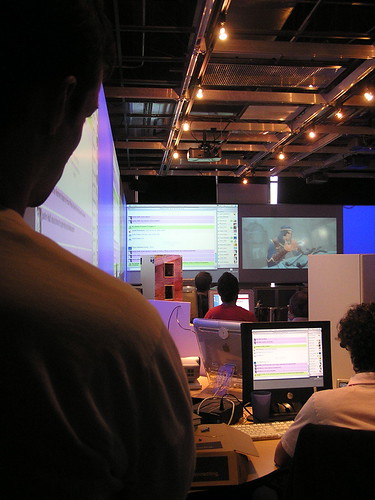
Last to speak was Mats Johnsson, who spoke from a business perspective about the coming generation of protoypes, demos, and models, which would make business meetings and tradeshows look more like the scenes in Star Wars movies in which people congregate around a hologram. He also showed some examples from a well-known demo about morphological models of faces that I covered earlier this year. The Calit2 facility also showcased its display systems, as these photographs show, at the even.

Questions from the audience were a bit by-the-numbers and focused on cultural clichés like violence and videogames on the one hand and interactive entertainment and cutting-edge education on the other. Perry was probably the most interesting respondent. He talked about his background growing up in an environment of cultural violence and terrorism in Northern Ireland, which made American anxieties about game violence laughable to him. He spoke about a video that he liked to show in talks as well, which I sadly failed to find on YouTube, that shows a six-year-old girl speaking knowledgeably and with definite opinions about trebuchets, knowing the complicated physics and strategic dimensions of these historical military weapons only from game play. (I did, however, find this helpful trebuchet how-to website for girl scouts, which is worth checking out.) One fun fact did emerge from the Q&A, however, about the energy demands of virtual life and the ultimate carbon footprint created. According to Tomlinson, a citizen in Second Life uses as much energy in a year as a typical real-life dweller in Brazil.


Labels: , , , , ,

Wednesday, May 30, 2007

More From the Department of Irony

Can I point out that the webcast of this Friday's Copyright in the Digital Age: An Update is being shown to the public only through compliance with a Byzantine set of rules and regulations?

Great, I thought. It's a webcast. So I can be at UCLA for that day, as I had planned, and still see a panel discussion being shown sixty miles away at the UC Irvine Science Library. After all, it's how I'm often able to "attend" events on multiple UC campuses on the same day.

But no. I called the library to get the URL, so I'd be ready at my desktop to catch all the exciting library and information science action. Apparently they are only licensed to show the webcast on only one computer at only one designated time. Otherwise I have to shell out $395 to have my own licensed copy! Why has the sponsor of the event, the American Library Association, agreed to this preposterous policing of ostensibly public content?

Labels: , , ,

Saturday, May 12, 2007

Six Principles for Interdisciplinary Research

Above, you can see my ACM card, which represents one of my professional affiliations. I also have one for the Modern Language Association. In fact, I'm a member of so many professional associations as a result of doing research on digital culture that I don't even list them on my c.v. any more, for fear of confusing committee members. I think it's emblematic of how interdisciplinarity happens at the level of the practices of everyday life.

So I showed it as a visual aid yesterday, when I was on a faculty panel for the annual workshop for the CalIT2 Group for Interdisciplinary Graduate Research with colleagues Mark Warschauer, Don Saari, and Luis Avilés. Among other fun facts, I learned that Warschauer had studied with one of my favorite writers on epistemology and cybernetics, Gregory Bateson, and that Avilés is doing very interesting work about spectatorship that includes visual representations of Spanish rule under Charles V. (He showed an impressive tapestry that would have made Lev Manovich's info-aesthetics people envious.)

I handed out copies of Siva Vaidhyanathan's Critical Information Studies: A Bibliographic Manifesto and made a plug for the new interdisciplinary UCI Design Alliance. I also thought about my own experiences as a graduate student and person potentially on the job market and shared six principles for interdisciplinary research.

1. Write well: When you step outside your discipline, what you will be judged by is your writing, and you have to revise rigorously in order to make it through blind peer reviews. This is also the key to having your work reach a wider audience so that people in those disciplines will be interested in your work.

2. Try and try again: Academia is all about persistence in the fact of rejection, particularly rejection of new ideas. You will certainly be rejected by people in your own discipline, so why take it too hard when it happens in another one?

3. Listen to the cultural conversation: On the other hand, there are places that will never accept your work until you become more attentive to their genres and the norms about research that they promulgate. Look at papers from people within that discipline and go to conferences to hear what's being talked about. In choosing conferences, think about trade-offs. A major international conference may be pricey, but it may give you the big picture very efficiently. A local conference may give you the opportunity to follow-up with face-to-face collaborations.

4. Know your limits: For example, I find submitting to social science journals too far out of my ken. It's important to know the ways of thinking in which it is hard to translate your ideas.

5. Be willing to retrain: You may want to build skills, such as those in new media production for example. Sometimes it is necessary to do this outside of your university, so consider it an opportunity to try out things in a safe zone away from your colleagues.

6. Keep a moral center: As Mark Warschauer said, interdisciplinarity is about understanding the world. It is not about virtuoso performances or strategies for academic display. There should be a reason that you are pursuing this research that has to do with a public policy issue, area of basic knowledge, or mode of artistic expression that allows you not only to understand the world but change it.

On my list, it seemed like there was the most anxiety about the effective writing principle, particularly for international graduate students who are doing advanced study in the United States. Many of them asked about campus resources for help in this area. Afterwards, I peeked at the blogs of attendees Silvia Lindtner and Eric Baumer and -- based on what I saw -- I would say that there is also a very positive interest in public writing in the group I met. I particularly liked Eric's meditation on what a specialist in Informatics should call him or herself: informaticist or informatician?

Labels: , , , , ,

Friday, May 11, 2007

n00b Tube

Maybe it was all that talk in the ARG about the looming gas crisis and the fact that I'm off to Holland tomorrow, but I decided not to drive to UC San Diego yesterday. I had intended to see the latest round of CalIT2 talks with the rather unfortunate title of Californovation, which may sound a little too much like a Red Hot Chili Peppers album to my taste. Thankfully, I didn't miss it, since the event was webcast live and should soon also be posted to their YouTube channel. I had tuned in primarily to hear Lev Manovich's talk, who argued that Humanists should rethink the tools that they use for teaching and research to capitalize on new data visualization techniques and powerful analytics that can represent primary sources that document the human experience on a much larger scale than was ever before possible. Manovich argued that we should grapple with more "big data" and "real-time simulations." He claims that using a common language and sharing methods of analysis could improve the conversations going on within the academy and the research being done on behalf of a larger citizenry. As someone who is slated to teach in the experimental teaching classroom in Fall, in our Teaching, Learning & Technology Center, I feel like the rich multiscreen multimedia learning experience that Manovich modeled still is not coming soon enough. I also was surprised that no one suggested that his commitment to making very large databases of the world's photography, music, and film easily available for comparison and close reading in the space of the classroom might be thwarted by anxious copyright holders. From a Virtualpolitik standpoint, I thought that his attention to the use of digital media by Transparency International to fight corruption globally was a particularly interesting case study. He also announced the formation of an interesting new critical code studies program with VP pal Noah Wardrip-Fruin.

Not everyone was as sure about Manovich's program of action, and the topic of "epistemological humility" came up several times in the discussion. Cathy Davidson of Duke, who recently hosted the HASTAC conference, pointed out that this exchange should work both ways, so that humanistic tools and methods are also valued. She also argued that certain economies of specialization may be at work and that she couldn't contribute much very efficiently to coding projects with her ancient programming skills in FORTRAN. A few minutes afterwards, ironically, I signed up for a summer course in 3-D design using Maya. After a semester learning ActionScript for Flash, I'm not nearly as intimidated by the prospect, and it may actually help me better understand some of my objects of study. Maya is also a software package that Manovich has pointed to as a further example of his transcoding thesis, since soon we will all be driving Maya-looking cars and work in Maya-looking buildings.

Labels: , , , , ,

Wednesday, April 04, 2007

Second Person


Tonight I sat in on an evening of discussion around "writing and gameplay" to commemorate the book Second Person with Noah Wardrip-Fruin, Jordan Mechner, Mark Marino, and Jeremy Douglass.

Although Mechner was there discussing the challenging of turning a videogame -- Sands of Time of the Prince of Persia series -- into a feature film devoted to more than killing monsters, he's done work that celebrates the regional and the political in his documentary Chavez Ravine. Mechner, like many of the other presenters that evening, was interested in the procedurality of a "bad choice," which in the case of completing a puzzle that activates the castle's defense system, may be your only one. The way that choice-making still remains dramatically important, even when the media is no longer an interactive one, could be seen as one way to approach the old Narratology vs. Ludology debate.

I had seen Marino's 12 Easy Lessons to Better Time Travel before, but I think his choice to combine it with course management software was a witty improvement. Obviously, as someone who sat through nine hours of Tom Stoppard's The Coast of Utopia, I have a lot of patience with nonlinear plots, but Marino's sense of humor serves the project well. As someone fascinated with chatbots going back to the "Horses of Elberfeld," I also liked the fake interactivity of his chatbot in the story "Ticky." (Marino also created monologues for the notorious Grand Theft Auto game that include an army recruiter, a driver's ed instructor, and a controlling Italian mother.)

In keeping with the "bad choices" theme, Douglass discussed the text-based interactive work of fiction "Shade," which takes place in the existential trap of an apartment. Audience member and innovative game designer Tracy Fullerton, however, talked about the problems with the game interface and its irritating protocols that make the equivalent of tying a shoe into an elaborate algorithm of discrete instructions. Douglass didn't disagree that this lack of intuitiveness could be frustrating, but he did advocate for the pleasures of this particular form of literacy. With other audience members, there was also some discussion of the much lauded "Facade," in connection with the question of whether it was a true story simulation or merely a chatbot.

Wardrip-Fruin is also hosting what looks to be a great panel with Jesper Juul and Judith Faifman at UCSD on the 18th. Info is here.

(Picture above courtesy of Jenny Cool of The Participant Observer.)

Labels: , , , , ,

Thursday, March 01, 2007

State of Emergency


The terrible deaths of eight students in a high school in Alabama from a tornado makes the rhetorical issues surrounding risk communication an urgent issue for the general public, especially because according to the Associated Press warning systems actually were deployed according to procedures: sirens were going off, and students were being held on the premises. Ironically, as the news was coming out of Alabama, I was attending "One Step ahead of the Crisis," a panel discussion about the uses of technology in disaster response and preparation that mentioned mass notifications to parents of school children as an exemplary case.

This oddly named "Igniting Technology" evening included presentations by computer scientists and officials representing municipalities and school districts who discussed scenarios that included assembling city workers in the event of a gas leak near Disneyland (Anaheim) and reuniting missing people in shelters after an earthquake (Ontario). Given that clear communication plays such a central role in these situations, I was a little bit taken aback by the visually chaotic information on the PowerPoint slides and the sloppy use of "utilize" by presenters.

However, other aspects of the presentations were compelling, particularly those affiliated with the NSF-funded ResCUE project. For example, I found demonstrations of the Evac-Pack interesting, although I recognized the rhetoric of the human-as-sensor as being borrowed from commonly disseminated PR about the new technologically-savvy Army as well. Like Wi-Fi Bedouin it is also a project that merges tropes of wearability with those of human contact.

UCI professor Nalini Venkatasubramanian emphasized the importance of capitalizing on peer-to-peer systems and social networks as robust solutions to communication breakdowns. As the government seeks to regulate these systems and justifies constraints by citing threats from terrorists, child molesters, and pirates, it is important to keep in mind that maintaining a non-centralized network that tolerates multiple pathways and patterns of use may be key to saving lives in a crisis.

Labels: , , ,