Thursday, February 25, 2010
Sunday, January 31, 2010
Do You Want the Bad News First? Or the Really Bad News?
Assessing the Future Landscape of Scholarly Communication contains some grim assessments about the institutional barriers to the production and evaluation of digital scholarship, online outreach, or networked knowledge in the academy.
Age and Institutional Factors
We found no evidence to suggest that “tech-savvy” young graduate students, postdoctoral scholars, or assistant professors are bypassing traditional publishing practices. In fact, as arguably the most vulnerable populations in the scholarly community, one would expect them to hew to the norms of their chosen discipline, and they do. Established scholars seem to exercise significantly more freedom in the choice of publication outlet than their untenured colleagues, although, in the sciences, high-impact publications remain important for garnering research grants throughout a career. There is some indication that faculty in newer and less established departments in the humanities and social sciences may be more amenable to risk-taking in publication practices since their particular institutions support such efforts to carve out the identity of niche departments.
New Publication Genres
As noted above, institutions already have experience in judging non-text productivity in the arts and some professional schools. Some individuals and departments in humanistic disciplines are discussing or implementing amendments to tenure and promotion criteria in order to draw analogies between existing forms of scholarly publication (e.g., books and articles) and new, multimedia, dynamic forms of publication. A number of interviewees identified the need to have a more nuanced tenure and promotion system that could judge “intermediate” forms of scholarship, such as archival websites, perhaps as something in between “service to the field” and a more formal peer-reviewed publication that advances a well-developed scholarly argument.
The fact remains, however, that: (1) new forms of scholarship must be perceived as having undergone rigorous peer review, (2) few untenured scholars are presenting such publications as part of their tenure packages, and (3) the mechanisms for evaluating new genres (e.g., nonlinear narratives and multimedia publications) may be prohibitive for reviewers in terms of time and inclination. Associate professors may well be the class that will exercise more freedom in the type of publication submitted for promotion to full professor (e.g., an encyclopedia or electronic resource instead of the second book).
Advice to Young Scholars
The advice given to pre-tenure scholars was quite consistent across all fields: focus on publishing in the right venues and avoid spending too much time on public engagement, committee work, writing op-ed pieces, developing websites, blogging, and other nontraditional forms of electronic dissemination (including courseware)
Blogs
Among most of our interviewees, blogs were simply off the radar as a source of scholarship and are generally viewed as a waste of time because they are not peer reviewed. “You have to have some standards! How in the hell are you going to judge the quality of what’s on a blog?” “...who has the time! There have to be some filters!” There was, however, limited
mention of “good” blogs in economics, astrophysics, political science, archaeology, and history (that often serve simply as more sophisticated versions of the subject listserv and are used in much the same way: for finding out about new developments or events in a field and for making general announcements). But again, the particular scholars we interviewed generally said they do not spend time following them (even those who maintain their own blogs). A number of faculty mentioned reading blogs related to a topic of their research (e.g., a historian consulting a blog about a particular branch of science or a political scientist consulting a well-known economics blog in preparation for an interview with a media outlet).
Conservatism of Young Scholars
There may be a trend among young scholars in all fields, and particularly graduate students, to be especially leery of putting ideas and data out too soon for fear of theft and/or misinterpretation. Given these findings, we caution against assumptions that “millennials” will change the landscape of scholarship by virtue of their facility with technology. There is ample evidence that, once initiated into the profession, newer scholars, be they graduate students, postdoctoral scholars, or assistant professors, adopt the behaviors and norms of their mentors to advance their careers. Of course, teenagers eventually develop into adults. Moreover, given the complex motivations around sharing scholarly work and the importance of peer review as a quality and noise filter, we think it premature to assume that Web 2.0 platforms geared toward early public exposure of ideas or data, or open peer review, are going to spread among scholars at the most competitive institutions. These platforms may, however, become populated with materials—such as protocols or primary data—that established scholars simply want to disseminate in some formal way without undergoing unnecessary and lengthy peer review. It is also possible, based on our scan of a variety of “open peer-review” websites, that scholars in less competitive institutions (including internationally), who may experience more difficulty finding a high stature publisher for their work, will embrace these publication outlets. Time will tell.
Social networking/Web 2.0
Although graduate students and younger scholars are much more “net savvy” than their established counterparts, and engage with YouTube, have personal websites, and social networking tools, this tends to be largely (if not exclusively) for personal and leisure use, not scholarly practice. Publishers experimenting with social networking reader tools (commenting, etc.) are not seeing them taken up in large part by the readership. Some attribute this lack of uptake to conservatism, time, interest, and fear of having ideas stolen. Young scholars tend to adopt the conventional practices of their subfields and mentors, despite the perception that they will change the world.
I would consider my own path to scholarly publication with a peer-reviewed book that started as a blog as a narrative that is likely to continue to be highly anomalous. MIT Press has obviously published a number of works by well-known academic bloggers and is invested in new media disciplines that test boundaries, but I also benefited from testing out ideas at conferences, as the report recommends on page eight, and cultivating face-to-face networks of like-minded academics. And I still write far more material for established journals and edited collections from other prestige publishing houses like Routledge or Continuum than I do for peer-reviewed electronic journals or online presses.
The particularly dispiriting section on "Public Engagement" that starts on page twenty-three is also worth reading. Harley's subjects bring out important aspects of the multiple publics that constitute the frameworks for public exchanges, and it is true that members of the media or gatherings of life-long learners often don't want to hear complex arguments or nuanced interpretations.
Harley will be presenting her findings at the Digital Media and Learning conference in San Diego in February, so I would encourage all Southern Californians interested in the digital humanities to attend her session.
Labels: blogging, digital humanities, higher education, MIT Press
Saturday, January 02, 2010
Blue Ribbon Book Time
Labels: MIT Press, professional associations
Tuesday, December 08, 2009
Tuesday, November 03, 2009
Too Many Gizmos
Instead of something akin to a smartphone, soldiers lug around several disparate pieces of equipment: GPS devices, iris and fingerprint scanners, charts for calculating collateral damage estimates related to artillery or airstrikes, hand-held radios, cameras, notepad and pen.
Hsia takes what could be called a "platform studies" approach to the problem of computational media in the military and even makes what an uncomplimentary analogy to the Atari system that is the star of Ian Bogost and Nick Montfort's book Racing the Beam: the Atari Video Computer System: "To members of the Xbox generation, however, military hardware and software seem to date from the Atari era: Too often it is bulky, confusing and impractical."
In terms of software, the main culprits for the Army’s Luddite setup here is a weak architecture and lack of interoperability between systems.
Without going into operational and technical specifics, there are multiple systems the military uses for tracking vehicles and units, but many of these systems do not speak to one another. Even within systems one unit often cannot speak or synchronize with another because a software upgrade or patch makes their equipment incompatible. This results in a confusing battlespace where units sometimes lack complete situational awareness of other units operating around them.
There are also too many platforms being tailored to specific uses, inadvertently adding to the fog of war. Command and control, intelligence, logistics, and medical systems all have a plethora of platforms with their own hardware and software requirements. These operating systems are an extreme hindrance for forward-deployed personnel operating in austere environments as they entail a greater support tail, and, more importantly, they all need power.In contrast, Iraqi forces are content with their one-size-fits-all bomb-detecting device from Cumberland Industries, even though the Amazing Randi has directly challenged the company to prove the following advertising claims:
Simultaneous Detection of Multiple Types of Explosives or Drugs. The ADE651® incorporates electrostatic ion attraction [ESA] technology to target the specific substances. It can accommodate multiple substance detection cards to detect a broad range of explosive or drug [narcotic] substances. It can more specifically identify a substance by removing detection cards from the ADE651® after detection is received until the attraction is lost.
Ignores All Known Concealment Methods. By programming the detection cards to specifically target a particular substance, (through the proprietary process of electro-static matching of the ionic charge and structure of the substance), the ADE651® will “by-pass” all known attempts to conceal the target substance. It has been shown to penetrate Lead, other metals, concrete, and other matter (including hiding in the body) used in attempts to block the attraction.
No Consumables nor Maintenance Contracts Required. Unlike Trace Detectors that require the supply of sample traps, the ADE651® does not utilize any consumables (exceptions include: cotton-gloves and cleanser) thereby reducing the operational costs of the equipment. The equipment is Operator maintained and requires no ongoing maintenance service contracts. It comes with a hardware three year warranty. Since the equipment is powered electro statically, there are no batteries or conventional power supplies to change or maintain.
High Explosives or Detonable Explosives Trinitrotoluene (TNT), DNT, Nitro Esters (PETN, nitroglycerine, ethylene glycol dinitrate), Ammonium nitrate, Dynamite, RDX/Hexogen/Octogan, Black Powder, ammunition & Propellants, Tetryl, Narcotics, Cocaine/Heroin/Morphine, THC/Marijuana/Cannabis, LSD/Ketamine/Midazolam, Amphetamine / D-methamphetamine, Ecstasy, Opium/Opiates, Chloro-Methyl & Benzodiazepine drugs, Ivory, Human Recognition (Detection).
For more about this device, read "Iraq Swears by Bomb Detector U.S. Sees as Useless."
Labels: Iraq war, military, MIT Press, ubiquitous computing
Friday, October 16, 2009
Drinking from the Firehose: Nowcasting I
At the Nowcasting conference gets underway, I find myself reminded of how Jeremy Douglass talked about how one of Lev Manovich's students was working with data streaming in from lookbook.nu. He compared this opportunity for real-time analysis to "drinking from the firehose." There was a lot of drinking from the firehose in the day's presentation.Conference organizer Peter Lunenfeld introduced the conference with an epigraph from Rivka Galchen who despairs of the possibility of discovering "the state of things as they presently are, let alone to predict the future," because it poses a "problem so computationally complex that to solve it even approximately would require a thousand crays working in tandem?" Galchen recommends that we "forget about forecasting; even nowcasting is near impossible." As Lunenfeld points out, "Nowcasting" has become a subeject of interest for the collaborative art group TEH as well.
Lunenfeld also showed Bruce Mau's famous napkin sketch, reproduced above, to explain how design have become an über-category for discourse in the digital humanities. As he presents the digital humanities, it is also a long list of modifiers that include "collaborative," "networked," "interactive," "rhizomatic," "locative," "productive," "active," "intertextual," "hybridizing," and "generative." Furloughs at UCLA notwithstanding, he asserted that it was a "great moment to be a humanist," since "not everything is the digital humanities. But the digital humanities are about everything." He also foregrounded the idea of the "designed humanities," which will also be a theme in the upcoming HASTAC@DAC panel, to encourage participants to think about "what ways can our thinking about everything from the hierarchies of reading to the affordances of interaction" could be understood in the context of the prior century of design to grasp how it might "inform the next century."
Next up was Anne Burdick, who introduced herself by noting that some of her interests in the intersections between electronic literature, corpus linguistics, and media theory and associated practices of "marginalia and remix" had already been previewed at the Media in Transition Conference. She noted that her "mix of analog and digital" in her body of work indicates a form of research, so that her role as a designer was not as service provider but as a colleague doing research in her own field with an aim "not to generate a commercially successful product but to engage in questions" regarding the unique materiality of different media types.
Burdick has worked closely with Lunenfeld in the MIT Press Mediawork series, where she worked on the design for N. Katherine Hayles' Writing Machines in which the "severed body part" of the "technotext" allows for the "interweaving of Kate the Critic and original source material" by fostering a visual rhetoric of "cutting and pasting" and lexicon mapping. The webtake on the Hayles' text was done by Erik Loyer, which whom I worked closely in this summer's NEH-Vectors seminar on "Broadening the Digital Humanities." Burdick had presented to the Vectors group, which also included Hayles, as did Johanna Drucker who was later in the day's program.
She also showed materials from The New Ecology of Things, which rethinks the "essayistic home of the book" and previews the coming era of "vooks" with video/print interfaces, even if the text might be dated by the fact that the M-codes imbedded in the book for pervasive computing purposes no longer function.
Burdick also inspired me to add the Fackel Gate, which is not built through proprietary software and grappled with the design challenge of having "to work in a single browser window" and "replicate information from books on a shelf." Fackel's text also needs a "dictionary of perjorative terms" in order to understand the function of his language by reading his criticism through entries such as "artist" and "historian."
In closing, Burdick suggested a number of ways that design enriches the digital humanities through elucidating structural logics, rhetorical schema, narrative hierarchies and presenting analysis that might "visually interpret, remap or reframe, and reveal patterns." She also argued that the speculative function of design was also important because it is "propositional, cast into the future, provocative, optimistic, inventive, asks 'what if.'" Her closing video, A New Ecology of Bookmarks, created by two media design shows a hypothetical bookmark that allows for filtering, interpretation, and cutting and pasting into a new composition to show a "potentially transformative communication tool." In the Q&A, in response to Drucker, she explained that academic presses had little money for user testing, even of the kind that Peter Lunenfeld said might be helpful when readers complain that magazine paper is too slick, since "people want to write on it." Burdick also reiterated that the "project is not necessarily to make something that works" but to consider the notion of "writing space" as Jay Bolter describes it.
Labels: conferences, information aesthetics, MIT Press, print media
Thursday, October 08, 2009
Wonkfest 2009
Mark Balnaves opened the session by presenting research that he had done with Matthew Allen about the differences between "e-government" and "e-governance." Like my own work in the Virtualpolitik book, the focus of Balnaves' talk was on the ways that governments often use technologies to preserve the status quo. He argues -- following David Coursey and Donald F. Norris, that e-goverment has had remarkably little engagement with the public. For Balnaves, e-government has failed to deliver on the promise of its "progressive and transformative" potential and primarily serves for 1) records management, 2) enhancement and manipulation of existing data, and 3) perception management. Of course, he notes that there are legal limitations on what the President can do on Facebook, just as there are even greater barricades to having citizens participate in deliberations in Congress. In practical terms, the news from the latest Report to Congress on the E-Government Act of 2002 doesn't indicate that much substantive progress has been made. In contrast, he claims that media-driven e-governance is capable of very rapid changes in public perception as private networks and social media mobilize citizens. Here he credited the influence of B.J. Fogg's ideas about MIP or Mass Impersonal Persuasion on his thinking. However, he observes that this can also foster radical media and once totally defunct movements such as Marxist-Leninism.
Next up was Sandra Braman, author of Change of State: Information, Policy, and Power with a paper about her research analyzing the genre of the RFC or Request for Comments, which focuses on discussions about the technical constructs of computer networks rather than the management issues handled by ICANN. With over 5700 plus documents filed since 1969, she has a rich mine of material offers both a model of collective decision-making and an archive of quirky ephemera from a range of geek personalities that includes "jokes, memoirs, poems, and autobiographies" in the mix, along with policy-making and policy analysis. It's obviously an interesting source of metadiscourse that includes major guidelines on netiquette. In her NSF-funded study, she has found that 12% of RFCs actually address policy issues and that there were proactive suggestions for handling spam and viruses. However, the RFC contingent clearly had some blind spots beyond an obvious English-only bias. Certainly, the group favored talk about young people far more often than the elderly, and only a surprisingly paltry 2 RFCs were devoted to issues of disability. She also noted that vendors could try to manipulate deliberations by proposing protocols that favor particular kinds of proprietary software, and theat there might be other moves that assert intellectual property rights inappropriately.
Yale's Laura DiNardis admitted that her favorite RFC was probably 2324, which was authored on April 1st and was devoted to coffee pot protocols, but the subject matter of her talk actually focuses on IPv4 and IPv6 addresses and how the politics of Internet protocol might be tested by a scarcity of IPv4 addresses, as the 4.3 billion allocated are stretched by new devices and trends toward ubiquitous computing. She is the author of Protocol Politics, also from MIT Press, and her next book will be devoted to Technologies of Dissent and their architectures. As IPv4 addresses become depleted she cautioned against introducing markets and took a skeptical view of the property model. She argued that such systems would only privilege large players like established universities like MIT and corporations that have traditionally been part of the military-industrial complex and discriminate against those in emerging markets. She noted that Halliburton was just recently given a large Class A resource block of addresses. She also claimed that the switch to IPv6 was being slowed by the fact that big players have no incentive to change. The potential hazards that she listed included risks to business, risks to technical architecture, disincentives for innovation, legal and regulatory challenges, and the risk of unitended consequences. Introduce markets and you inevitably introduce regulation in a realm that has traditionally been navigated through "governance with a small 'g'" rather than with a large one. Members of the audience understood her somewhat arcane points and focused on suggesting ways to make this looming crisis better understood by the public. Someone posed an analogy with spectrum scarcity, and another person urged a comparison with dwindling phone numbers in a particular area code.
The last presenter was An-Shou Cheng who discussed his NSF-funded research project on the rhetoric in Congressional hearings about Network Neutrality. Cheng argued that in the 2006 hearings, pro-neutrality advocates emphasized equality while their opponents stressed "choosing own goals." By 2008 the pro group had switched to "freedom" as a theme, while the con group had switched to "wealth" and "social justice." However, some members of the audience were unhappy with how Cheng ignored the ways that these hearings had been manipulated with a politically motivated structure of "balance." Others wondered why he chose Schwartz's Value Inventory as his main tool, when this index spoke more to private psyches than public attitudes about the government.
Labels: conferences, government reports, government websites, MIT Press
Sunday, September 13, 2009
Character with More Characters
Lanick makes the argument that it is not just a question of authors promoting their books as online personalities, because whole academic publishing houses need to use sites like Facebook and Twitter to promote their brands and inspire interest and sales. She also argues that having an online presence is also an important part of intelligence-gathering.
Most university presses use social media to discuss what is happening in their community and the publishing world as well as what is going on with particular books and authors. At MIT, we have found it very useful to follow others, including colleagues at peer presses and trade houses, journalists, authors, and other organizations and individuals that are relevant to our list. Editors are using social networking to attract authors. Publicists can quickly scan Twitter for alerts when book review editors resign or contribute to the buzz about a particular topic or title, and authors can keep the press and their followers interested in what they are doing to promote their new book. The possibilities are endless.
Labels: MIT Press, print media, social networking
Tuesday, July 07, 2009
The Lives of Others
Nonetheless, after a rapid and enthusiastic reading The Future of Learning Institutions in the Digital Age, I was left with two possible criticisms.
First, although this book claims that its "primary focus is higher education," it was remarkably light on specifics. Given the tendency of philanthropic institutions only to fund K-12 initiatives that focus on what I have described as the "exoticism of the young," I was looking forward to a monograph that addressed the culture of college campuses, where academic scholarship and new social computing practices have had a particularly contentious relationship. I will confess that some of this attention to the subject on my part is also self-interested. My new book project, Early Adopters: The Instructional Technology Movement and the Myth of the Digital Generation, focuses on the higher education scenarios that I began writing about in conjunction with a talk at Berkeley's Center for Studies in Higher Education, when I first wrote about how knowledge paradigms and information paradigms differ. Furthermore, I've promised to write about local experiments with "interdisciplinary pedagogy" in which Southern California as a site for "regional advantage, to use AnnaLee Saxenian's term, for the upcoming DAC conference. Unfortunately, their "Portfolio of Virtual Learning Institutions: Models, Experiments, and Examples to Learn and Build On" contained almost no examples of work done for college credit. The Gamelab Institute of Play, Quest to Learn, the New York City Museum School, and the School of the Future in Philadelphia.
Second, I found myself thinking about the "others" mentioned in a passage about the transformation of "modes of organization, structures of knowledge, and the relationships between and among groups of students, faculty, and others across campus or around the world" (14). I noticed that these "others" were largely constituted as off-campus others, who might be "strangers" who could "remain anonymous" (16) as they participate in life-long learning, contribute to wikis, serve as audiences for faculty blogs, and enter into symbiotic information-exchange relationships with those on campus remotely. Yet one of the challenges to digital learning in higher education is precisely the fact that these "others" are often not far away. They are librarians, instructional technology specialists, and other members of non-tenure-track academic underclasses, who contribute much to initiatives for digital learning but are further marginalized by existing reward systems. Among friends and colleagues in the region, this last group includes book authors, bloggers, and editors who have influenced my own work.
As Clark Kerr once said, the university really is a "multiversity." It's easy for bomb-throwing guest columnists like Mark C. Taylor to say that we should "End the University as We Know It" by terminating tenure and dissolving departments. What's harder to determine is how digital culture can make campuses both better environments for learning and more just workplaces for those who never received the privileges that Taylor wants to end.
Labels: book reviews, higher education, MIT Press, teaching
Sunday, May 17, 2009
Speaking When Spoken To
(Apologies to Skip Rizzo of Virtual Iraq and Lewis Johnson of Tactical Iraqi for the accidental reversal of their project names.)
Labels: auditory culture, MIT Press
Saturday, December 27, 2008
In Simple Packages
Labels: analog media, blogging, MIT Press
Sunday, October 12, 2008
Infomercial
The Virtualpolitik book is officially in the MIT Press catalogue! You can also pre-order on Amazon!Labels: MIT Press, print media
Wednesday, May 21, 2008
Speed Dating
I'm afraid I've written a very long post about a series of very short presentations.
In any case, I've decided that I suffer from attention surplus disorder, so that all attempts to enlighten and entertain me in faster formats are inevitably lost on me as an audience member.
In the upcoming Virtualpolitik book about digital rhetoric, in the chapter about PowerPoint, I write about the transnational "pecha kucha" speed presentation style that the lore says was developed by Astrid Klein and Mark Dytham for designers and architects in Japan, which has since become a global phenomenon. I still have yet to see a real full-blown pecha kucha event, but this year's "SoftWhere" conference at the Software Studies Workshop was intended -- at least in principle -- to emulate the image-laden twenty-slides-of-twenty-seconds-each ideal. I'm also reading the new book Software Studies: A Lexicon this week, which incorporates selections from many of the presenters, so I made sure to make the trip south to attend this pre-HASTAC event at UC San Diego today.
Although a surprising amount of Warren Sack's talk was strangely taken up with images of book covers, such as The Postmodern Condition or Machine Dreams, he did have a number of provocative observations about the difference between what he called "digital ideology" and "digital life" or the vernacular experience of daily culture. As Sack described this cultural shift, “It is not only possible but usual” for a person to be in "two places at the same time." He also noted that area codes no longer indicate "where we live" but rather "where we bought the phone." For those teaching the grand narratives of the Western canon, such as my colleagues in the Humanties Core Course, Sack argued that certain kinds of stories about epics, quests, allegories of being lost, and separation from family members may eventually become "strange to future generations" with GPS-enabled cellular telephones and other ubiquitous computing devices. Sack claimed that "the digital" is "not just a condition of scientific knowledge" but a phenomenon that changes what we know as "common sense.” Of course, given the black-box nature of many programs and the ways that popular culture often mistranslates ideas from computational sciences, there are ways that this "common sense" can also be read differently.
When Sack argued that there was a critical role to be played by software studies to get beyond what he characterized as the limitations of “the aesthetics of computer scientists," he was using a very specific disciplinary lens intentionally to further his critique of those who generally teach software in the academy. For example, his definition of "functionalism," which for Sack was a negative term, hearkened back to Adorno's criticism of early twentieth-century art that eschewed ornament and yet couldn't recognize that avoiding style was a style itself, and effaced the role that the word "functionalism" has played in cybernetics and systems theory. In our discussion afterward, Sack quite reasonably argued that these interdisciplinary discourses between anthropologists and information scientists ultimately played a relatively minor role in teaching computer science as a profession and that it was necessary for artists to assert their pedagogical role as well. In his talk he argued that software instruction was often limited to "speed," "efficiency," and "correctness" borrowed from the worlds of business and mathematics, and that even concepts like "interactivity," "user-friendliness," and "realism" were generally treated in a cursory manner.
When it came to pretty pictures, there was much more to be seen in the presentation by conference impresario Lev Manovich, who shared his cosmopolitan impressions of the "new architectural and spatial imagination" Given the current fascination among academics for DIY production, Manovich made a particularly apt point that all the "excitement about amateur content" misses the importance of the role of the "global professional culture universe" in shaping a "software society" that may be distinct from a "knowledge society." This interest in "support networks" and "contemporary lifestyles" creates a somewhat different transnational map of the culture industry from the narratives of Manuel Castells and one that is oriented around design questions dear to my heart, such as this blog posting that asks about why one of my favorite things in the world (literally) can't be better designed: the overly humble hotel minibar. Manovich seemed to be almost riffing on Henry Jenkins's famously fan-oriented invitation to the reader, "Welcome to Convergence Culture," with his own explicit "Welcome to Cultural Analytics" after he sketched out seven trends. As he pointed out, statistics are becoming a part of "personal life" for many people in social media environments where data can be mined and graphed.
In the visuals for Ian Bogost's talk, there wasn't as much evidence of the rhetorical way he uses his Leica, but it was a noteworthy presentation nonetheless, which previewed his upcoming MIT Press book, c0-authored with Nick Montfort, in the new "platform studies" series. As a person trained in the study of literature, Bogost is well aware of the importance of "material constraint" to "expression" and cited a range of examples that included mnemonic devices for oral-formulaic poetry, the language experiments of the Oulipo, and the chemical properties of film emulsion. Bogost also offered a helpful taxonomy for software studies at which my work tends to be at the upper and -- probably fair to say -- superficial level: 1) Reception/operation 2) Interface, 3) Form/function, 4) Code, 5) Platform.
In the book with Montfort, Bogost looks closely at the Atari system and how cost considerations played a role in how software was written, particularly because of the position played by a piece of equipment called the television interface adapter or TIA. Because the early Atari lacked a frame buffer, the programmer had to construct every scan line and thus create displays that depended upon rows of color. Bogost argued that this was particularly significant because it shaped the very genre of many seminal games. In the case of the adaptation of Adventure, which had been a text-based game, these constraints were particularly important in shaping the history of videogame design.
This engagement with what has been for too long denigrated as "technological determinism" continued with the next presentation by Anne Helmond of the Institute for Networked Cultures, which sent me a wonderful surprise package of their publications a few months ago, thanks to Geert Lovink. Helmond is involved in research that looks how blogging engines may be shaping the very rhetorical practices of blogging itself, particularly when it comes to the topographies of what has been called "the commentosphere." On the practical level of pedagogy and publication, Cynthia Nie also discussed this issue at a meeting of the Digital Educators Consortium in December of last year.
DEC colleague Mark Marino followed up with a presentation about work being done on the collaborative blog Critical Code Studies. However Marino was also willing to undermine the gravitas that otherwise might be claimed by his new field by joking about the pretensions of yet another the field in the Critical _____ Studies mold, which The Valve has called the "Critical X Studies" paradigm. Certainly, as someone affiliated with the Critical Information Studies movement with Siva Vaidhyanathan, I also find myself interrogating this model as well. At the end of the Virtualpolitik book, I look at how postwar "Information Science" became "Information Studies" and the resultant loss in ithe field's interdisciplinary ambitions and possibilities for collaboration, so that -- although this move away from the absolutist ideology of science may have been salutory -- it also came with certain costs in that it encouraged a centrifugal tendency toward intellectual fragmentation. Marino also reminded audience members of how Espen Aarseth pushed against the colonization of game studies by critical theory. Although Marino felt that including "rhetoric, economics, and politics" is important, he is willing to acknowledge his own anxiety that maybe it is it all "just a metaphor." As Marino said, “Why don’t I just use cooking?” as a semiotically rich code system through which to understand the world.
In "#include Genre," Jeremy Douglass, Marino's frequent collaborator at the blog WRT: Writer Response Theory talked about the role that "quotation, intertextuality, and transclusion" plays in understanding how particular genres of digital media evolve. As models, Douglass looked at Raph Koster's work on the development of the 3D shooter or Jesper Juul's research on matching tile games.
Since media theorist Benjamin H. Bratton is recently the editor of the study of Paul Virillio, Speed and Politics, it was perhaps somewhat ironic that the accelerated pecha kucha format seemed to undermine the impact of his idea-rich talk, which was often illustrated with stock figures whose eyes were covered with anonymizing rectangles. On the Tarde/Durkheim balance, Bratton announced himself as being in favor of "more Tarde" and "less Durkheim" and thus more interested in emergent networks than in the nation-state. (He also cited the work of Bruno Latour. ) As examples he pointed to the conditions of late modernity in which "maps are instrumental mechanisms for the chain of representation."
Yet it could be argued that by declaring that "All Design is Interface Design," Bratton simultaneously privileged the "point of contact that governs the conditions of exchange" and nullified the prospects of treating it as a discrete object of study in relation to the underlying source code. Instead his work focuses on different conjugations of assemblages and the "distribution of the sensible and insensible" across many types of interface. In other words, instead of turtles all the way down, one could say that perhaps for Bratton it seemed to be a matter of interfaces all the way down. Instead of a hierarchy like the Bogost/Montfort ordering, Bratton provided a series of interpretive approaches to interfaces that included those for "groups of people" and "groups of groups of people" that indicated a much more sophisticated cultural analytics approach than the available time allowed for explication.
As a rhetorician interested in how government institutions simultaneously serve as regulators and media-makers, there were obvious reasons to take notes on the talk by Kelly Gates about how the Ocean systems line of products for the Avid video editing system's "government solutions" and more specifically the dTective software package was used to transform surveillance video into evidence admissible in a court of law through nonlinear editing techniques. She argued that "postproduction enables an emerging class of law enforcement specialists" who share media in collaborative work environments. For Gates, this involves optimizing both "visual opacity" and "visual acuity," although she also claimed that these Hollywood-style editing techniques were not necessarily "disruptive to the relationship between image and reality."
Many years ago, while still a graduate student, I was a research assistant for a Joyce scholar, so I was utterly charmed by the fact that Nick Montfort abandoned the pecha kucha format entirely in favor of running a Python computer program, which can be download here, that emitted variations of little but Molly Bloom style "yeses" for his appointed time. For electronic authors, Montfort argued that the challenge was not writing a sentence or a series of sentences but rather composing a "distribution."
When it came to snappy academic one-liners, Peter Lunenfeld's talk on "Counterprogramming" had perhaps too many to write down in six and a half minutes. He also was unafraid to pay homage to the visual power of kitsch in his slides, which included a Bruce Lee statue erected in honor of "universal peace" that was unveiled in Bosnia. Yet bon mots aside, Lunenfeld was certainly willing to give serious credit to three previous conferences as inspiration: Street Talk: An Urban Computing Happening in 2004, the UCLA workshop on Design for Forgetting and Exclusion in 2007, and a 2008 conference on The Workaround as a Social Relation.
He also previewed his forthcoming book from MIT Press, The Secret War Between Downloading & Uploading, which looks at a long history of the computer as a culture machine. He divides this chronology into a pageant that is ordered as follows into six sections: "The Patriarchs" (Vannevar Bush and J.C.R. Licklider), "The Plutocrats" (Thomas Watson Sr. and Thomas Watson Jr.), "The Aquarians" (Alan Kay Douglas Engelbart), "The Hustlers" (Bill Gates and Steve Jobs, "The Hosts" (Linus Torvalds and Tim Berners-Lee), and "The Searchers" (Larry Page and Sergey Brin).
As I argue in the following passage of the Virtualpolitik book, there is another sense in which Bush and Licklider can be seen as "patriarchs."
It is noteworthy that – even in Bush’s wildest imagination – the Memex owner does not know how to type, since the man inserts “longhand analysis” into the burgeoning hypertextual document that Bush describes. After all, typing was considered a skill consigned to women in the twentieth-century workplace. Even fifteen years later, J.C. R. Licklider was still assuming
that hand drawn symbols and speech recognition technologies would be necessary to achieve what he called “man-computer symbiosis,” since “one can hardly take a military commander or a corporation president away from his work to teach him to type."
Because Bush discusses how cultural prejudices and institutional forms of blindness can stymie technological innovation, it is particularly ironic that he can not see the consequences of his own gender ideologies and what may well be an unconscious set of beliefs that he holds about the femininity of certain labor practices. Although Bush’s interest in perfecting voice input devices and writing tablets may seem prescient in the current age of ubiquitous computing and intuitive interface design, at the time it meant that many of the inventions that he imagined would be unable to get off the drawing board for decades, so that Bush was essentially arguing that funding and effort be directed to impractical pie-in-the-sky technologies.
Although Lunenfeld well understood the appeal of the digital humanities movement that emulates "big science" by producing "big humanities," he argued that there was "still a lot that can be done on the small." In particular he cautioned against a "rush to replace psychoanalysis with cognitive science" exemplified in humanists' current fascination with brain mapping, the most dubious of which he singled out for criticism: the "godscan." For Lunenfeld, there are also other political and cultural stakes to be attuned to outside the academy, particularly when "the market is out there and pushing machines" to become a mobile mix of shopping mall and television screen.
Unfortunately, by the time we got to the double-serving presentation by Casey Reas and Ben Fry, I could do little more that promise myself that I would order their book Processing from MIT Press and check out their website for open source creative tools at Processing.org, which explains the goal of their software as follows:
Processing is an open source programming language and environment for people who want to program images, animation, and interactions. It is used by students, artists, designers, researchers, and hobbyists for learning, prototyping, and production. It is created to teach fundamentals of computer programming within a visual context and to serve as a software sketchbook and professional production tool.
Given my work on digital libraries, I was also sorry that Matthew Kirschenbaum only had six and a half minutes to talk about what he jokingly called "Critical Storage Studies," which involved scholarship about "storage, inscription, forensics, and materiality" and allows for the fact that software exist as physical inscribed objects, which can even be seen as palimpsests. Kirschenbaum has a major role in the big-budget Preserving Virtual Worlds Project with Illinois, Maryland, Stanford, and RIT.
Michael Mateas's talk about "Authoring and Expression" touched on some of the connections between rhetoric and software studies that he was just beginning to work with when I met him at the Digital Arts and Culture conference in 2005. By suggesting that "an architecture is a machine to think with," Mateas examines "authorial and interpretive affordances" and takes the traditional triad of author-text-audience in classic rhetoric into the realm of artist–system–audience. Furthermore, as a creator keenly aware of the role of ideology, Mateas asks: if “the space of the sayable” is constrained, "what does it mean to consciously design this?" He followed up this idea by pointing out that "establishing a sign system" is a privileging activity, although audiences can still play an active role. Although there is a risk of solipsism by asserting that it is "narrating to ourselves that defines progress and representation," Mateas is not necessarily a radical relativist. For him, "computation is always double" and involves the "relation between code machine and rhetorical machine" in which there is an active circulation of signs. In what could be read as a gentle jab at the serious games with which his work is often associated, Mateas noted that there are problems to claiming to know about "learning" and "planning" in AI architecture, since this certainty kills the very circulation of signs. As his final examples of the importance of thinking about "craft practices" and "representational practices," he pointed to "weird languages" that include esoteric programming languages such as Chef and Shakespeare.
As the day concluded, Noah Wardrip-Fruin, who is experimenting with blog-based peer review for his book Expressive Processing, had the final words. Since government and institutional rhetoric is my specialty, I'm not sure that I entirely agreed with his reading that asserted the superiority of The Restaurant Game to the ACM's letter of protest about the "Total Information Awareness Program," given the relative sizes of their constituencies, but Wardrip-Fruin's willingness to test out ideas in open forums certainly shows his sensitivity to public sphere issues. He also earned points for bravery by using automated timing for his slides so that the session ended with a strict-construction pecha kucha presentation.
Update: In addition to some interesting conversations about the conference that are linked to this posting on Facebook, there have been some noteworthy reactions in the blogosphere. Benjamin Bratton's reflections about the bifurcations of the project, along with his own definition of software, are here. Anne Helmond had a more concise review of the day's proceedings for the Institute of Network Cultures here.
Labels: conferences, hacking, information aesthetics, MIT Press, powerpoint politics, ubiquitous computing, UC San DIego
Sunday, May 18, 2008
For Old Time's Sake
People often ask how I became interested in e-government issues and in digital literacy initiatives. As I explain in the beginning of the Virtualpolitik book, the answer has to do with my first job after graduating from college: running after-school educational programs for a delinquency prevention center, where I expanded the computer lab considerably. As I describe in the book, in 1989 this center was one of the experimental sites for the Public Electronic Network or PEN, which was run by the city of Santa Monica in an attempt to create opportunities for public discussion and deliberation in a series of related online venues. It has since been written about by Howard Rheingold, Mark Poster, and a number of other academics.As someone who used the system and supervised the accounts of "at-risk" youth, I was struck by the fact that teens and pre-teens almost instantaneously treated it as a social networking site for peer-to-peer exchanges in what I have described as a "high-tech version of passing notes," despite all my lofty ambitions for engaging them with a direct digital democracy.

Today I had lunch with two of my wonderfully smart and funny former students at the center, who found me through Google, and who have since gone on to colleges, careers, and families of their own. One of them actually brought a picture of herself at the old lab, which she has agreed to have reproduced in the MIT Press text, and we reminisced about this early initiative in computer-mediated communication. She remembered the experience vividly and pointed out that it was actually I who had unintentionally introduced the practice of using the machines for informal in-room electronic messages, when I had wanted to demonstrate the speed at which a piece of virtual mail could travel from one terminal to another.
It was a great afternoon of catching-up and an important reminder of the long-lasting benefits of digital literacy programs in which kids are given opportunities for both structured interactions and improvised electronic contact.
Labels: Google, MIT Press, personal life, teaching, technology
Saturday, April 26, 2008
We Make Our Avatars, and Thereafter Our Avatars Make Us
The title of this blog entry was one of the best lines at the conference, and it came from an informant interviewed by Celia Pearce, director of the Experimental Game Lab at Georgia Tech, who has been doing interesting work on the game play of older women. I tend to complain about a youth-centric bias in research on digital culture, so it's always nice to see Celia as part of the lively exchanges that take place in academic conferences. I was very pleased to hear that Celia's book Communities of Play: Emergent Cultures in Online Games and Virtual Worlds will be in the Spring 2009 catalog from MIT Press along with my Virtualpolitik book based on this blog. Her work on the "Uru Diaspora" is definitely worth checking out.Labels: conferences, MIT Press, UC Irvine, virtual worlds
Friday, November 02, 2007
Book Nook
The first Lunenfeld book I read was The Digital Dialectic: New Essays on New Media, a ground-breaking collection of stereotype busting essays of the highest intellectual caliber about matters digital that includes work by Lunenfeld, Kate Hayles, William Mitchell, Lev Manovich, Erkki Huhtamo, George Landow, my UCI colleague Mike Heim, and creator-critics such as Bob Stein and Brenda Laurel.
Just this week, I assigned students the chapter on “The Interface” from Lev Manovich’s The Language of New Media, which I noticed opened with an extended discussion of the significance of Lunenfeld’s work, specifically his famous interrogation of the lopsided influence of Ridley Scott has had on shaping public attitudes about technology for decades through Blade Runner (1982) and Scott's Macintosh computer ad (1984).
Lunenfeld is also the author of the influential Snap to Grid: A User's Guide to Digital Arts, Media & Culturess, which I think was one of the first books to write about hypertext and virtual reality without resorting to utopian or sci-fi clichés or poststructuralist jargon. In the book Lunenfeld questions an ideology of aesthetic freedom, by looking closely at how computers shape the artistic practices and thereby sets the stage for today’s research in code studies or software studies that looks critically at questions of constraints. The artists Lunenfeld analyzes in this influential book include Char Davies, JODI, Christian Möller, Stelarc, and William Gibson.
As an interface designer, he appeared as creator and editorial director of the Mediawork project, where he produced a pamphlet series for the MIT Press that was intended to redefine the relationship between serious academic discourse and graphic design, and between book publishing and the World Wide Web. I had been reading Lunenfeld's USER in connection with some of the things said about the term "user" at the 4S and AoIR conferences this year and had been savoring its wide-ranging exploration of contemporary culture that includes graphically dramatic commentary on apocalyptic warnings, bumper sticker rhetoric, blockbuster art shows, 24/7 schedules ramped up to the speed of “25/8,” and the semiotics of equating technology and videogame play with masturbation. It was interesting to see how Lunenfeld described this polemical work as something other than a manifesto, since Lunenfeld claims that in the current mediascape “part of the excitement is that the old categories don’t hold; there’s no coherent, oppositional avant-gardes anymore. There are still cries of rage and acts of violence, but not much in the way of compelling manifestos. I’m interested in utilities anyway, not manifestos. A utility adds functionality to a software system, and can be built upon in turn by further utilities later on down the road. Utilities are evolutionary rather than revolutionary . . ."
As someone who studies both intellectual property claims and cultural narratives about theories of information, I'm looking forward to Lunenfeld’s forthcoming monograph The Secret War Between Downloading and Uploading: How the Computer Became Our Culture Machine. Kudos to innovative MIT editor Doug Sery for choosing yet another readable/teachable title to bring to the press.
Lunenfeld opened his talk with a wonderful image of a book whose pages were woven on a Jacquard-style loom, a copy of which you can also see here on this page from the Institute for Figuring. Like Adrian Johns, Lunenfeld is interested in how the alternative histories of computing also can be read in the alternative histories of printing manufacture. Lunenfeld described this book of prayer as a "brilliant fiasco" and "outlier in the history of information-delivery devises" that sold only sixty copies, despite its luminous presentation in silver and black thread. However, in response to the death-of-the-book debates that were going on when I was writing my dissertation, Lunenfeld argued that the book was a "highly adaptable object" and that even "dry and dusty" academic books can be enlivened by graphic presentation techniques borrowed from the design explosion taking place in the magazine world.
He showed layouts from McLuhan's The Medium is the Massage and the ubiquitous alphabet-city "junkie wear" leather jacket for which Baudrillard's Simulations was designed to be interior pocket-sized. He also pointed out that the once visually innovative series from Zone Books could no longer be put in the laptop bags now commonly carried by both men and women, since they were now more like "medieval manuscripts chained to a library." Lunenfeld described himself as a maker of "interstitial literature for an interstitial time" and was willing to acknowledge the importance of "chunking" and "pull quotes" to serve current practices of dilatory reading.
He closed by looking at perhaps the most controversial area of academic publishing: web delivery of content. The most radical authors in favor of the free culture model are those who like Lawrence Lessig and Chris Kelty are putting entire books from academic presses online with Creative Commons licenses, apparently without harming sales. In contrast, Lunenfeld showed what had been developed for the Mediaworks pamphlets, which included supplementary "Webtakes," such as an extraordinary web comic essay by Scott McCloud in response in to the Brenda Laurel book from the series, and delivery of content that included multimedia modes of production that enriched otherwise insufficient text, such as DJ Spooky's music+text+sticker graphics packaging.
In Lorraine Wild's talk, the editorial policies of MIT Press continued to be an important theme, since she discussed how the controversial image on the cover of the catalogue for Wack! Art and the Feminist Revolution had generated considerable outrage and explication in the art blogosphere, after MIT Press rejected a restrained painting of a pile of white laundry against a hardwood floor as insufficiently attention-getting for the cover of the book.
As one of the principals of Green Dragon design and a person who helped radically revamp the curriculum of graphic design education in America in her role as a pedagogue at Cal Arts, Wild also had a lot to say about Los Angeles as a regional site for exchanging ideas and techniques. She talked about the "Ed Ruscha" effect and the way that artists could engage with industrially printed books. She also claimed that print designers were now in a position much like painters in the late nineteenth century as photography and cinema were on the rise and that working during the "birth of another medium" in the digital realm created challenges when clients wanted screens with icons rather than books. She also talked about the art catalogue business and how branding strategies could be so important for the printed matter she had designed for the Murakami show up now at MOCA that also makes copyright and intellectual property central subjects for art.
Speaking as an LA native and one who dabbles with collaborative pedagogical experiments designed to get students to think critically about the natural and built environment that surround them, perhaps the most exciting part of Wild's talk was the making of l.a. now as a collaboration between students of architecture, public policy, and design in the area. Although she described the book initially as "one giant copyright violation" with pages and pages taken off the Internet posted around a room in their first interdisciplinary session, this collection of census data, cinematic images, snippets from regional literature, etc. turned out to be a remarkably successful project, both as a publishing venture and a sadly now-dated portrait of the region.
During the question and answer period, there was considerable talk about why book design wasn't a factor in academic hiring, promotion, and tenure, with some like Catherine Liu arguing against the "deconstructive preciosity" of books like Avital Ronnell's The Telephone Book and the value of "kicking it old school" with "tough-minded" academic tomes.
Labels: book reviews, copyright, information aesthetics, information theory, MIT Press, print media, urbanism
Wednesday, April 04, 2007
Second Person

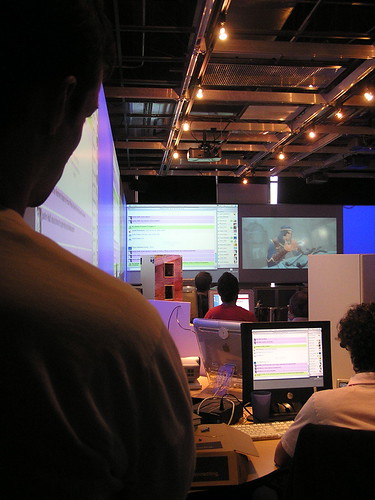
Tonight I sat in on an evening of discussion around "writing and gameplay" to commemorate the book Second Person with Noah Wardrip-Fruin, Jordan Mechner, Mark Marino, and Jeremy Douglass.
Although Mechner was there discussing the challenging of turning a videogame -- Sands of Time of the Prince of Persia series -- into a feature film devoted to more than killing monsters, he's done work that celebrates the regional and the political in his documentary Chavez Ravine. Mechner, like many of the other presenters that evening, was interested in the procedurality of a "bad choice," which in the case of completing a puzzle that activates the castle's defense system, may be your only one. The way that choice-making still remains dramatically important, even when the media is no longer an interactive one, could be seen as one way to approach the old Narratology vs. Ludology debate.
I had seen Marino's 12 Easy Lessons to Better Time Travel before, but I think his choice to combine it with course management software was a witty improvement. Obviously, as someone who sat through nine hours of Tom Stoppard's The Coast of Utopia, I have a lot of patience with nonlinear plots, but Marino's sense of humor serves the project well. As someone fascinated with chatbots going back to the "Horses of Elberfeld," I also liked the fake interactivity of his chatbot in the story "Ticky." (Marino also created monologues for the notorious Grand Theft Auto game that include an army recruiter, a driver's ed instructor, and a controlling Italian mother.)
In keeping with the "bad choices" theme, Douglass discussed the text-based interactive work of fiction "Shade," which takes place in the existential trap of an apartment. Audience member and innovative game designer Tracy Fullerton, however, talked about the problems with the game interface and its irritating protocols that make the equivalent of tying a shoe into an elaborate algorithm of discrete instructions. Douglass didn't disagree that this lack of intuitiveness could be frustrating, but he did advocate for the pleasures of this particular form of literacy. With other audience members, there was also some discussion of the much lauded "Facade," in connection with the question of whether it was a true story simulation or merely a chatbot.
Wardrip-Fruin is also hosting what looks to be a great panel with Jesper Juul and Judith Faifman at UCSD on the 18th. Info is here.
(Picture above courtesy of Jenny Cool of The Participant Observer.)
Labels: interactive narrative, MIT Press, panels, UC San DIego, USC, virtual worlds
Saturday, February 03, 2007
Primary Sources
Okay hackers and slackers, it's time for another Virtualpolitik book review. Thanks to a series of airport delays, I've had the opportunity to spend the last few days looking over the excellent New Media Reader from MIT Press. In the interest of disclosing possible biases, I'll confess to having known editors Nick Montfort and Noah Wardrip-Fruin since the DAC conference in Copenhagen, but the book is well worth picking up even if you aren't familiar with their work. It's already been praised by Lev Manovich and Janet Murray for good reason, who provide introductions, but it's a notable collection of teachable texts from a number of perspectives.I often complain that those who study hypertext and virtual worlds tend to apply literary theory to technological phenomena without considering how technological theories could conversely elucidate new media texts. This is a book that collects many of the major accessible texts from computer scientists speaking to broad audiences that should be included in the critical theory canon, given how central information culture has become.
Moreover, it's the best collection of primary sources about gender and informationalism that I've ever seen. For example, it's got the wonderful lead in to the famed human vs. computer Turing test about guessing whether someone is male or female (50). Or Licklider's laugh-out-loud anachronistic assertion that "one can hardly take a military commander or corporation president away from his work to teach him to type" (80).
Furthermore, it's a terrific look at the early pioneers of computerized information science that offers real insight into the Weltanschauung of their emerging discipline, and it contains a number of examples of how they use themselves as experimental subjects that were literally almost Freudian in their appeals.
Of course, these historical accounts include assessments of failures and admissions of limitations that often don't appear in more utopian narratives in the literature of technology. If anything, I would have liked to have seen more of this acknowledgment of programmatic restraints. Perhaps this desire for more narratives and explanatory theories about reaction, anxiety, and blindness regarding technology's role in a society reflects my own research bias, but I do think there is a tragic dimension to many of the initiatives at Xerox PARC that were stymied by certain cultural and even national biases. Readers may remember that my dad was a Xerox Senior Systems Analyst for most of his engineering career, and I grew up watching their personal computer, printer-plotter, and other ahead-of-their-time projects flounder. (Then again, my family has a long history of involvement with innovative but doomed ambitious technical projects, so I may have a more jaded point of view about progress than most people.)
Having taught similar material to undergraduates, I may have a few minor quibbles about the choices they made. Given the usefulness of sound-bites in those situations, I would have picked different pieces by Wiener, Weizenbaum, and Negroponte, but what they've chosen would certainly still work in a classroom. I would have also liked to have seen Heidegger and Bateson in there for foundational theory. And, of course, I think Weaver's introduction to -- and its essential skewing of -- Shannon's Mathematical Theory of Communication is always on my must-read list for potential syllabi.
This may seem petty, but I'm also something of a translation snob, so it bugged me to see such a stilted translation of the poetry of Raymond Queneau that used dated poeticisms like "nought" and "ere" and "O" that weren't in the original, which a wise woman and excellent translator once taught me to avoid. Furthermore, as someone willing to encourage my classes to mutilate books, I was also faintly peeved that one couldn't actually cut apart the poem with the French line and the English translation in front and back position.
Finally, I would have liked to see less work from rarefied arts communities and more of the DIY aesthetic of users actually hacking systems and creating stuff in the practices of their everyday lives. (See my nascent media manifesto on the subject in the weeks ahead.)
Overall, however, The New Media Reader is a well-designed landmark book with a great user interface that includes a timeline and -- amazingly -- a CD-ROM that actually works. Seeing Quicktime films of actual demos from the sixties and having access to actual programs from an earlier era of computing is truly thrilling. My advice to people teaching digital media survey classes would be: buy it; read it; assign it.
Labels: book reviews, information theory, MIT Press, teaching
Tuesday, October 31, 2006
Serious Games Summit, Day 2
One of the most thought-provoking papers I saw was Mia Consalvo's "Is it Cheating, Learning, or Both? An Expert Explores the Boundaries of Cheating & Learning in Videogames," which asserts that beliefs don't necessarily reflect practices, given the fact that every gamer cheats. Of course, I liked the fact that she opened her paper with the issue of academic plagiarism. I must admit, however, that I would have liked to have heard her talk a bit about how ideas of justice play into cheating ideology. I have a ten-year-old who has been searching for cheat codes after designing a beautiful home for his family to move into, close to the university so it would be convenient for me, and then being crestfallen when he discovered that his parents couldn't move in to the house, if he gave them their real-world jobs. (He doesn't want to cheat in fantasy games, only in real world simulations in which life is manifestly not fair.) Consalvo has a book forthcoming from MIT Press, which I'll review here as soon as it's out.
Then I saw how the female tweens in Whyville had a thriving economy based on clams, which largely depended on the sale and manufacture of face parts. Although Chief Visionary Officer James M. Bower didn't talk about "Constructivism" per se, as the title of his talk promised, he did give an excellent rundown on the virtual government, newspaper, public nutrition service, science research, automotive industry, and even disease control agency that operate with considerable amounts of user-generated content. If there were ever an argument against DOPA and dismissing the value of social networking sites, it's Whyville.
Although it wasn't as interesting as learning about the WhyPox, I did enjoy the presentation of Kevin Q. Harvey from the University of Chicago School of Public Health who explained the rationale behind "Zero Hour," an anthrax simulation for medical professionals with a low-bandwidth Flash platform and design flexibility to adapt to using mobile devices to maximize authenticity in group interactions and simultaneity in experiencing real time events. As a poll-worker this year, I thought it interesting that the fake news broadcast said that Chicagoans should report to their polling places to receive vaccinations. That'll show the people who don't vote!
Excellent live blogging from Ian Bogost is here.
Labels: conferences, MIT Press, serious games


